Tax Filing Certification for Beginners Islamabad 2026
Introduction
If you've been searching for a tax filing certification for beginners in Islamabad, you're not alone. Every year, thousands of students, freelancers, and salaried professionals in Pakistan realize they need practical tax knowledge — not just theory from a textbook. That's exactly why the Institute of Corporate and Taxation (ICT) was built: to turn complete beginners into confident, FBR-ready tax filers. Whether you're a fresh graduate, a working professional, or someone tired of paying a consultant every year just to file a simple return, this guide walks you through everything — what tax filing certification actually means, why it matters more than ever in 2026, and how you can start learning through ICT's best tax training institute programs, including the industry-recognized Certified Tax Advisor (CTA) course.
Pakistan's tax landscape has changed dramatically. With FBR pushing e-invoicing, digital audits, and stricter non-filer penalties, understanding how to file taxes correctly isn't optional anymore — it's a survival skill. This article is written specifically for beginners: no prior accounting background needed. By the end, you'll know what a tax filing course covers, how much it costs, what job opportunities open up afterward, and how to enroll in a practical, certificate-backed program in Islamabad.
What Is Tax Filing Certification?
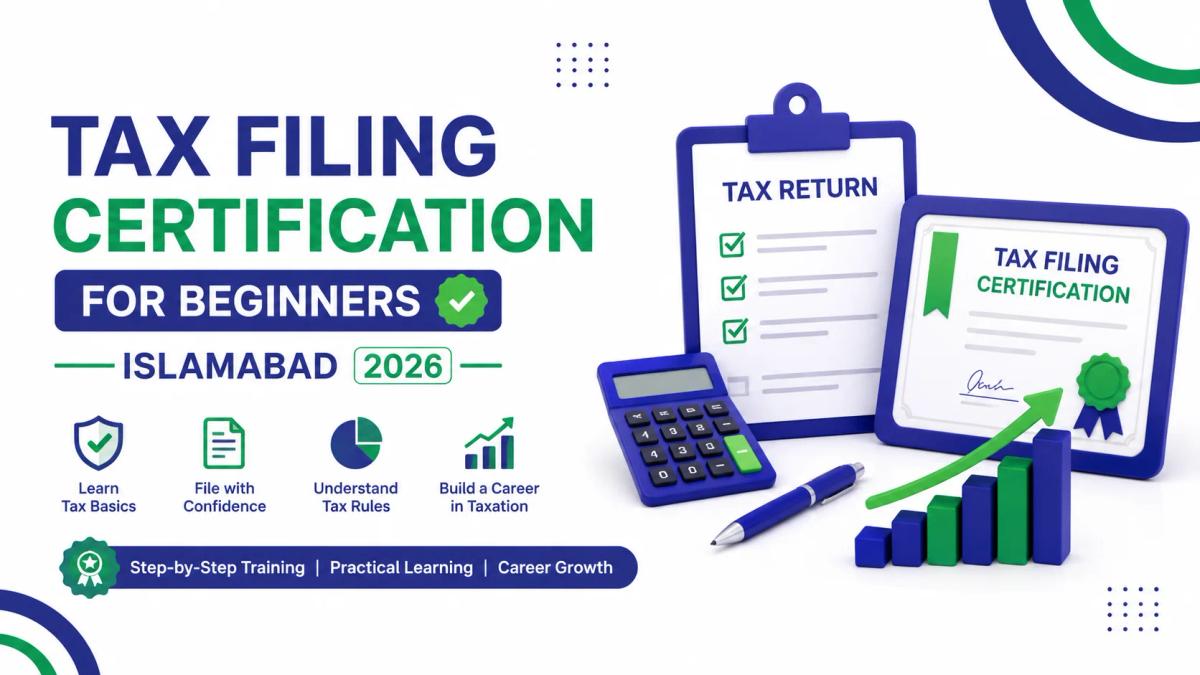
A tax filing certification is a short, practical training program that teaches individuals how to register with FBR, file income tax and sales tax returns, use the IRIS portal, and stay compliant with Pakistani tax laws. Unlike a full accounting degree, it's designed to get beginners job-ready or client-ready in a matter of weeks, combining legal knowledge with hands-on practice on real FBR forms.
For anyone in Islamabad searching for a tax filing course Islamabad or a beginner tax filing course, the short answer is: yes, you can learn this skill quickly, and yes, it can become a genuine career path — either as an employee, freelancer, or independent tax consultant.
What Is Tax Filing Certification (In Detail)?
Tax filing certification is structured training that covers:
- Understanding the Income Tax Ordinance 2001 and Sales Tax Act 1990
- Registering for an NTN (National Tax Number) and STRN (Sales Tax Registration Number)
- Learning how the FBR IRIS portal works for e-filing
- Preparing and submitting income tax returns and sales tax returns
- Understanding withholding tax, ATL (Active Taxpayer List) status, and tax compliance
- Practicing real filing scenarios for salaried persons, business owners, and freelancers
If you want a deeper look at how the portal itself works, ICT's blog on what is FBR IRIS portal and how to use it for tax filing is a great supplementary read. Similarly, if you're unclear on the difference between the various tax identifiers, the guide on ATL, NTN, STRN, and SECP differences breaks it down simply.
Why It's Important — Especially in Pakistan
1. Filer Status Now Affects Almost Everything
Being a "filer" in Pakistan isn't just about avoiding a fine anymore. Filers pay lower withholding tax on banking transactions, property purchases, vehicle registration, and even mobile top-ups. Non-filers face steadily rising penalties — a trend covered in detail in the FBR non-filer penalties 2026 escalation blog.
2. FBR Is Going Digital — Fast
With digital invoicing, AI-assisted audits, and the IRIS 2.0 rollout, tax filing is becoming more automated but also more scrutinized. ICT's guide on FBR's digital transformation in Pakistan explains why professionals who understand these systems have a real edge.
3. Demand for Skilled Tax Preparers Is Rising
Every salaried employee, freelancer, and small business now legally needs to file returns. Yet very few people actually understand the process. This gap is exactly why is taxation a good career in Pakistan is one of the most searched questions among students today — and the answer, backed by market demand, is a confident yes.
4. Freelancers Especially Need This Skill
Pakistan's freelance economy is booming, and freelancers now face specific tax obligations. If you fall into this category, the blog on freelancer tax compliance in Pakistan is worth reading alongside this certification guide.
Step-by-Step Guide: How to Get Your Tax Filing Certification
Step 1: Understand the Basics First
Before enrolling, get comfortable with foundational terms — income tax vs sales tax, direct vs indirect taxation, and what "compliance" actually means in a tax context. ICT's income tax return filing mistakes article is a useful primer on common beginner errors to avoid from day one.
Step 2: Register for a Beginner-Friendly Course
Look for a course that combines legal theory with hands-on IRIS practice. ICT's short courses are specifically designed this way — see the breakdown in short taxation courses in Pakistan: learn income tax, sales tax & more.
Step 3: Learn NTN & STRN Registration
You'll practice registering a taxpayer profile on IRIS — the same process used for real clients. The guide on steps to obtain NTN in Pakistan (2026) mirrors exactly what's taught in the practical sessions.
Step 4: Practice Filing Real Returns
You'll file mock income tax returns for salaried individuals, business owners, and freelancers. For a walkthrough of the general process, see steps for filing income tax return in Pakistan 2026 and how to file an income tax return in Pakistan.
Step 5: Learn Sales Tax Filing
Sales tax filing is a separate skill set entirely, covering annexures, input/output tax, and STRN compliance. If you want to go deeper here, ICT also offers a dedicated Master Sales Tax course after your beginner certification.

Step 6: Understand Filer vs Non-Filer Status
Learn how ATL status is determined and maintained. The blog filer vs non-filer in Pakistan and how to become an active tax filer in Pakistan complement this module well.
Step 7: Get Certified and Start Practicing
Once you complete assessments, you receive a certificate that verifies your practical competency — something you can show employers or clients directly.
Tips for Beginners
- Don't skip the IRIS practice sessions — theory alone won't prepare you for real client work.
- Learn Excel alongside taxation. A basic grip on spreadsheets makes return preparation much faster; ICT's Master Advanced Excel course pairs well with any taxation program.
- Stay updated on deadlines. FBR frequently extends or changes filing deadlines — see FBR extends tax filing deadline for an example of how often this happens.
- Start with nil returns if you're unsure. Filing a nil income tax return is a low-risk way to practice the process for real.
- Track your progress against a realistic study plan — a structured 90-day plan from student to tax consultant can help beginners stay on schedule.
Key Skills, Tools & Benefits
Skills You'll Learn
- Reading and applying tax law (Income Tax Ordinance 2001, Sales Tax Act 1990)
- Filing income tax and sales tax returns independently
- Using the FBR IRIS portal confidently
- Advising individuals and small businesses on compliance and tax planning
- Preparing withholding tax statements and certificates
Tools You'll Use
- FBR IRIS Portal — for actual e-filing
- Microsoft Excel / Google Sheets — for calculations and record-keeping
- Tax software — increasingly AI-assisted, as discussed in AI tax calculation and legal risk in 2026
Benefits of Certification
- Instant credibility with clients or employers
- Ability to file your own returns and save consultancy fees
- A foundation to specialize further — for example into UAE Taxation, Saudi Taxation, or USA Taxation if you want international clients
- Entry point into broader corporate roles, including Company Secretary or Certified Business Advisor paths later on
Job Scope, Salary & Demand
Tax professionals in Pakistan are in steady demand across accounting firms, corporate finance departments, and increasingly, the freelance market. According to ICT's own market analysis in tax professional salary in Pakistan, certified beginners can expect entry-level roles in tax preparation, compliance support, or bookkeeping firms, with clear salary growth as they specialize.
For those aiming higher, career opportunities after becoming a Certified Tax Advisor shows how a beginner certification can be a launchpad toward advisory roles, corporate tax positions, or even running an independent consultancy — a path covered thoroughly in how tax knowledge helps you start your own consultancy.
International demand is growing too. Many Pakistani professionals now serve clients abroad remotely — see how Pakistanis are building global tax careers and tax skills salary comparison across USA, UK, UAE, and Saudi Arabia (2026) for a sense of what's possible once you build on your beginner certification.
According to the Federal Board of Revenue, Pakistan's tax base continues to expand as digital filing becomes mandatory for more categories of taxpayers — meaning trained professionals who can navigate this system will only become more valuable.
Why Choose ICT — And How to Learn (Free + Paid Resources)
Why ICT?
ICT has built a reputation as one of the best taxation institutes in Islamabad, and more broadly across Pakistan. Unlike many institutes that focus purely on theory, ICT's model is built around practical FBR training — a distinction explained well in best FBR training institute in Islamabad and why our institute is better than other institutes.
Key reasons students choose ICT:
- Practical, hands-on IRIS training — not just lectures
- Certification recognized by employers and clients
- Flexible online and physical class options (see the comparison in online vs physical tax courses in Pakistan)
- A clear pathway from beginner certification into advanced specializations like Advance Taxation and Litigation (ATL)
Free Resources to Start With
Before enrolling, beginners can explore free content such as:
- ICT's tax calculator to understand how tax liability is computed
- Blog guides like salaried tax slabs Pakistan 2025-26 and income tax slabs Pakistan 2025-26
- Official resources from the FBR itself for verifying rules and deadlines
Paid, Structured Learning
For a certification that actually counts toward your career, ICT's Certified Tax Advisor (CTA) course is the natural next step after a beginner program, and the institute's tax course module breakdown — basics to expert shows exactly how the curriculum progresses.
If you're also interested in complementary skills, ICT offers:
- Certified Data Analyst — useful for tax data analysis
- AI-Driven CFO — for those aiming at senior finance roles
- Certified AI Automation — relevant as AI reshapes tax and finance work
Real-World Examples
Consider Ayesha, a fresh commerce graduate in Islamabad with zero prior taxation experience. After completing a beginner certification, she started filing returns for family members and small shopkeepers in her neighborhood — turning a side skill into a small income stream within months. Her journey mirrors the roadmap laid out in freelancer to tax consultant: 2026 roadmap.
Or take the case of a working professional who wanted to stop paying a consultant every year. After a short beginner course, he now files his own salaried-person return confidently — a common outcome documented in how a taxation certification can boost your job.
Freelancers, too, are increasingly turning tax knowledge into a service they sell on platforms like Fiverr and Upwork — a trend explored in tax services on Fiverr and Upwork: Pakistan 2026 guide.
Future Career Opportunities
A beginner tax filing certification is rarely the final destination — it's the foundation. From here, graduates commonly move toward:
- Specialized international taxation — UK Taxation, Canadian Taxation, UAE Taxation, or Saudi Taxation
- Corporate advisory roles, supported by courses like Company Secretary or Certified Business Advisor
- Independent consultancy, as detailed in start a tax preparation business in 2026
- Trade and customs-related careers, via Master Import & Export or the Certified Customs Clearance & Litigation Professional course
With AI increasingly entering the tax space, ICT's blog on will AI replace tax consultants? offers a balanced, reassuring take: professionals who combine human judgment with digital tools — not those who ignore technology — will remain most in demand.
Frequenly Asked Questions
1. Is tax filing certification worth it for complete beginners?
Yes. You don't need an accounting background to start. Courses are designed step-by-step, starting from basic concepts and moving into real IRIS practice, so beginners can become job-ready within weeks.
2. How long does a tax filing course take?
Most beginner-level tax filing certifications run a few weeks, depending on whether you choose weekend, evening, or intensive formats.
3. Can I become a tax consultant after this certification?
Yes — many students use the beginner certification as a stepping stone toward the Certified Tax Advisor program and eventually build an independent consultancy practice.
4. Is FBR tax filing difficult to learn?
Not if you learn it practically. The IRIS portal has a learning curve, but hands-on training removes most of the confusion beginners face when trying to self-teach.
5. What documents are required for tax filing in Pakistan?
Typically CNIC, salary slips or business income records, bank statements, and details of assets/expenses. Your course will cover exactly how to organize these for filing.
6. How much does a tax filing course cost in Islamabad?
Fees vary by institute and course depth. It's best to contact ICT directly for current fee structures, as pricing is periodically updated based on course content and duration.
Conclusion: Take the First Step Toward Your Tax Filing Career
Tax filing isn't just a compliance requirement anymore — it's a genuine, growing career path in Pakistan, whether you want to file your own returns, help family and friends, or build a full consultancy business. Starting with a solid, practical tax filing certification for beginners in Islamabad gives you the exact foundation you need, without wasting time on unnecessary theory.
If you're ready to stop guessing and start learning the real, hands-on way FBR filing actually works, explore ICT's beginner-friendly programs and take the next step with the Certified Tax Advisor course. Book a seat at ICT today and turn tax filing from a confusing chore into a skill that pays off for years to come.
Comments (0)
No comments yet. Start the conversation!
Leave a Reply
Your email address will not be published. Required fields are marked *