
Online vs Physical Tax Courses in Pakistan – Which Is Better?
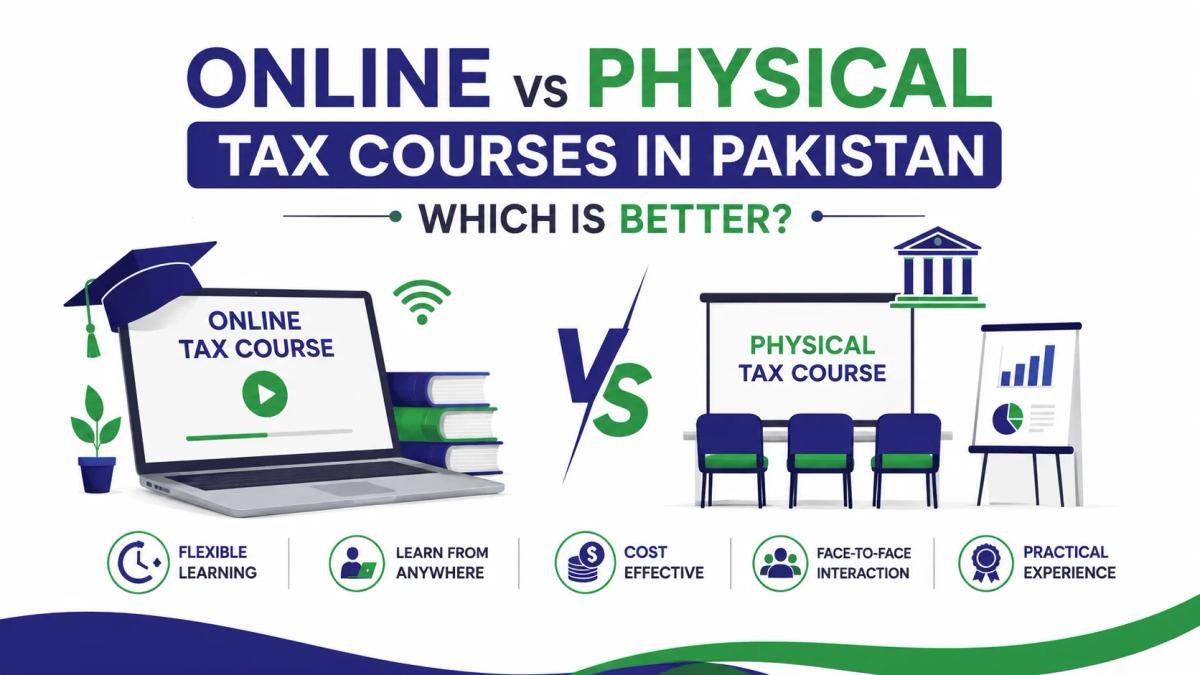
If you're planning to build a career in taxation, one of the first decisions you'll face isn't about which institute to join — it's about how you want to learn. Should you enroll in an online tax course, or is a physical, in-person program the smarter investment? Both paths can turn you into a qualified, job-ready tax professional. The real difference lies in flexibility, cost, hands-on FBR practice, and how well the format fits your daily routine.
This guide breaks down both options in detail — cost, practical training quality, networking, and career outcomes — so you can make a decision based on facts, not guesswork.
What Does a Tax Course in Pakistan Actually Cover?
Regardless of delivery format, a serious taxation program should walk you through the full compliance cycle a working tax consultant deals with, including:
- Income Tax Ordinance 2001 and its practical application
- Sales Tax Act 1990, registration, and return filing
- FBR IRIS portal navigation and e-filing
- NTN registration and active taxpayer (ATL) status
- Withholding tax rules and rates
- Corporate and individual return filing
- Real FBR notice case studies
A course that only covers theory without live IRIS practice leaves graduates underprepared. For a closer look at how the portal itself works, ICT's FBR IRIS login guide is a useful companion resource while you study.
Why Taxation Training Is in Demand Right Now
Pakistan's tax landscape keeps shifting — new finance acts, revised slabs, and portal upgrades like IRIS 2.0 mean outdated course material quickly becomes useless. A few forces are driving demand for properly trained professionals:
- Frequent policy changes — untrained filers often make expensive mistakes when slabs or rules shift. Our breakdown of salaried tax slabs for 2025-26 shows how quickly these numbers move.
- A growing freelance economy — more freelancers and remote workers now need to understand their tax obligations under Pakistani law.
- Stricter non-filer enforcement — penalties for staying off the Active Taxpayer List have escalated; see our guide on FBR non-filer penalties for 2026.
- Career mobility — a recognized certified tax advisor course opens doors into accounting firms, corporate tax departments, and independent consultancy.
Online Tax Courses: Pros and Cons
Online learning has grown fast in Pakistan, with institutes now offering recorded lectures, live Zoom sessions, and downloadable resources.
Advantages
- Flexibility — study around a job or other commitments.
- Lower cost — no commuting or venue overhead.
- Access from anywhere — ideal for students outside major cities, or overseas Pakistanis learning Pakistani tax law remotely.
- Repeatable content — revisit tricky topics like withholding tax or sales tax as often as needed.
Disadvantages
- Interaction can be limited unless live sessions are built in.
- Requires self-discipline to finish on schedule.
- Hands-on IRIS practice can feel less guided without someone physically walking you through it.
International-focused programs — such as a UK taxation course, a US taxation track, or specialized modules like the LLC formation course — are almost always delivered online, since they're built for students who want global tax exposure without relocating.
Physical Tax Courses: Pros and Cons
A physical course means attending in-person classes at a training institute, typically in a major city like Islamabad, Karachi, or Lahore.
Advantages
- Direct instructor access — questions get answered on the spot.
- Hands-on IRIS practice — instructors walk students through live filing scenarios step by step.
- Structured discipline — fixed timings keep most students consistent.
- Networking — you meet fellow students and instructors who can become professional contacts later.
Disadvantages
- Less flexible; you're locked into a fixed schedule.
- May involve commuting time and cost.
- Limited to students who live near, or can travel to, the institute.
If you're evaluating options in the capital, our detailed guide to the best taxation institute in Islamabad and our roundup of FBR-focused tax courses in Islamabad are good starting points.
Online vs Physical: Side-by-Side Comparison
| Factor | Online Tax Course | Physical Tax Course |
|---|---|---|
| Flexibility | High — learn anytime | Fixed schedule |
| Cost | Usually lower | Slightly higher (venue, resources) |
| Practical FBR IRIS training | Depends on live sessions | Strong, hands-on guidance |
| Networking | Limited | Strong, in-person connections |
| Best for | Working professionals, overseas Pakistanis, remote learners | Students in Islamabad, Karachi, and nearby cities wanting direct mentorship |
| Certificate value | Same, if institute is credible | Same, if institute is credible |
Neither format is universally "better." The right choice depends on your location, your learning style, and how much hands-on FBR practice you personally need before working with real clients.
Which Should You Choose?
- Choose online if you're employed full-time, live outside major cities, or want an internationally focused program.
- Choose physical if you're based in Islamabad or Karachi, prefer face-to-face mentorship, and want maximum hands-on IRIS exposure.
- Choose hybrid if your institute blends recorded lectures with live practical sessions — this is increasingly the standard among top providers.
A Real-World Example
Two students, same city, different paths:
- Ali, a full-time employee, enrolls online because he can only study evenings. He completes his IRIS training through recorded sessions plus a weekly live Q&A.
- Sara, a fresh graduate with flexible time, joins a physical course. In-person mentorship gets her comfortable helping small business clients with sales tax registration almost immediately.
Both go on to become certified tax consultants. The format didn't decide their outcome — consistency and the quality of practical training did.
Career Scope After a Tax Course
A completed taxation course opens several paths:
- Tax Consultant — advising individuals and businesses on filing and compliance.
- Corporate Tax Executive — working inside a company's finance or tax department.
- Freelance Tax Practitioner — filing for multiple clients independently. Our roadmap from freelancer to tax consultant walks through this transition step by step.
- Accounting Firm Associate — supporting chartered accountants with compliance work.
For a realistic look at what practitioners actually earn as they build experience, see our breakdown of tax advisor salary and scope in Pakistan for 2026. Those looking to specialize further can also explore trending tax specializations for freelancers or dedicated tracks like master sales tax.
What You'll Learn, Format Aside
Whichever format you pick, a solid course should cover:
- NTN registration and becoming an active taxpayer
- Practical income tax return filing — see our Income Tax Ordinance 2001 compliance guide
- FBR IRIS portal navigation, including the IRIS 2.0 survival guide
- Sales tax rules and registration
- Withholding tax rates
- How FBR audit notices are triggered and handled
- Building a base of recurring income tax clients once you're practicing independently
If you're weighing manual filing skills against newer AI-assisted tools, our piece on manual vs AI-assisted tax filing in 2026 is worth a read before you commit to a course structure.
Why Choose ICT for Your Tax Course
Whether you prefer online or physical learning, ICT (Institute of Chartered Tax) is a recognized taxation training institute in Pakistan offering:
- Certified Tax Advisor courses, both online and physical
- International taxation modules, including UK taxation and US-focused tracks — see also our notes on common mistakes in US taxation exams and US LLC tax filing from Pakistan
- Live FBR IRIS practical training with real filing scenarios
- Guidance for freelancers dealing with double taxation relief and international clients, including insight on the best countries for freelance tax services
- Support for students who want to eventually start their own tax preparation business or become a registered tax preparer in Pakistan
You can explore the full range of programs on our courses page, read more on our blog, or learn more about ICT and why it's considered among the best tax training institutes in Pakistan.
Frequently Asked Questions
1. Which is better, online or physical tax courses? Neither is universally better. Online courses suit flexible, remote learners; physical courses suit students who want hands-on mentorship and in-person IRIS practice.
2. Is an online tax course valid in Pakistan? Yes. As long as the certificate comes from a recognized, credible training institute, an online tax course holds the same professional value as a physical one.
3. How much does a tax course cost in Pakistan? Costs vary by institute and course length. Online courses are usually slightly cheaper due to lower overhead, while physical courses may carry additional venue and resource costs.
4. Can I become a tax consultant after an online course? Yes. Many certified tax consultants in Pakistan started with online training, particularly when the course included live IRIS practical sessions.
5. Do employers accept online tax certifications? Most employers care more about practical filing competence than delivery format, so a well-recognized online certificate is generally accepted.
6. What's the difference between income tax and sales tax courses? Income tax courses focus on individual and corporate filing under the Income Tax Ordinance 2001. Sales tax courses cover the Sales Tax Act 1990, including registration and return filing for businesses.
Final Thoughts
Both online and physical tax courses in Pakistan can lead to the same outcome: solid FBR compliance knowledge and a recognized certification. Your decision should come down to your schedule, your learning style, and how much hands-on practice you personally need before working with real clients.
Ready to start? Explore our Certified Tax Advisor course or contact our team to find the format that fits you best. You can also verify any existing certificate through our certificate verification page.
Comments (0)
No comments yet. Start the conversation!
Leave a Reply
Your email address will not be published. Required fields are marked *