
Income Tax Ordinance 2001 Updated 2026: FBR Sections & Amendments
Quick Answer
The Income Tax Ordinance, 2001 is Pakistan's primary federal law on income taxation, administered by the Federal Board of Revenue. Its latest official consolidated version is amended up to 30 June 2026, incorporating the Finance Act, 2026, which received presidential assent and became effective from 1 July 2026. Key operative sections include 114, 120, 122, 147, 148, 149, 153 and 177.
Introduction
If you file a return, deduct tax from a supplier, or receive an FBR notice, every one of those actions traces back to a single statute: the Income Tax Ordinance, 2001. At the Institute of Corporate and Taxation (ICT), we train tax consultants, accountants and law graduates who work with this Ordinance every day — which is why our Income Tax Ordinance 2001 compliance guide for 2026 and our practical FBR notices explained guide are among the most-read resources on this site. Professionals who want structured, section-by-section command of the law usually start with our Certified Tax Advisor course — Enroll Now.
The problem most readers face is not access to the law. The FBR publishes it free. The problem is that the Ordinance is a 900-page document with layered footnotes, omitted provisions, and cross-references to eight schedules. This guide cuts through that. It tells you exactly which version is current, what changed in 2026, and what the sections you will actually encounter in practice mean.
Key Takeaways
- The Ordinance came into force on 1 July 2002 and is amended every year through the Finance Act.
- The current FBR consolidation is amended up to 30 June 2026.
- The Finance Bill, 2026 was presented on 12 June 2026 and became the Finance Act, 2026, effective 1 July 2026.
- The National Assembly approved the Bill on 26 June 2026 and the President assented on 27 June 2026.
- 2026's headline reform is faceless tax administration — faceless audit and assessment, faceless appeals, and a National Faceless Centre.
- Section 7E (deemed income on immovable property) has been omitted.
- Returns for Tax Year 2026 (due 30 September 2026) are still computed under Finance Act, 2025 rates. Most Finance Act, 2026 rate changes bite from Tax Year 2027.
- The ATL late-filing surcharge under Section 182A rose sharply — Rs. 100,000 for companies, Rs. 50,000 for AOPs and Rs. 25,000 for individuals.
What Is the Income Tax Ordinance 2001?
The Income Tax Ordinance, 2001 (XLIX of 2001) is the federal law that imposes and governs income tax in Pakistan. It replaced the Income Tax Ordinance, 1979 and came into force on 1 July 2002. It is administered by the Federal Board of Revenue (FBR) under the Revenue Division, Ministry of Finance.
The Ordinance does four things. It defines what income is taxable. It sets who must pay and at what rate. It creates the machinery — returns, assessments, audits, appeals, recovery. And it fixes the consequences of getting it wrong.
It does not stand alone. It works together with the Income Tax Rules, 2002, annual Finance Acts, and FBR circulars and SROs. For the wider picture of how direct and indirect taxes interact, our comparison of sales tax versus income tax is a useful companion read.
How the Ordinance Is Structured
Understanding the architecture saves hours of searching.
| Part | What It Covers | Typical Sections |
|---|---|---|
| Chapter I | Preliminary and definitions | 1–3 |
| Chapter II | Charge of tax, super tax | 4, 4AB, 4C, 5–8 |
| Chapter III | Computation — heads of income | 9–65 |
| Chapter IV | Common rules, tax year, residence | 66–85 |
| Chapter V | Persons — individuals, AOPs, companies | 86–100 |
| Chapter VI | Special industries and international | 99–107 |
| Chapter VII | Anti-avoidance | 108–112 |
| Chapter VIII | Minimum tax | 113–113C |
| Chapter IX | Returns and assessment | 114–126 |
| Chapter X | Procedure — appeals, recovery, withholding | 127–227 |
| Schedules | Rates, exemptions, capital gains, WHT | First to Fourteenth |
The First Schedule carries the rate tables. The Second Schedule carries exemptions and reduced rates. The Tenth Schedule carries the higher-rate regime for persons not on the Active Taxpayer List.
Latest Amendment Date
The latest official consolidated version of the Income Tax Ordinance, 2001 published by the FBR is amended up to 30 June 2026. It sits at the top of FBR's Income Tax Ordinance page and supersedes the earlier consolidations amended up to 20 February 2026 and 31 July 2025.
Context matters here, because "latest amendment date" means two different things.
The consolidation date is the date up to which FBR has folded all amendments into the printed text. That is 30 June 2026. FBR's own listing shows the 30.06.2026 version at the top, followed by versions amended up to 20.02.2026, 31.07.2025 and 30.06.2024.
The amending instrument date is when the change was actually made law. For 2026 that is the Finance Act, 2026. The National Assembly approved the Finance Bill 2026 on 26 June 2026, the President assented on 27 June 2026, and the amendments took effect from 1 July 2026 unless otherwise provided.
There is a practical lesson in that gap. Between February and July 2026, three different "current" PDFs of the same Ordinance were circulating. Practitioners who quoted the February consolidation in a July submission were quoting repealed provisions. Always check the date printed on the cover page before you cite a section. This habit is drilled into every student in our Advance Taxation and Litigation course — Book a Seat.
What the Finance Act 2026 Changed
The 2026 amendments are the most administration-heavy set of changes in years. The theme is automation, not just revenue.
Faceless tax administration. The Act introduces faceless audit and assessment under section 122E, faceless appeals under section 129A, faceless jurisdiction of income tax authorities under section 209B, and a National Faceless Centre under section 227D. Audit proceedings under section 177 and consequent amendment proceedings under sections 122 and 111 will be conducted without disclosing the identity of the presiding officer, with hearings held electronically under section 227E.
Algorithmic Settlement Mechanism. Under a new section 134B, FBR may offer digitally generated settlement proposals before an assessment or amended assessment under sections 121, 122 or 122E, based on risk profiling, compliance history and identified discrepancies. Taxpayers who accept may revise their returns without separate penalty or default surcharge, with a corresponding enabling insertion at section 114(6B).
Property relief. Section 7E — tax on deemed income from immovable property — has been omitted following the Federal Constitutional Court judgment holding that tax cannot be imposed on notional income. Advance tax on sale under section 236C for ATL persons is now 2.75%, and on purchase under section 236K is 1.25%. Our capital gain tax guide for Pakistan 2026 covers the downstream effect on property disposals.
Salaried relief. The 9% surcharge under section 4AB on salary income above Rs. 10 million has been withdrawn, and the salaried slab table has been substituted.
New withholding regimes. A 5% withholding regime under section 154B now applies to revenues received from social media and digital platforms — minimum tax for residents on the ATL, final tax for non-residents without a permanent establishment. This matters enormously for creators and remote earners; see our freelancer tax guide for Pakistan.
Data reporting. New section 165AB requires banks and Electronic Money Institutions to electronically report account holders whose aggregate deposits or withdrawals exceed Rs. 100 million in a reporting period, and section 175AA authorises structured information exchange between FBR, the State Bank, banks and EMIs.
For the budget-level view of these measures, read our Pakistan Budget 2026 tax changes explained.
Which Tax Year Do the 2026 Amendments Apply To?
This is the single most misunderstood point of the 2026 season, and it costs people money.
Tax Year 2026 runs from 1 July 2025 to 30 June 2026. The return for that year is due 30 September 2026 for individuals and AOPs, and 31 December 2026 for companies with a June year-end. That return is computed under the rates enacted by the Finance Act, 2025.
The Finance Act, 2026 rate changes generally apply from Tax Year 2027. But its procedural provisions — faceless proceedings, the higher ATL surcharge, banking data reporting — operate from 1 July 2026 onward.
The practical consequence: a Tax Year 2026 return can be taxed at Finance Act, 2025 rates while a late-filing surcharge on that same return is charged at the higher Finance Act, 2026 amount. Read the slab position for the current year in our income tax slabs Pakistan 2026 guide and file using our step-by-step IRIS 2.0 filing guide.
Key Sections of the Income Tax Ordinance 2001
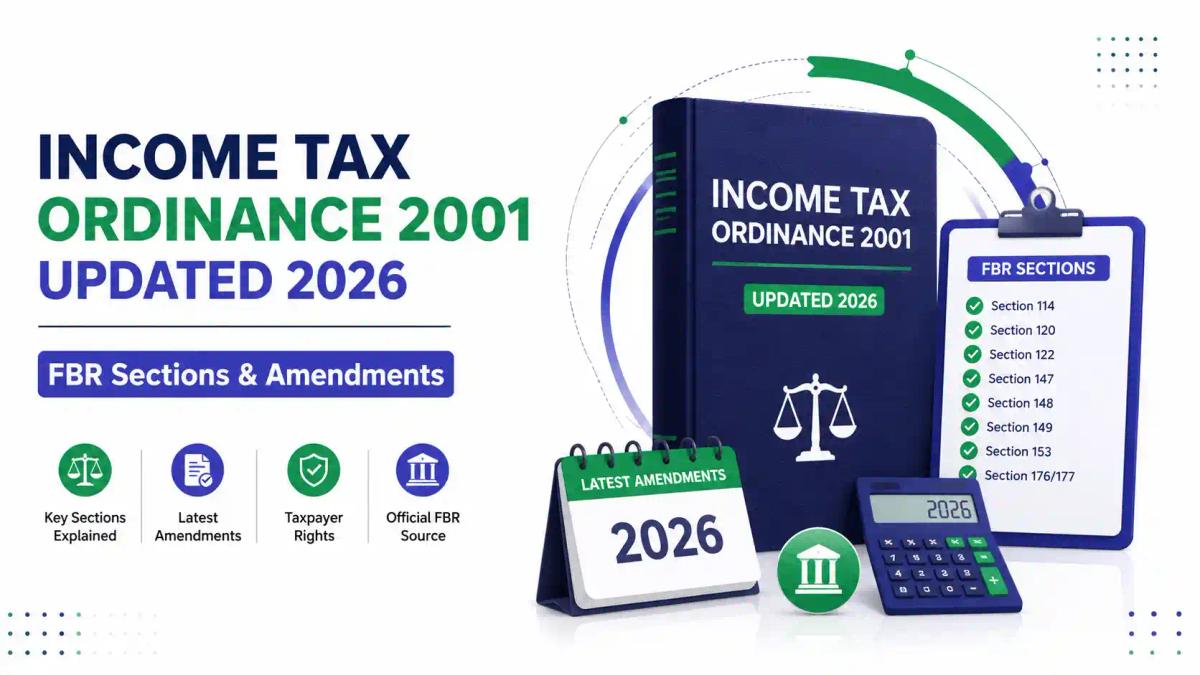
Direct answer: The sections you will meet most often in practice are 114 (return of income), 120 (deemed assessment), 122 (amendment of assessment), 147 (advance tax), 148 (tax on imports), 149 (salary withholding), 153 (payments for goods, services and contracts), and 176/177 (information gathering and audit). Together they cover filing, assessment, collection and enforcement.
| Section | Subject | Who It Affects Most |
|---|---|---|
| 114 | Return of income | Every taxpayer |
| 118 | Due date for furnishing returns | Every taxpayer |
| 120 | Assessments (deemed assessment) | Every filer |
| 121 | Best judgement assessment | Non-filers, non-responders |
| 122 | Amendment of assessment | Audited taxpayers |
| 137 | Due date for payment of tax | Taxpayers with demand |
| 147 | Advance tax paid by the taxpayer | Businesses, AOPs, companies |
| 148 | Imports | Importers |
| 149 | Salary | Employers, salaried persons |
| 153 | Payments for goods, services and contracts | Withholding agents |
| 165 | Withholding statements | Withholding agents |
| 176 | Notice to obtain information or evidence | Anyone holding relevant records |
| 177 | Audit | Selected taxpayers |
| 182 / 182A | Penalty and ATL surcharge | Late filers |
Practitioners who work these sections daily typically formalise the knowledge through the Certified Tax Advisor course — Learn More.
Section 114
Direct answer: Section 114 imposes the obligation to furnish a return of income. It lists the categories of persons required to file, empowers the Commissioner to require a return by notice, and governs revised returns. It is the foundation of the entire compliance chain — almost every penalty and audit provision traces back to a Section 114 obligation.
Persons required to file include every company and AOP regardless of income, individuals with taxable income above the threshold, persons charged to tax in either of the two preceding years, owners of immovable property above prescribed limits, holders of commercial or industrial electricity connections, and NTN holders. Section 118 fixes the due date; Section 119 allows an application for extension.
Two 2026 changes matter. Section 114(2A) now requires companies to submit financial statements in electronically readable formats — spreadsheets and similar, excluding PDF or images — from Tax Year 2026 onwards. And the amendment at section 114(6)/(6B) removes the requirement of Commissioner's approval for a revised return filed under the new algorithmic settlement route.
A Section 114 notice is the most common notice FBR issues. If you have one, our dedicated guide on how to respond to an FBR notice under Section 114 walks through the reply. If you have no income to declare, you still file — see how to file a nil income tax return.
Section 120
Direct answer: Section 120 provides that a complete return furnished under Section 114 is treated as an assessment order deemed to have been issued by the Commissioner on the day the return was filed. In other words, self-assessment is the default in Pakistan. FBR does not need to pass a separate order for your declared position to become an assessment.
Two consequences follow.
First, a deemed assessment under Section 120 gives you finality unless FBR acts under Section 122. That is why the amendment window under 122 is the real risk period, not the filing date.
Second, if the return is incomplete, the Commissioner may issue a notice to complete it. If the deficiency is not cured, the return may be treated as invalid — and an invalid return means you never filed at all, with all the Section 182 and ATL consequences that follow.
The Finance Act, 2026 amended the definition of "assessment" at section 2(5) to accommodate the faceless framework, which means a Section 120 deemed assessment can now be picked up and processed through the National Faceless Centre rather than a named local officer.
Section 122
Direct answer: Section 122 empowers the Commissioner to amend an assessment — including a deemed assessment under Section 120 — where the assessment is considered erroneous and prejudicial to the interest of revenue, or where definite information shows income has escaped assessment or has been under-declared. Amendment is subject to statutory time limits and a mandatory show-cause notice.
Practically, Section 122 is where audit results turn into demand. The sequence is almost always: selection under 177 or 214C, information gathering under 176, then an amendment under 122.
The taxpayer's protections under this section are real and worth knowing. The Commissioner must issue a notice setting out the reasons. You are entitled to be heard. An amendment cannot be based on a mere change of opinion — it needs definite information.
In 2026, Section 122 proceedings became a faceless process. Amendment proceedings under sections 122 and 111 are now conducted without direct identification of the presiding officer, with the hearing carried out electronically and the officer's facial and voice identity kept confidential. Before an order under 121, 122 or 122E is passed, FBR may present a system-generated settlement offer under section 134B, which the taxpayer may accept and settle by filing a revised return.
Anyone handling amendment proceedings professionally should study litigation procedure formally. Our Advance Taxation and Litigation course covers notice drafting, replies and appeal strategy — Start Learning.
Section 147
Direct answer: Section 147 requires taxpayers to pay advance tax in quarterly instalments during the tax year, based on their latest assessed or declared turnover and tax liability. It applies to individuals, AOPs and companies meeting the prescribed thresholds. Advance tax is adjustable against the final liability shown in the return.
The mechanics: quarterly instalments are payable in September, December, March and June. Companies compute on a turnover-based formula; individuals above the threshold compute on their last assessed liability. A taxpayer who estimates a lower liability may file an estimate under Section 147(6), supported by evidence, but a deliberate under-estimate exposes you to default surcharge under Section 205.
The Finance Act, 2026 omitted section 147(6C), aligning the export tax regime under section 154 with the minimum tax framework in section 113 as the export rate for goods was reduced from 2% to 1.25%.
Expert observation: advance tax is the most common source of unexpected default surcharge in corporate assessments. Businesses treat it as optional cash-flow management, and then discover at assessment that the surcharge has been running for four quarters. Build a quarterly reminder into your compliance calendar — our Pakistan tax calendar 2026 lists every due date in one place.

Section 148
Direct answer: Section 148 requires the Collector of Customs to collect advance income tax from importers at the time goods are cleared for home consumption. The rate depends on the category of goods listed in the Twelfth Schedule and on whether the importer appears on the Active Taxpayer List. For most importers the collection is adjustable; for certain categories it operates as minimum or final tax.
Rates are driven by the Twelfth Schedule split. Part I covers essential raw materials and capital goods at the lowest rate. Part II covers intermediate goods. Part III covers finished consumer goods at the highest rate. Importing Part I goods costs Active Taxpayers 1% and non-filers 2%; Part II importers face 3.5% for filers and 7% for non-filers; Part III attracts 6% for filers and 12% for non-filers, while pharmaceutical imports carry 4% for filers and 8% for non-filers.
The filer differential here is the whole point. A commercial importer off the ATL pays double the tax on the same consignment before a single rupee of profit is earned. For traders, this is the strongest financial argument for staying compliant — see filer vs non-filer in Pakistan and non-filer tax rates 2026.
Importers and trade professionals who want the customs and taxation side together often pair this with our Master Import and Export programme and read import and export tax rules explained.
Section 149
Direct answer: Section 149 requires every employer to deduct income tax from salary at the time of payment, using the average rate of tax applicable to the employee's estimated salary income for the year. The employer may adjust for tax credits, other taxes already deducted, and admissible deductions where the employee provides evidence.
Section 149 is the reason most salaried Pakistanis never write a tax cheque. It is also the reason many over-pay: employers frequently ignore admissible tax credits because employees never submit the supporting documents.
For 2026, two changes are material. The 9% surcharge under section 4AB on salary income exceeding Rs. 10 million has been withdrawn, and the salaried slab table has been substituted. The substituted table applicable to salaried individuals is as follows:
| Taxable Income | Rate of Tax |
|---|---|
| Up to Rs. 600,000 | 0% |
| Rs. 600,001 – Rs. 1,200,000 | 1% of amount exceeding Rs. 600,000 |
| Rs. 1,200,001 – Rs. 2,200,000 | Rs. 6,000 + 11% of excess |
| Rs. 2,200,001 – Rs. 3,200,000 | Rs. 116,000 + 20% of excess |
| Rs. 3,200,001 – Rs. 4,100,000 | Rs. 316,000 + 25% of excess |
| Rs. 4,100,001 – Rs. 5,600,000 | Rs. 541,000 + 29% of excess |
| Rs. 5,600,001 – Rs. 7,000,000 | Rs. 976,000 + 32% of excess |
| Above Rs. 7,000,000 | Rs. 1,424,000 + 35% of excess |
Source: substituted salaried slab table under the Finance Act, 2026.
Deduction under Section 149 does not replace the return. Salaried persons must still file, claim credits, and file a wealth statement where required — see tax deductions for salaried persons and the IRIS 2.0 wealth statement guide.
Section 153
Direct answer: Section 153 requires prescribed persons to deduct tax at source when making payments for the sale of goods, the rendering of services, or the execution of contracts. It is the most frequently applied withholding provision in Pakistan and the most frequently mis-applied one. Rates vary by nature of payment, category of recipient and ATL status.
The Finance Act, 2026 restructured these rates substantially:
| Payment Category | Rate (ATL) |
|---|---|
| Specified service sectors | 7% (increased from 6%) |
| Independent professional services — doctors, lawyers, architects, accountants, software engineers or developers | 15% |
| Advertising services to electronic and print media | 1.5% of gross amount |
| Other services not otherwise categorised | 14% (reduced from 15%) |
| Terminal or port services under 153(1)(b) | 12% of gross payment |
| IT and IT-enabled services | 4% for ATL, 8% for non-filers |
Two threshold changes also matter. The turnover threshold in clause (115) — under which section 153 does not apply to individual traders as prescribed persons — has been increased from Rs. 100 million to Rs. 200 million, and clause (57) exempting Trading Houses has been omitted.
Expert observation from practice: the most expensive Section 153 error is not the rate. It is failing to file the withholding statement under Section 165, which turns a correct deduction into a disallowed expense and a penalty. If you deduct, you must report. Our guide on what withholding tax is and how to handle it covers the reporting chain in full.
Corporate finance teams that manage this monthly benefit from structured training. The Certified Tax Advisor course devotes a full module to withholding compliance — Book a Seat.
Section 176/177
Direct answer: Sections 176 and 177 give FBR its investigative powers. Section 176 empowers the Commissioner to require any person to furnish information, produce records, or attend and give evidence on oath. Section 177 empowers the Commissioner to select a taxpayer for audit of income tax affairs, call for records, and after considering the explanation, pass an amended assessment under Section 122.
Section 176 is broader than most taxpayers realise. It reaches beyond the taxpayer to banks, customers, suppliers and any person holding relevant records. It is the provision behind third-party information requests. Under the 2026 framework, a statement under oath required from a taxpayer or any other person under section 176 is now to be recorded through E-hearing under section 227E.
Section 177 is the audit provision. Selection can be by the Commissioner under 177 or by FBR's computerised balloting under 214C. Once selected, you receive a notice specifying the records required and the issues identified. The provisions of section 177 continue to apply to audits conducted in a faceless manner, and the taxpayer's opportunity of being heard is preserved.
The Finance Act, 2026 expanded these powers significantly. Under section 177(6B), FBR may mandate installation of electronic resources and integration systems, appoint auditors, audit mentors and sectoral experts on contract, require re-audits of accounts, require inventory re-valuation by cost accountants, and require actuarial valuations. There is a safeguard: if the registered person objects to the nomination of a particular accountant or cost accountant within 15 days, the Commissioner, if he agrees with the objection, may substitute another.
If you have received an audit notice, read how FBR audit notices work in Pakistan and our complete FBR audit notice guide 2026 before you reply. The trend toward algorithmic selection is covered in digital tax audits and AI at FBR.
Taxpayer Rights
Direct answer: The Income Tax Ordinance, 2001 grants enforceable rights alongside its obligations. These include the right to a show-cause notice before adverse action, the right to be heard, the right to appeal at multiple forums, the right to a refund of excess tax, the right to seek rectification, and the right to confidentiality of tax information.
Your principal rights under the Ordinance:
- Right to notice and hearing. No amendment under Section 122 and no best-judgement assessment under Section 121 may be made without a show-cause notice and an opportunity to be heard.
- Right to extension. Section 119 allows an application for extension of time to file, made before the due date.
- Right to revise. Section 114(6) permits a revised return to correct errors, and the 2026 amendment removes the approval requirement in settlement cases.
- Right of appeal. Appeal to the Commissioner (Appeals) under Section 127, then the Appellate Tribunal Inland Revenue under Section 131, then reference to the High Court under Section 133. The Finance Act, 2026 added faceless appeals under section 129A.
- Right to rectification. Section 221 allows correction of a mistake apparent from the record.
- Right to refund. Section 170 governs refund applications for excess tax paid. Our IRIS tax refund process guide explains the practical steps.
- Right to confidentiality. Section 216 restricts disclosure of taxpayer particulars, subject to statutory exceptions.
- Right to object to nominated auditors. The 15-day objection window under the 2026 audit amendments.
A new institutional safeguard was added in 2026. An Independent Case Scrutiny Committee under section 133A, comprising legal and tax experts, must now approve references and appeals before higher judicial forums by the Commissioner Inland Revenue — a measure intended to reduce unnecessary departmental litigation. In practice, that should reduce the volume of weak departmental appeals that taxpayers currently have to defend for years.
Rights are only useful if exercised within time. Appeal limitation periods are short and strictly enforced. This is precisely the discipline taught in our Advance Taxation and Litigation course — Enroll Now.
Official FBR Source
Direct answer: The only authoritative text of the Income Tax Ordinance, 2001 is the consolidated version published by the Federal Board of Revenue on fbr.gov.pk. The current file is titled "Income Tax Ordinance, 2001 Amended upto 30.06.2026" and is available free on FBR's Income Tax Ordinance page. Commercial editions and third-party summaries — including this article — are secondary.
Where to go, in order of authority:
- FBR — Income Tax Ordinance page:
https://www.fbr.gov.pk/categ/income-tax-ordinance/326— the consolidated Ordinance, with the 30.06.2026 version listed first. - FBR — Acts, Rules and Ordinances:
https://www.fbr.gov.pk/act-rules-ordinances/131226— Finance Acts, the Income Tax Rules, 2002, and amendment ordinances. - FBR Budget 2026-27 section: the Finance Bill and Finance Act, 2026 as enacted.
- Pakistan Code:
https://pakistancode.gov.pk— the official law repository maintained by the Laws of Pakistan Cell. - FBR IRIS portal:
https://iris.fbr.gov.pk— for filing, notices and ATL status.
A word of caution grounded in experience. Search results for "Income Tax Ordinance 2001 PDF" routinely surface 2019, 2022 and 2024 consolidations hosted on private sites, and those pages often rank above FBR itself. Download only from FBR, and check the cover page date. If your PDF does not say 30 June 2026, it is out of date.
For registration and portal access, see our FBR IRIS 2.0 login and registration guide and ATL status check guide.
Penalties, Default Surcharge and ATL Consequences
Direct answer: Non-compliance under the Ordinance attracts a penalty under Section 182, a default surcharge on unpaid tax under Section 205, and removal from the Active Taxpayer List. In 2026 the ATL consequence is the most expensive of the three, because it doubles withholding rates on ordinary transactions for an entire year.
The Finance Act, 2026 sharply increased the section 182A surcharge for regaining ATL status after late filing — for companies from Rs. 20,000 to Rs. 100,000, for AOPs from Rs. 10,000 to Rs. 50,000, and for individuals from Rs. 1,000 to Rs. 25,000. There is one carve-out: an individual who furnishes an undertaking not to purchase or acquire any property for six months from the date of the undertaking is not required to pay the surcharge.Failure to install prescribed electronic resources or comply with FBR integration requirements can result in disallowance of up to 3% of the expenditure claimed under section 21(r) — reduced from the earlier 8% of allowable deduction.
Against that, a new tax credit under section 64D allows 10% of qualifying expenditure on hardware, software and equipment used exclusively for FBR integration, available only against normal tax payable.
Read more in FBR non-filer penalties and the 2026 escalation and Active Taxpayer List explained.
Common Mistakes Taxpayers Make With the Ordinance
- Citing an outdated consolidation. The most common error in written submissions. Always verify the cover-page date.
- Confusing tax year with financial year. Tax Year 2026 ended 30 June 2026. Finance Act, 2026 rates mostly start from Tax Year 2027.
- Treating deduction as filing. Salary tax deducted under Section 149 does not discharge the Section 114 filing obligation.
- Ignoring the withholding statement. Deducting correctly under 153 but not filing under 165 still creates exposure.
- Assuming an extension will come. FBR has publicly resisted extensions in recent years. Plan for 30 September.
- Reading a section without its schedule. Section 148 without the Twelfth Schedule, or 149 without the First Schedule, is only half the rule.
- Missing the appeal limitation. A strong case filed late is a lost case.
See also common tax mistakes Pakistani businesses make in 2026.
Expert Tips for Reading the Ordinance Correctly
- Start from the definition. Section 2 controls the meaning of almost every operative term. Read it before the section.
- Follow the footnotes. FBR's consolidation footnotes every substitution and omission with the amending Act. That history often decides an interpretation dispute.
- Check the Second Schedule before concluding taxability. Many liabilities are switched off by an exemption or reduced rate clause.
- Check the Tenth Schedule before quoting a withholding rate. ATL status changes the number.
- Cross-check with the Finance Act text. The consolidation is an FBR compilation; the Finance Act as passed is the enacted law.
- Keep circulars separate from law. An FBR circular explains FBR's view. It does not bind a court.
Career Scope: Who Needs to Master This Law
Command of the Income Tax Ordinance, 2001 is the core competence behind several growing career paths in Pakistan: tax consultant, corporate tax manager, FBR practitioner, litigation associate, and compliance officer. With faceless assessment and algorithmic settlement now embedded in the law, the demand is shifting toward professionals who understand both the statute and the digital process it now runs on.
Explore earning benchmarks in our tax consultant salary guide for Pakistan 2026, and see the certification landscape in top tax certifications in Pakistan 2026. Professionals with a corporate remit often add the Company Secretary course to the taxation track.
Why Choose ICT for Income Tax Ordinance 2001 Training
The Institute of Corporate and Taxation (ICT) teaches this law the way it is actually practised, not the way it is printed. Our faculty are practising chartered accountants, advocates and FBR-facing consultants who file returns, defend audits and argue appeals in the same season they teach them. Training is delivered on the live IRIS 2.0 environment, with real notice formats, real reply drafting, and section-by-section walkthroughs of the current 30 June 2026 consolidation — not a slide deck from three Finance Acts ago. Students receive updated course material after every Finance Act, so what you learn in class is the law in force when you sit with a client. With campuses in Islamabad, Lahore and Karachi and online cohorts nationwide, our Certified Tax Advisor course has become the standard route into professional practice for graduates, accountants and law students across Pakistan — Enroll Now. If you want to compare options first, read our complete guide to the best taxation institute in Islamabad.
Frequently Asked Questions
1. What is the latest version of the Income Tax Ordinance 2001?
The latest FBR consolidation is amended up to 30 June 2026. It incorporates the Finance Act, 2026 and replaces the earlier versions dated 20 February 2026 and 31 July 2025.
2. When was the Income Tax Ordinance 2001 last amended?
Through the Finance Act, 2026. The National Assembly approved the Bill on 26 June 2026, the President assented on 27 June 2026, and the amendments apply from 1 July 2026 unless otherwise provided.
3. Where can I download the Income Tax Ordinance 2001 PDF?
From FBR's official Income Tax Ordinance page at fbr.gov.pk. The 30.06.2026 version is listed first. Avoid third-party PDFs, which are frequently outdated.
4. What is Section 114 of the Income Tax Ordinance 2001?
Section 114 sets out who must furnish a return of income, empowers the Commissioner to require a return by notice, and governs revised returns. It is the source of the filing obligation.
5. What is the difference between Section 120 and Section 122?
Section 120 treats a complete return as a deemed assessment on the date of filing. Section 122 allows the Commissioner to amend that assessment where it is erroneous and prejudicial to revenue, or where definite information shows escaped income.
6. What is the tax return deadline for Tax Year 2026?
30 September 2026 for individuals and AOPs; 31 December 2026 for companies with a 30 June year-end. Tax Year 2026 covers income earned from 1 July 2025 to 30 June 2026.
7. Does the Finance Act 2026 apply to my Tax Year 2026 return?
Generally no for rates — Tax Year 2026 is computed under Finance Act, 2025 rates. But procedural provisions, including the higher ATL surcharge and faceless proceedings, apply from 1 July 2026.
8. What is faceless audit under the Income Tax Ordinance?
A system in which audit under section 177 and amendment proceedings under sections 122 and 111 are conducted without disclosing the officer's identity, with hearings held electronically under section 227E.
9. Has Section 7E been abolished?
Yes. The Finance Act, 2026 omitted section 7E following the Federal Constitutional Court judgment that tax cannot be imposed on notional or deemed income.
10. Do I need a lawyer to respond to an FBR notice?
Not necessarily. Most Section 114 and Section 176 notices can be answered by a trained taxpayer or consultant through IRIS. Audit proceedings under Section 177 and amendments under Section 122 are where professional representation genuinely changes outcomes.
Conclusion
The Income Tax Ordinance, 2001 remains the backbone of Pakistan's direct tax system, and 2026 marked its most significant administrative shift since IRIS itself. The law is now consolidated up to 30 June 2026, deemed assessments can be picked up by an algorithm, audits are conducted by officers whose identity you will never learn, and settlement offers arrive by system rather than by negotiation.
The single recommendation that matters: work only from the current FBR consolidation, and know the eight or nine sections that generate almost every notice you will ever receive. Everything else can be looked up.
Your logical next step is to file your Tax Year 2026 return before 30 September 2026, then build the section-level command that turns compliance from a scramble into a service you can charge for. Book a seat at ICT and start with the Certified Tax Advisor course — Book a Seat.
Comments (0)
No comments yet. Start the conversation!
Leave a Reply
Your email address will not be published. Required fields are marked *