
Tax Appeals in Pakistan 2026: Commissioner to ATIR Guide
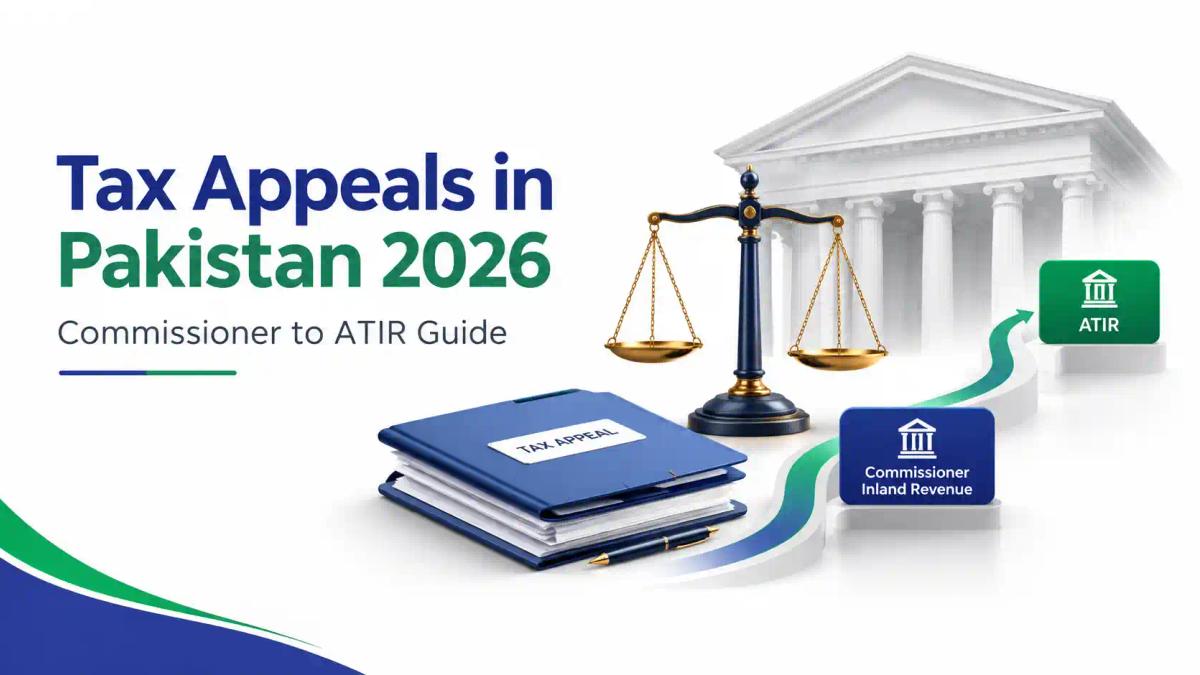
Introduction
Receiving an assessment order, a penalty order or a refund rejection from the Federal Board of Revenue (FBR) is stressful, but it is rarely the end of the road. Pakistan's tax laws give taxpayers a layered right of appeal, and the taxpayers who use it well are usually the ones who understand the forums, the deadlines and the paperwork before the clock starts running.
The appeal system has also moved quickly. In 2024 the route to the Appellate Tribunal Inland Revenue (ATIR) was reshaped; the Finance Act, 2025 restored a two-tier system and the Finance Act, 2026 added faceless appeals and an internal scrutiny committee for the department's own litigation. If you are working from an article written two years ago, parts of it may now be wrong.
This guide walks you through the full journey: what a tax appeal is, how the Commissioner (Appeals) and ATIR differ, the deadlines, the documents, stay of recovery, and what happens after the Tribunal. It is written for individuals, company owners, accountants and early-career tax practitioners. If you have only received a notice (not yet an order), start with our FBR notices explained guide first.
Quick Answer: What Is a Tax Appeal in Pakistan?
In Pakistan, a taxpayer challenges an FBR assessment or penalty order by appealing first to the Commissioner Inland Revenue (Appeals), generally within 30 days. A further appeal lies to the Appellate Tribunal Inland Revenue (ATIR), and then a reference on a question of law to the High Court. Since the Finance Act 2025, taxpayers may also go directly to ATIR.
Key points
- First appeal: Commissioner Inland Revenue (Appeals), under section 127 of the Income Tax Ordinance, 2001 (and section 45B of the Sales Tax Act, 1990).
- Second appeal: Appellate Tribunal Inland Revenue, under section 131 of the Ordinance; the Tribunal is the last forum that can re-examine the facts.
- Third stage: A reference to the High Court under section 133, limited to questions of law.
- Recovery does not stop automatically: you must apply for a stay.
- Deadlines are strict: a late appeal needs a written request showing "sufficient cause" for the delay.
What Is a Tax Appeal, and What Can You Appeal Against?
A tax appeal is a formal, statutory challenge to a decision made by a tax authority. It is not a letter of complaint, and it is not the same as replying to a notice. You appeal against an order, which is the authority's final decision on a matter, to a higher authority that can confirm, change or cancel it.
Under section 127 of the Ordinance, the orders that can be taken to the Commissioner (Appeals) include orders under sections 120, 121 and 122 (assessments and amended assessments), orders holding a person liable for tax not deducted or collected, refund orders under section 170 and penalty orders under section 182. In practice, the orders taxpayers most often challenge are:
- An amended assessment after an audit (see our FBR audit notice guide).
- A best judgment assessment issued when a taxpayer did not respond or file.
- A penalty for late filing, non-filing or other defaults (see FBR non-filer penalties).
- A withholding tax order against a person who allegedly failed to deduct or deposit tax (see what withholding tax is and how to handle it).
- A refund rejection or short refund (see the IRIS tax refund process).
Notice versus order: why the difference matters
A notice asks you to do something or explain something. An order records a decision. Many notices (for example, a show-cause notice before an amendment) give you the chance to be heard, and a strong reply can prevent an adverse order altogether. Our guides on responding to an FBR notice under section 114 and how FBR audit notices work cover that stage. This article starts where those end: when an order has been passed and you disagree with it.
The Tax Appeal Hierarchy in 2026
| Stage | Forum | Main provision (Income Tax) | What it can examine |
|---|---|---|---|
| Original decision | Officer / Commissioner Inland Revenue | Sections 120, 121, 122, etc. | Assessment, penalty, refund, withholding |
| First appeal | Commissioner Inland Revenue (Appeals) | Section 127 | Facts and law |
| Second appeal | Appellate Tribunal Inland Revenue (ATIR) | Section 131 | Facts and law (last fact-finding forum) |
| Reference | High Court | Section 133 | Questions of law only |
Two points deserve emphasis.
First, section 126A has been omitted by the Finance Act, 2025, according to the FBR's consolidated Ordinance. That section had introduced monetary limits deciding whether a case went to the Commissioner (Appeals) or elsewhere. Dawn reported that the Finance Act 2025 restored the two-tier process of Commissioner (Appeals) followed by ATIR regardless of the amount involved, and that taxpayers reach the High Courts only through a tax reference after those forums.
Second, a choice now exists at the first stage. Section 127 carries a proviso allowing an aggrieved person either to appeal to the Commissioner (Appeals) or to give up that right and file directly before ATIR. We return to that choice below.
Stage 1: Appeal to the Commissioner Inland Revenue (Appeals)
Who can file and how long do you have?
Any person dissatisfied with an appealable order can file. The appeal must be made within 30 days of service of the notice of demand (for assessments or penalties) or of service of the order (for other cases), as section 127(5) provides. The Commissioner (Appeals) may admit a late appeal if you apply in writing and show you were prevented by sufficient cause.
Count from the date of service, not the date printed on the order. In the IRIS era, service is often electronic, so keep the IRIS upload date and any email or SMS alert. Our Pakistan tax calendar 2026 is useful for return and payment deadlines, but appeal deadlines always run from your own order.
Is there a payment requirement before appealing?
The text of section 127(2) reproduced in published versions of the Ordinance says that no appeal against an order of assessment may be made unless the tax due under section 137(1), meaning the tax admitted as payable on the return, has been paid. Confirm the current wording of this sub-section in the FBR consolidation before you file, because a defective appeal can be rejected on this point alone.
Step-by-step: how to file the first appeal
- Obtain the order and confirm the date of service. Download it from IRIS if it was issued there; our IRIS 2.0 login and registration guide explains access.
- Calculate the deadline. Add 30 days to the date of service and diarise it with a safety margin.
- Pay any tax that must be paid before appealing (see above) and keep the payment challan.
- Pay the appeal fee by challan. The fee differs for companies and non-companies and depends on whether the appeal is against an assessment, so check the amount in section 127(4) of the current text.
- Prepare the appeal in the prescribed form, verified as prescribed, stating the grounds precisely.
- File through the prescribed mode. Section 127 allows the Board to prescribe electronic filing, so confirm whether your Commissioner (Appeals) office requires IRIS filing in your case.
- Attend the hearing and file written submissions.
- Collect the appellate order and note the new deadline for any further appeal.
Writing grounds of appeal that work
Section 127 requires the appeal to state its grounds precisely. Vague grounds such as "the order is against law and facts" do little work. A useful structure is:
- Statement of facts: a short, dated narrative of what happened, with document references.
- Grounds on jurisdiction and procedure: for example, no proper show-cause notice, no opportunity of being heard, or an order passed after the time allowed.
- Grounds on law: the provision relied on and why the officer misapplied it.
- Grounds on facts and evidence: which documents prove your position and why the officer's findings are unsupported.
- Prayer: what you want, such as annulment, reduction or remand.
The principles of natural justice matter here. An order made without notice or without a fair hearing can often be attacked on that ground alone, whatever the merits.
Sample structure for a statement of facts
A statement of facts is the short, neutral story of your case. It should be accurate, dated and tied to documents. Use this skeleton and replace each bracket with your own facts. Do not copy it as written, and do not include anything you cannot support.
The following is a sample template for guidance only. Replace all bracketed placeholders with accurate details supported by your documents before filing an appeal.
- Parties and status. [Name], NTN [number], [individual / company / AOP], tax year [year], falling under [Commissioner / zone].
- The return. On [date], the appellant filed the return for tax year [year], declaring [heads of income / turnover]. (Annexure A.)
- The notice. On [date], a notice under section [number] was issued/served, requiring [what]. (Annexure B.)
- The reply. On [date], the appellant responded by [method], enclosing [documents]. (Annexure C.) If no reply was filed, state the reason honestly and with evidence.
- The hearing. The matter was fixed for [date]. The appellant [attended / was not heard because …]. (Annexure D.)
- The impugned order. On [date], the officer passed an order under section [number], determining [what] and creating a demand of Rs [amount]. The order was served on [date] by [mode]. (Annexure E.)
- Payments made. The appellant has paid Rs [amount] on [date], as shown by challan [number]. (Annexure F.)
- Timeliness. The appeal is filed on [date], within [number] days of service. If late, add a cross-reference to the condonation application.
Keep each paragraph short, number the annexures and avoid argument. Argument belongs in the grounds. The same discipline helps when you prepare for a sales tax review; see our guide to sales tax audit preparation for organising records.
Documents to file
- Copy of the impugned order and notice of demand
- Proof of service date (IRIS screenshot, email or courier record)
- Appeal fee challan and proof of any required tax payment
- Return, wealth statement and revised return, if relevant (see how to file a revised return)
- Books of account, invoices, bank statements and withholding certificates
- Show-cause notices, replies and hearing records from the original proceedings
- Power of attorney or authority letter for your representative
- Written application for condonation of delay, where needed
The documents required for a Tax Year 2026 return overlap heavily with what you will need in a dispute about that year.
Additional evidence
The Commissioner (Appeals) can call for particulars or cause further inquiry before deciding. Expect the department's officer to be heard as well. If you hold documents that were not before the assessing officer, take advice on how and when to place them on record, because procedural rules about additional evidence can be technical.
Challenging an ex parte or best judgment order
An ex parte order is one passed without hearing you, usually because you did not reply to a notice or did not attend. A best judgment assessment under section 121 of the Income Tax Ordinance, 2001 is the best-known example: the officer estimates your income from the material available instead of from a return or accounts. Both are appealable. Orders under section 121 are among those listed in section 127, so the usual 30-day period from service applies, and you can ask for condonation if you were late.
Being "ex parte" is not a ground by itself, and the officer is entitled to proceed if you ignored a valid notice. The grounds that tend to matter are:
- Defective or missing notice. Was a notice actually served, to the correct address or IRIS account, and did it give a real date and a real opportunity to respond?
- Denial of a fair hearing. Did the officer decide before the date you were given, or refuse a reasonable adjournment? The principles of natural justice are a legitimate ground on their own.
- No proper basis for the estimate. If the order simply inflates income without explaining how it was reached, say so and show the correct figures.
- Order passed out of time. Check the limitation period that applies to the provision used.
- Wrong person or wrong year. Check the name, NTN and tax year on the order.
Evidence is what changes the outcome. At appeal, bring what you should have produced earlier: books of account, bank statements, invoices and withholding certificates. Explain honestly why they were not produced below. A taxpayer who says "my IRIS account was inaccessible" should be able to show it, which is why our guide to IRIS login problems and solutions is worth reading before an account problem becomes a missed notice.
Prevention is cheaper than appeal. Many best judgment orders follow a missed return or an unanswered notice, so read our guides on who must file an income tax return in Pakistan in 2026, responding to a section 114 notice and the tax audit process.
The Direct Route to ATIR: Should You Skip the First Appeal?
The proviso to section 127(1) allows an aggrieved person to surrender the right of appeal before the Commissioner (Appeals) and file directly before ATIR. That is a strategic decision, not a shortcut.
Reasons to consider the direct route
- The dispute is mainly a pure question of law that the Commissioner (Appeals) is unlikely to decide in your favour.
- You want a Tribunal ruling that can serve as precedent for later tax years.
- You want to avoid what you expect to be a lengthy first appeal.
Reasons for caution
- You give up a forum that is often quicker and more accessible.
- You lose the chance to build a record through two hearings.
- The Tribunal's workload and listing times may be heavier than the first appellate office.
Take professional advice before surrendering the first appeal. If you are an accountant or consultant, this is exactly the kind of judgement call taught in ICT's Advance Taxation and Litigation course.
Stage 2: Appeal to the Appellate Tribunal Inland Revenue (ATIR)
What is ATIR?
The Appellate Tribunal Inland Revenue is the independent second appellate forum for direct and indirect taxes. Its website describes it as sitting under the Ministry of Law and Justice, with benches in Islamabad, Lahore, Karachi, Peshawar and Multan, and publishes the appeal form, rules and cause lists. The Tribunal's chairperson states that its orders are final, with appeals to the High Court only for substantial questions of law. In other words, ATIR is the last forum that can re-weigh the evidence.
Deadline for appealing to ATIR
Under section 131 as amended by the Finance Act, 2025, appeals to the Tribunal are reported to be due within 30 days of receipt of the Commissioner (Appeals)'s order. Older articles and some websites still say 60 days, which was the earlier position, so always check the current text of section 131 in the FBR consolidation. The Tribunal may admit a late appeal on a written application showing sufficient cause. The department can also appeal; the Finance Act 2025 is reported to have clarified the Commissioner's right to do so.
Step-by-step: filing an ATIR appeal
- Read the Commissioner (Appeals)'s order carefully and decide which findings you challenge.
- Note the date of receipt and calculate the deadline.
- Download the appeal form from the ATIR website and complete it as prescribed.
- Draft grounds that arise out of the order under challenge. Grounds that were never part of the dispute below can be rejected.
- Pay the Tribunal fee, which differs for companies and others, and attach the receipt.
- Attach the impugned orders (both the Commissioner (Appeals) order and the original order), the grounds, the statement of facts and your authority letter.
- File a separate stay application if recovery is a risk.
- Track the cause list for your bench and attend.

What happens at the hearing?
Both sides are heard. The Tribunal may confirm, modify or annul the order, or send the matter back (remand) for fresh decision. A remand does not end the dispute; it returns the case to the officer with directions, and you should prepare for a second round of proceedings. Our guide to common tax mistakes Pakistani businesses make shows how many disputes begin with weak record-keeping, which is just as costly at the Tribunal as at the officer stage.
How to track your appeal
There is no single "appeal status" page for every forum, so use the channels that apply to your stage.
- Commissioner (Appeals): Check your IRIS account for notices, orders and hearing intimations, and keep your own diary of dates. Genuine FBR communications appear in your IRIS account, as explained in our FBR notices guide, and our IRIS 2.0 guide covers access. If you are unfamiliar with the portal, start with what the FBR IRIS portal is and how to use it.
- ATIR: The ATIR website has a cause list, a judgments page and a link to an appeals system. It also announces that a new Appeals Management System is being rolled out, so confirm what it currently offers. Check the cause list for your bench regularly, and ask your representative to confirm each hearing date.
- High Court: Each High Court publishes cause lists and case information on its own website.
Whatever the forum, record the filing receipt, diary or reference number and next hearing date the day you file.
Appeal Deadlines at a Glance
| Step | Income Tax Ordinance, 2001 | Sales Tax Act, 1990 |
|---|---|---|
| First appeal to Commissioner (Appeals) | 30 days (section 127(5)) | 30 days (section 45B) |
| Appeal to ATIR | 30 days from the Commissioner (Appeals) order, as amended in 2025 (section 131) – verify | Section 46; procedure follows sections 131 and 132 of the Ordinance |
| Reference to High Court | 90 days (section 133) – verify | 90 days from the Tribunal's order being communicated (section 47) |
| Late filing | Written application showing sufficient cause | Sufficient cause |
How we sourced this table: the 30-day periods under section 127(5) and section 45B appear in the published text of those provisions and in a Supreme Court decision reported by Business Recorder on section 45B. The 90-day reference period for sales tax is in section 47. The ATIR and income tax High Court periods have been amended over the years, so confirm them against the live text before relying on them.
Worked example: calculating your deadline
Suppose an amended assessment order is served on you through IRIS on Thursday 15 October 2026, and you want to appeal to the Commissioner (Appeals), which has a 30-day period from service.
- Day 1 is generally the day after service, although you should confirm how limitation is computed under section 226 of the Ordinance and any applicable rule on the day of service.
- Counting 30 days from 15 October takes you to Saturday 14 November 2026.
- A Saturday may be a non-working day for the relevant office. Do not assume the deadline moves to Monday. Plan to file by Friday 13 November 2026 at the latest.
Then, add your working steps:
| Task | Target date |
|---|---|
| Order downloaded and service date saved | 15 October |
| Pre-appeal payment and fee challan confirmed | 22 October |
| Draft grounds and statement of facts reviewed | 30 October |
| Stay application prepared | 30 October |
| Appeal filed with proof of filing | 6 November (well before 13 November) |
Filing a week early gives you time to fix a rejected upload or a fee challan error. Put the same steps into your own calendar alongside the dates in our Pakistan tax calendar 2026.
Condonation of delay
Condonation of delay is the formal request that a late appeal be admitted despite missing the deadline. The test in the statute is sufficient cause. A good application:
- States the exact dates of the order, service and filing.
- Explains day by day why the delay happened, with evidence such as hospital records or proof that the order was not visible in IRIS.
- Is filed together with the appeal, not later.
Do not plan around condonation. It is discretionary, and officers and the Tribunal can be strict, particularly where the delay arises from carelessness.
Stay of Recovery: What Happens to the Tax Demand While You Appeal?
Filing an appeal does not automatically stop the department from recovering the disputed tax. Section 131(5) makes this explicit for ATIR appeals: tax stays payable under the assessment unless recovery is stayed.
At the Commissioner (Appeals) stage, section 128 allows a stay of recovery if the Commissioner (Appeals) is satisfied that recovery would cause undue hardship, after hearing the Commissioner against whose order you are appealing. The version of section 128 reproduced online (updated to 2021) provides for a stay of up to 30 days, extendable by a further 30 days if the appeal order is to be passed within that period. Check the current text because stay provisions are amended often.
At the ATIR stage, the Tribunal may, on application and after hearing the Commissioner, stay recovery if recovery of tax upheld by the Commissioner (Appeals) would cause undue hardship. The reproduced text sets a maximum of 180 days in aggregate, with the period of any High Court stay excluded from that count.
Constitutional petitions for interim protection. In several July 2026 orders, the Sindh High Court dealt with taxpayers who had appealed to the Tribunal or the Commissioner (Appeals) and applied for a stay, but whose stay applications had not yet been heard. The court directed that no coercive recovery be taken until the appellate forum decided the stay application or the appeal, whichever came first. One such order arose from a default surcharge appeal. These are individual orders on their own facts, not a guarantee of relief.
Recovery after multiple adverse decisions. Professional commentary on the Finance Act, 2025 reports a provision under which tax can become immediately payable where three appellate forums, including the High Court, have decided in the department's favour and the amount exceeds Rs 200 million. Check sections 138 and 140 of the current Ordinance if a large demand is involved.
Practical advice: file the stay application with the appeal, attach evidence of hardship (cash-flow statements, bank balances, payroll commitments) and explain what security or partial payment you can offer.
After ATIR: Reference to the High Court
If you lose at the Tribunal, the next step is a reference to the High Court under section 133 of the Income Tax Ordinance or section 47 of the Sales Tax Act. A reference is not a fresh appeal on the evidence. It is limited to questions of law arising from the Tribunal's order.
Appeal versus reference: what is the difference?
| Appeal (Commissioner / ATIR) | Reference (High Court) | |
|---|---|---|
| Can the facts be re-examined? | Yes | No – facts as found by the Tribunal |
| Nature of issue | Facts and law | Question of law only |
| Who decides | Tax authority / Tribunal | High Court bench |
| Time limit (typical) | 30 days | 90 days |
Draft the question of law carefully. A typical sales tax reference form requires a statement of the case, the facts found by the Tribunal and the specific question of law. Many references fail because the issue is really about facts or because limitation was not addressed, and the Sindh High Court has returned several matters to the Tribunal to decide limitation properly.
Further forums. Beyond the High Court, further petitions may lie to the Supreme Court or the Federal Constitutional Court depending on the subject matter and the current constitutional arrangement. Take specialist advice, because the allocation of jurisdiction has been changing.
Transition issues. The shift from the 2024 system to the Finance Act, 2025 system raised questions about references already filed in High Courts. A reported 2026 judgment (2026 PTD 227) addressed whether references against Commissioner (Appeals) orders should be remitted to ATIR, and held that the amended position applies to pending matters, not to matters already closed. If your case straddles that period, ask your adviser how it applies.
Finding relevant ATIR and High Court judgments
Tribunal and High Court decisions can make or break an appeal, especially on questions of law. A practical way to research:
- Start with the issue, not the party. Search by section number, the legal question and the tax year (for example, limitation under a particular section).
- Use official sources first. The ATIR website has a judgments page, and High Courts publish orders on their own sites. The Sindh High Court's case law portal, for instance, hosts individual order sheets that can be searched.
- Check whether it is reported. Reported judgments (in law journals) are easier to cite, but an unreported order is still evidence of how a bench approached an issue.
- Check the law has not changed. A judgment under the 2024 appeal system may not apply the same way after the Finance Act 2025, as courts have addressed transitional questions in 2026.
- Check the history. Was the decision appealed, reversed or distinguished?
- Verify AI-assisted research. If you use AI tools to summarise case law, confirm every citation against the original judgment; our guide to AI tax calculation and legal risk explains why.
Do not cite a case you have not read in full. A single wrong citation can damage credibility with the bench.
The department's side: Independent Case Scrutiny Committee
Section 133A, introduced in 2026, requires FBR to refer certain cases to an Independent Case Scrutiny Committee before filing references, appeals or reviews in the higher courts. In July 2026 FBR notified rules for these committees, which provide for a retired judge as chairman, a senior advocate and a senior revenue officer. The Commissioner must refer a case within ten days of a Tribunal or High Court order, and the committee has fifteen days to give its recommendation, extendable with reasons. For taxpayers, the practical effect should be fewer weak departmental references, but you should still expect that departmental appeals against a favourable ATIR order remain possible.
After the Appeal Is Decided: Appeal Effect and Non-Compliance
Winning an appeal does not change your tax record by itself. The department has to give effect to the appellate order, which means passing a fresh order that recomputes the tax in line with the decision. Section 124 of the Ordinance deals with assessment giving effect to an order.
Points to know:
- Full confirmation. Professional commentary on the Finance Act, 2025 reports that no appeal effect order is needed where the tax in the original order is fully confirmed by an appellate authority.
- Partial relief. Where an order is partly modified, set aside or remanded, commentary reports that appeal effect is given only for the issues and tax confirmed or modified, not for issues sent back. Read section 124 as currently amended to see how this affects a composite assessment for the whole year.
- Remand is not a win yet. If the Tribunal remands your case, you return to the officer with directions and should expect fresh proceedings and a new order that is itself appealable. Our income tax compliance guide lists the assessment sections involved.
- Refunds after success. If your success creates a refund, follow the refund process and keep the appellate order and the appeal effect order together.
If the department does not comply
I have not verified a statutory deadline for giving appeal effect or a statutory penalty for failing to do so, so check section 124 and any FBR instructions in the current consolidation. A practical sequence is:
- Obtain a certified or clear copy of the appellate order and note the date it was served.
- Write to the Commissioner, attaching the order and asking for the appeal effect order.
- Follow up through the IRIS or the Commissioner's office and keep proof of every request.
- If the delay continues and you are being harmed (for example, recovery of a demand that has been set aside), speak to a lawyer about the remedies available, which may include a petition before the High Court. Courts decide such petitions on their facts.
Sales Tax Appeals: How They Differ
Sales tax disputes follow a similar ladder, but under a different Act. If you are registered for sales tax (see our guides to what sales tax is in Pakistan and registering for sales tax), keep these points in mind:
- Commissioner (Appeals), section 45B: 30 days from receipt of the order. The Supreme Court has treated the statutory period for the Commissioner (Appeals) to decide as mandatory, with the published text allowing 120 days extendable by 60 days for recorded reasons; an order beyond that can be void.
- ATIR, section 46: the Tribunal hears sales tax appeals using the procedure in sections 131 and 132 of the Income Tax Ordinance.
- High Court, section 47: an application for reference on a question of law, within 90 days of the Tribunal's order being communicated. The High Court sends a copy of its decision to the Tribunal.
- Common disputes: input tax disallowance, show-cause notices barred by limitation, and registration issues. Our income tax versus sales tax comparison helps you identify which Act governs your problem, and the Master Sales Tax course goes deeper for practitioners.
Federal excise appeals sit in a similar framework, so check the Federal Excise Act, 2005, if your order arises under it.
Federal Excise appeals
The Federal Excise Act, 2005 follows a similar structure. Practitioner commentary describes the Commissioner (Appeals) as the first appellate forum under section 34 of that Act, alongside section 127 of the Income Tax Ordinance and section 45B of the Sales Tax Act. Time limits and forms are set by the Act itself, so read the current text of the Federal Excise Act and the order in front of you rather than assuming they match the sales tax periods.
If your business deals with both sales tax and excise, keep one dispute file per order and per Act. For the sales tax fundamentals, read our guides on sales tax in Pakistan and how to file sales tax returns, and consider the Master Sales Tax course if you handle these cases professionally.
Appeals in Specific Dispute Types: Withholding, Refunds and Non-Residents
The forums are the same, but the evidence and the arguments differ by type of dispute.
Withholding tax orders
Section 127 covers orders holding a person personally liable for tax that was not deducted or collected, and orders recovering tax from the person from whom it should have been collected or deducted. These typically arrive after a withholding audit, where the officer says a payer failed to deduct tax, deducted at the wrong rate, deducted but did not deposit, or did not file the withholding statement.
Before you draft grounds, collect the facts the dispute usually turns on:
- Was tax deducted, and was it deposited? Keep payment challans and certificates.
- Which provision and rate apply? Section 153 payments in particular depend on the nature of the payment and the recipient's status. Our guide to what withholding tax is and how to handle it explains how the chain works.
- Were statements filed? A correct deduction that was never reported creates its own exposure. See the section 165 withholding statement filing guide.
- Bank-related withholding. If the dispute concerns deductions on banking transactions, see our withholding tax on bank transactions guide.
Refund rejection and short refunds
Orders under section 170, which governs refunds, are listed among appealable orders in section 127. If FBR rejects a refund claim or grants less than you claimed, first obtain the written order that records the decision and the reasons. A system status message is not an order. Then calendar 30 days from service of that order. Read our IRIS tax refund process guide to confirm that your claim was filed correctly in the first place, because a technical defect in the claim is a common reason for rejection.
In the appeal, set out the claim in a short table: year, source of the refund, amount claimed, amount allowed and the difference, with each figure tied to a document.
Non-resident taxpayers
Non-resident taxpayers are not shut out of the appeal system. Section 127 speaks of a "person" aggrieved by an order, and the Ordinance also deals with representatives of non-residents (section 172) and tax treaties (section 107). In practice, three issues arise:
- Service and communication. Make sure FBR has a correct address or representative on record, because the 30-day clock runs from service.
- Authority to act. A representative in Pakistan will need a properly executed authority letter or power of attorney. Check what formalities apply to documents signed abroad.
- Treaty and foreign-tax points. If the dispute involves double taxation, gather residency evidence and foreign tax payment records. Our guides on double taxation relief for Pakistani freelancers and cross-border tax compliance cover the background, and ICT's overseas Pakistanis tax filing guide covers non-resident filing.
Non-resident disputes often combine procedural and treaty questions, so take specialist advice before the deadline, not after.
What Changed in 2026: Faceless Appeals, ADR and Algorithmic Settlement
The FBR's consolidated Ordinance, amended up to 30 June 2026, now lists several appeal-related provisions that did not exist a few years ago:
- Section 129A, faceless appeals. The Finance Bill 2026 proposed that appeals may be processed through the National Faceless Centre as FBR prescribes, with provisions on appeals before the Commissioner (Appeals) continuing to apply. How this works in practice depends on notifications and the IRIS workflow, so check FBR's current instructions rather than assuming your appeal will be heard in person.
- Section 134A, Alternative Dispute Resolution. The Alternative Dispute Resolution Committee route allows a negotiated settlement of disputes. Commentary on the Finance Act 2025 reports that where the committee does not decide within 60 days, the matter returns to the forum where it was pending, and that time spent before the committee is excluded when computing limitation (section 226). Verify before relying on it.
- Section 134B, algorithmic settlement mechanism. FBR may offer a system-generated settlement before an order under sections 121, 122 or 122E, with revised-return consequences for the taxpayer. Our Income Tax Ordinance 2001 compliance guide summarises how this fits the wider faceless framework, and our budget 2026 tax changes guide covers the policy background.
For the trend towards data-driven audits that lead to these orders, read digital tax audits and AI at FBR.
Appeal, Rectification or ADR: Which Remedy Fits?
| Remedy | Use it when | Key limit |
|---|---|---|
| Rectification (section 221) | There is a mistake apparent from the record, such as a calculation or clerical error | Cannot re-argue the merits |
| Appeal (sections 127 / 131) | You disagree with the decision on facts or law | Strict time limits |
| ADR (section 134A) | Both sides may settle a genuine dispute | Depends on committee acceptance and process rules |
| Reference (section 133) | Tribunal decided a question of law wrongly | Question of law only |
If an order has an obvious arithmetic error, rectification can be faster and cheaper. But do not let a rectification application run past the appeal deadline unless an adviser confirms the position, because filing for rectification does not necessarily extend the time to appeal.
What Does a Tax Appeal Cost?
Costs fall into three groups:
- Statutory fees. Sections 127 and 131 prescribe an appeal fee, which differs between companies and other taxpayers. Check the current amounts in the Ordinance and attach the payment receipt.
- Tax that must be paid. This can include tax admitted on the return, any amount you offer as security for a stay, and any demand a forum orders you to pay.
- Professional fees. These are not fixed by law. They depend on the complexity of the dispute, the amount at stake and the forum. Ask for a written scope and fee estimate before you instruct anyone.
We do not quote an average "cost of an appeal" here because there is no reliable official figure. Anyone offering a flat price without seeing your order should be asked to explain what it includes.
Do You Need a Lawyer or Consultant?
The Income Tax Ordinance addresses appearance by an authorised representative (section 223). Individuals can file and argue simple appeals themselves, particularly at the first appeal stage, but the combination of strict limitation, technical grounds and stay applications makes professional help valuable for anything significant.
- Tax lawyer (advocate): essential for High Court references and constitutional petitions, and highly useful at ATIR.
- Tax consultant / chartered accountant: often best for reconstructing accounts, preparing financial evidence and handling the Commissioner (Appeals) stage.
- A team of both is common in larger disputes.
If you are considering this as a career, see how a Certified Tax Advisor compares with an accountant. ICT is a training institute; it does not represent taxpayers in court, and nothing in this article creates a lawyer–client relationship.
Practitioners who want a structured path into litigation work can read about ICT's Advance Taxation and Litigation course and the practical tax practitioner course in Islamabad.
If you want to build these skills as a career, ICT's Advance Taxation and Litigation course teaches notice replies, assessment defence and appeal strategy, and you can read the 2025 course overview and compare the course fees for 2026 before you decide.
Common Mistakes in Tax Appeals
- Missing the deadline because you counted from the order date rather than the service date.
- Not paying a required pre-appeal amount and having the appeal rejected as defective.
- Vague grounds that do not point to a specific error.
- Raising new grounds at ATIR that did not arise from the order below.
- Forgetting the stay application, leaving the department free to start recovery.
- Weak evidence because books, bank statements and withholding certificates were never organised.
- Ignoring procedural flaws, such as no show-cause notice or no hearing, which can be strong grounds.
- Treating a reference as a second chance to argue facts.
- Citing outdated law. Always confirm that you are quoting the FBR consolidation amended up to 30 June 2026.
Tax Appeal Checklist
- Order downloaded and service date recorded
- Deadline calculated with a margin and diarised
- Pre-appeal payment position checked
- Appeal fee challan paid and saved
- Statement of facts and precise grounds drafted
- Documents indexed and paginated
- Stay application prepared with hardship evidence
- Condonation application ready if the deadline is tight
- Authority letter or power of attorney signed
- Proof of filing and next hearing date saved
Official Sources to Check Before You File
Law changes every Finance Act, so verify the points in this guide against primary sources:
- FBR consolidated Income Tax Ordinance, 2001 (amended up to 30 June 2026)
- Appellate Tribunal Inland Revenue website for forms, rules, benches and cause lists
- Pakistan Code for official statute text
- Dawn's report on the restored two-tier system
- FBR's July 2026 rules on Independent Case Scrutiny Committees
Frequently Asked Questions
1. Where do I file an appeal against an FBR order? First with the Commissioner Inland Revenue (Appeals) that serves your taxpayer jurisdiction. You may alternatively give up that right and file directly before ATIR under the proviso to section 127(1).
2. How long do I have to appeal to the Commissioner (Appeals)? Thirty days from service of the notice of demand or order, under section 127(5) of the Income Tax Ordinance, and 30 days under section 45B of the Sales Tax Act.
3. What is the deadline for appealing to ATIR? The Finance Act 2025 is reported to have set 30 days from receipt of the Commissioner (Appeals)'s order. Older sources say 60 days. Confirm in section 131 of the current consolidation.
4. Can I appeal after the deadline has passed? You can apply for condonation of delay, supported by facts showing sufficient cause. It is discretionary, so do not rely on it.
5. Can FBR recover tax while my appeal is pending? Yes, unless recovery is stayed. Apply for a stay with the appeal and attach evidence of hardship.
6. Is ATIR's decision final? It is the last forum for facts. A reference on a question of law can go to the High Court under section 133 (income tax) or section 47 (sales tax).
7. Do I need a lawyer for an ATIR hearing? Not legally in every case, but representation by an advocate or experienced consultant is strongly advisable for contested matters.
8. What documents should I submit with my appeal? The order, proof of service, fee challan, grounds, statement of facts, supporting accounts and records, and an authority letter if represented.
9. What is the difference between an appeal and rectification? Rectification corrects a mistake apparent from the record under section 221. An appeal challenges the decision itself on facts or law.
10. Can a company file a tax appeal? Yes. Companies, AOPs and individuals all have appeal rights. Fees differ between companies and other taxpayers.
11. What happens if the Tribunal remands the case? The matter goes back to the officer with directions, and fresh proceedings follow. You will usually have new rights of appeal against any new order.
12. How much does an FBR appeal cost? There is a statutory fee that varies by taxpayer type, plus professional fees that are not fixed. Ask for a written estimate.
13. Can I challenge a best judgment assessment? Yes. Orders under section 121 are appealable to the Commissioner (Appeals) within 30 days of service. Strong grounds include defective notice, denial of a hearing and an unsupported estimate. Bring the evidence you did not produce earlier.
14. What if my refund is rejected? Obtain the written order under section 170 and appeal within 30 days of service. Attach the claim, proof of tax paid and a reconciliation of the amount claimed against the amount allowed.
15. Can a non-resident file a tax appeal in Pakistan? Yes, the right of appeal belongs to a "person" aggrieved by an order. Non-residents usually need a representative in Pakistan with a valid authority letter, and should ensure FBR has a correct address for service.
16. How do I check the status of my appeal? For the Commissioner (Appeals), check your IRIS account and hearing notices. For ATIR, check the cause list on atir.gov.pk and confirm dates with your representative. Always keep the filing receipt and diary number.
17. What if FBR does not follow the appellate order? Write to the Commissioner attaching the order and ask for the appeal effect order. Keep proof of each request. If harm continues, consult a lawyer about further remedies, such as a High Court petition.
Why Choose ICT for Tax Appeals in Pakistan 2026: Commissioner to ATIR Training?
The Institute of Corporate and Taxation (ICT) is a taxation and corporate training institute with its campus at I-10/3, Islamabad, and it describes its programmes as practical and industry-focused. For anyone who wants to work on tax appeals, from a first appeal before the Commissioner (Appeals) to a hearing at ATIR, ICT’s Advance Taxation and Litigation course covers notice replies, assessment defence and appeal strategy. Our guides on FBR notices, audit notices and the Income Tax Ordinance 2001 for 2026 are kept updated, so you learn the law as it currently stands. If you want a broader foundation, you can start with the Certified Tax Advisor course, compare the 2026 course fees, and contact ICT to ask about the next intake. ICT is a training institute and does not represent taxpayers before tax authorities or courts.
Conclusion
A tax appeal in Pakistan is a structured journey: the Commissioner (Appeals), then the Appellate Tribunal Inland Revenue, then the High Court on questions of law, with a direct route to ATIR now available if you choose it. What decides outcomes is rarely a single clever argument. It is meeting the deadline, paying what must be paid, stating precise grounds, supporting them with organised evidence and protecting yourself from recovery with a timely stay application.
Because the rules were reshaped in 2024, 2025 and 2026, always work from the current FBR consolidation and the live ATIR forms, and get professional advice for anything involving a large demand.
If you want to build these skills as a career, ICT's Advance Taxation and Litigation course teaches notice replies, assessment defence and appeal strategy, and you can compare the course fees for 2026 before you decide. Practitioners who prefer a broader foundation can start with the Certified Tax Advisor course. To ask about the next intake, contact ICT.
Comments (0)
No comments yet. Start the conversation!
Leave a Reply
Your email address will not be published. Required fields are marked *