
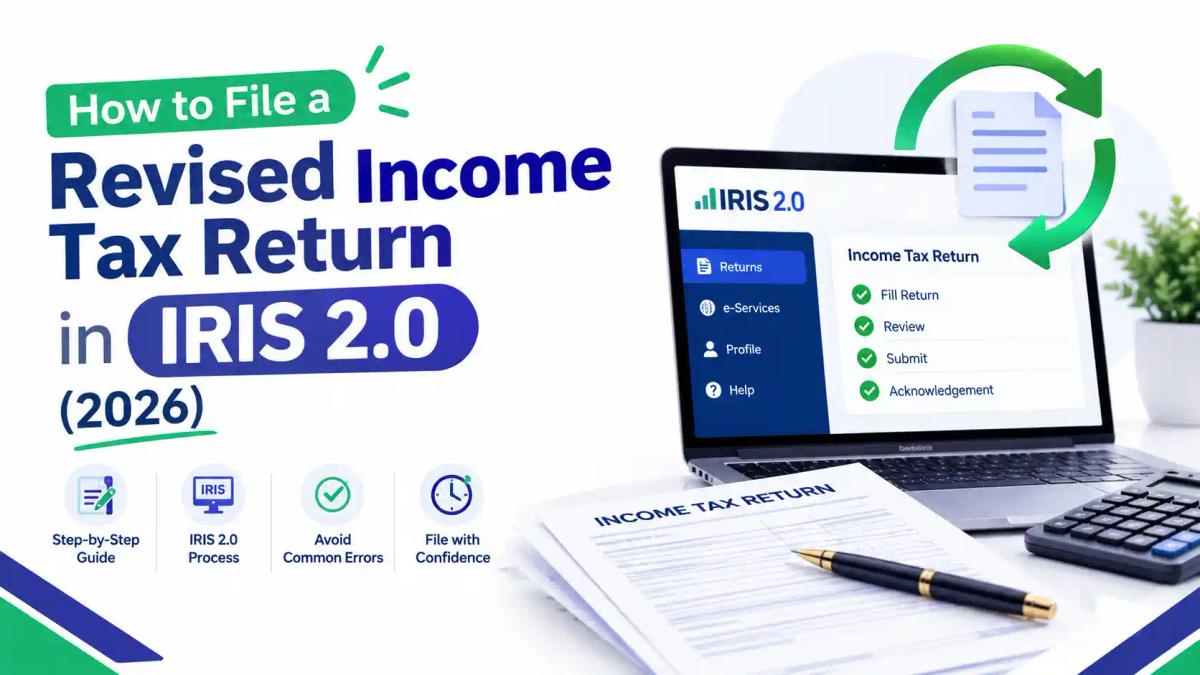
How to File a Revised Income Tax Return in IRIS 2.0 (2026)
Quick Answer
To file a revised income tax return in IRIS 2.0, log in at iris.fbr.gov.pk, open the Declaration menu and select the 114(6) revised return option for the relevant tax year. If more than 60 days have passed since the original return was filed, you must first submit a revision application stating your reasons and wait for the Commissioner's approval before the revised return becomes editable.
Introduction
Every filing season produces the same quiet panic. A salary certificate arrives late, a withholding tax certificate turns up in a drawer, a property sale was entered in the wrong tab, or the wealth reconciliation was forced to balance with a number nobody can now explain. At the Institute of Corporate and Taxation (ICT), the team handles this conversation hundreds of times between July and October, and the answer is almost always the same: the law gives you a route to correct it, and that route has rules worth knowing before you touch the portal. You can read more about how ICT trains practitioners on live FBR systems at ICT's official website, and the full practitioner pathway is covered in the Certified Tax Advisor Course.
Speak to an ICT Course Advisor Today
This guide walks through the entire revision process on IRIS 2.0 as it stands in September 2026: what the statute actually says, which of the two filing routes applies to you, what to write in the reasons field, how the penalty position works, and what the Finance Act, 2026 changed. If you have not yet filed your original return for this year, start with the step-by-step return filing guide for Pakistan 2026 first, because a revision is only available once a return exists on record.
Key Takeaways
- A revised return under section 114(6) is a correction of a return you already filed, not a second original return.
- Written reasons for revision are compulsory. Skipping them is the single most common cause of rejection.
- Inside 60 days of the original filing, the approval condition does not apply. Outside 60 days, an approval application comes first.
- If the Commissioner passes no order within 60 days of the request, approval is deemed to have been granted.
- Voluntary revision with payment of the short-paid tax, made before an audit or amendment notice arrives, protects you from penalty under section 114(6A).
- A revised return becomes an amended assessment order the day it is furnished, which is why the figures in it must be defensible.
What Is a Revised Income Tax Return in IRIS 2.0?
A revised income tax return in IRIS 2.0 is a corrected version of a return already submitted to the Federal Board of Revenue, filed under section 114(6) of the Income Tax Ordinance, 2001 by a taxpayer who has discovered an omission or a wrong statement in the original declaration. It replaces the original figures for that tax year and carries its own legal status once accepted.
The distinction that trips people up is between a return that is still a draft and a return that has been submitted. While a declaration sits in your IRIS drafts, you can edit it freely. The moment you submit it, section 120 treats the return as an assessment order issued by the Commissioner on that same day. Editing is over. Correction is now a formal legal act with conditions attached. Practical differences between the old portal and the current interface are set out in the FBR IRIS 2.0 login and features guide.
A revised return is also different from a resubmission. IRIS 2.0 does not let you overwrite a submitted return through the ordinary 114(1) task. A separate declaration type exists for revisions, and it appears in the Declaration menu as the 114(6) return of income filed after revision. Taxpayers who cannot see that option usually have an approval condition outstanding rather than a technical fault, though genuine portal errors do occur and are catalogued in the IRIS 2.0 return filing errors and solutions guide.
Which Law Governs Revised Returns in Pakistan?
Revised income tax returns in Pakistan are governed by section 114(6) of the Income Tax Ordinance, 2001, read with section 114(6A) for penalty relief, section 122(3) for the legal effect of the revision, and section 116(3) where a wealth statement is also being corrected. The Finance Act, 2026 added a settlement-based revision route through the new section 134B.
The operative words of section 114(6) are that a person who, having furnished a return, discovers any omission or wrong statement in it may file a revised return subject to stated conditions. The conditions require revised accounts or revised audited accounts where applicable, written and signed reasons for the revision filed with the return, approval of the Commissioner in writing, and a declared taxable income that is not lower, or a declared loss that is not higher, than the income or loss determined by an order issued under sections 121, 122, 122A, 129, 132, 133 or 221. If any of these conditions is not fulfilled, the return furnished is treated as an invalid return as if it had never been furnished.
That last sentence deserves its own paragraph, because it is the harshest line in the provision. A defective revision does not simply get sent back for correction. It is legally void. Anyone advising clients on this needs the statutory reading habit that the Income Tax Ordinance 2001 compliance guide for 2026 sets out, because the difference between a valid and an invalid revision is usually a single missing attachment.
Once a valid revised return is furnished, section 122(3) treats the Commissioner as having made an amended assessment of the taxable income and tax payable as set out in that revised return, and the revised return itself becomes an amended assessment order issued on the day it was furnished. The figures you enter are not a request. They become the assessment.
When Should You Revise Your Income Tax Return?
You should revise an income tax return whenever the original contains an omission or a wrong statement that changes declared income, tax payable, tax credits, withholding adjustments, or the wealth position. Revision is the correct route for factual and computational errors discovered by the taxpayer. It is not the route for disagreeing with an order passed by a tax officer.
The situations that generate genuine revisions in practice are consistent year after year. Income received but not declared, such as bank profit, rental income from a second property, or a capital gain on securities. Withholding tax credits claimed at the wrong figure because the CPR data did not match the certificate. Salary declared gross where it should have been split between taxable salary and exempt allowances. Business expenses omitted, inflating profit. Foreign remittances or assets left out of the wealth statement. A brokerage or property transaction posted to the wrong head of income. Many of these are catalogued in the most common income tax return filing mistakes in Pakistan.
There are also situations where revision is the wrong instrument. If the arithmetic in your return is right but IRIS computed it wrongly, that is a rectification matter under section 221. If a tax officer has already amended your assessment and you disagree, the remedy is an appeal, not a revision. If you simply forgot to file at all, you need an original late return and the surcharge route described in the FBR late filer surcharge guide for 2026, not a revision.
Decision matrix
| Situation discovered | Correct route | Statutory basis |
|---|---|---|
| Income omitted or wrongly stated by you | Revised return | Section 114(6) |
| Arithmetical or clerical mistake in an order | Rectification | Section 221 |
| Tax officer amended your assessment and you disagree | Appeal | Section 127 onwards |
| You never filed for that year | Original late return | Section 114(1) |
| Only the wealth statement is wrong | Revised wealth statement | Section 116(3) |
| Discrepancy raised through a settlement offer | Settlement-based revision | Section 134B |
Who Is Eligible to File a Revised Return Under Section 114(6)?
Any person who has already furnished an income tax return for a tax year and later discovers an omission or wrong statement in it is eligible to file a revised return under section 114(6) of the Income Tax Ordinance, 2001. Eligibility covers salaried individuals, business individuals, associations of persons, companies and non-residents alike.
Three eligibility points are worth stating plainly. First, there must be an original return on record for that tax year, because you cannot revise something that does not exist. Second, the discovery must relate to an omission or a wrong statement, which is the statutory language and which the Commissioner is directed to treat generously where the error is a bona fide one. Third, the taxpayer must still be within the practical outer limit of the assessment window, which is discussed below. If you are unsure whether you were even required to file for a particular year, the position is set out in who must file an income tax return in Pakistan 2026.
Freelancers and export-of-services filers form a distinct eligibility group because their returns interact with concessional final-tax treatment, and a badly executed revision can disturb that treatment. The interaction is explained in the freelancer tax guide for Pakistan 2026. Companies also need to remember that revised accounts, and where applicable revised audited accounts, must accompany the revision, which makes a corporate revision a board-level exercise rather than a portal task.
What Are the Legal Conditions for a Valid Revised Return?
A valid revised return under section 114(6) must satisfy four cumulative conditions: revised accounts or revised audited accounts where relevant, written and signed reasons for revision, approval of the Commissioner in writing where the 60-day window has closed, and declared income that is not lower than income already determined by a formal order. Failure on any one condition renders the entire revision invalid.
| Condition | Clause | Applies to | What IRIS 2.0 expects |
|---|---|---|---|
| Revised accounts or revised audited accounts | 114(6)(a) | Business individuals, AOPs, companies | Attachment uploaded with the declaration |
| Written, signed reasons for revision | 114(6)(b) | Every taxpayer | Text entered in the Content tab, plus signed scan |
| Commissioner's written approval | 114(6)(ba) | Revisions after 60 days | Approval order visible in the IRIS Inbox |
| Income floor test | 114(6)(c) | Every taxpayer | Declared income not below income determined by order |
The written reasons carry more weight than most filers assume. A one-line entry saying "correction of error" invites a rejection. A usable reason identifies the item, the source document, the amount and the effect. For example: omission of profit on debt of PKR 118,400 credited by the bank on 14 May 2026, evidenced by the withholding certificate, increasing taxable income by the same amount. Assembling that evidence before you start is the point of the tax year 2026 income tax return documents checklist.
The income floor test is the condition most often misread. It does not stop you from reducing your income. It stops you from declaring less than an amount already fixed by a formal order under sections 121, 122, 122A, 129, 132, 133 or 221. Where no such order exists and you are declaring more income than was assessed under section 120, the approval requirement is relaxed entirely, which is covered next.
How Does the 60-Day Rule Work in IRIS 2.0?
The 60-day rule creates two separate revision routes. A revised return filed within 60 days of the original filing does not require the Commissioner's written approval at all. After 60 days, approval becomes a precondition, though the law also grants deemed approval where the Commissioner fails to act within 60 days of the request.
The provisos to section 114(6) do the work here. The first relaxation removes the approval condition where the revised return is filed within 60 days of filing the return. The second relaxation treats approval as deemed to have been granted where the Commissioner has not made a written order of approval before the expiration of 60 days from the date when the revision was sought, or where the taxable income declared is more than, or the loss declared is less than, the income or loss determined under section 120. A further proviso directs that the Commissioner shall grant approval in the case of a bona fide omission or wrong statement.
Two of those limbs matter enormously in practice and are underused. If your revision increases declared income, approval is deemed granted, which is the legal answer to the common fear that voluntarily declaring more will trap you in an approval queue. And if a revision application simply sits unanswered for 60 days, the law says approval is deemed given. The Pakistan Tax Bar Association has previously written to FBR pointing out that although the law provides for revision without approval once 60 days have elapsed, the portal has not facilitated it, leaving taxpayers seeking genuine corrections stranded. Where a deemed-approval position is being asserted, keep the dated acknowledgement of your application, because that date is your evidence. Deadline discipline of this kind is mapped in the Pakistan tax calendar 2026.
| Timing of revision | Approval required? | What you file first |
|---|---|---|
| Within 60 days of original filing | No | The revised return directly |
| After 60 days, income increased | Deemed granted | Revision application, then revised return |
| After 60 days, income unchanged or reduced | Yes | Revision application, await written order |
| After 60 days, no order passed for 60 days | Deemed granted | Revised return, retain application evidence |
How Do You File a Revised Income Tax Return in IRIS 2.0 Within 60 Days?
Filing a revised return within 60 days of the original submission is the simplest route on IRIS 2.0 because no approval order is needed. You open the 114(6) declaration for the relevant tax year, enter the corrected figures across every affected tab, state your reasons, pay any differential tax, and submit.
- Log in to IRIS 2.0 at iris.fbr.gov.pk using your CNIC as the username for an individual, or your NTN for a company or AOP. Password and access problems are dealt with in the IRIS login problems and solutions guide.
- Open the Declaration menu on the top bar. Select the option described as 114(6), return of income filed after revision for complete year, then use the Period button to enter the relevant tax year, search, and select the applicable dates.
- Work through the tabs in sequence rather than jumping to the one you want to fix. Personal, salary, business, property, capital gains, foreign income, other sources, tax credits, deductible allowances, adjustable tax, final and fixed tax, and computation all recalculate off each other.
- Enter the corrected figures. Do not delete a line you cannot explain. Replace it with the supportable number and keep the evidence.
- Update the wealth statement and wealth reconciliation so that closing net assets minus opening net assets equals income minus expenditure. Guidance is in the IRIS 2.0 wealth statement guide for 2026.
- Enter the reasons for revision in the Content tab, then attach the signed reasons letter and any revised accounts.
- If additional tax is now payable, create a PSID, pay through your bank or the e-payment channel, and attach the CPR before submitting. The mechanics are covered in the PSID and CPR generation guide for IRIS 2.0.
- Submit, then download and store the acknowledgement. Confirm the task has moved from Draft to Completed Task.
Business filers should note that the sequence differs slightly where a profit and loss account and balance sheet are involved, and the annexes must be re-derived rather than patched. The full business route is set out in filing a business income tax return in IRIS 2.0.
How Do You File the Revision Application After 60 Days Have Passed?
Once 60 days have elapsed since the original filing, IRIS 2.0 requires an approval step before the revised return can be submitted. FBR states the position directly: "one has to file an application for revision in Iris", and only after approval can the revised return be filed.
- Log in to IRIS 2.0 and open the Declaration menu.
- Select the revision application task and set the tax period to the tax year you intend to revise.
- Type the reasons for revision into the Content tab, submit the application, and print a copy for your record. When the concerned Commissioner passes an order on the application, it becomes available in your IRIS inbox.
- Attach supporting evidence with the application rather than promising it later. Certificates, bank statements, corrected accounts and a computation showing the before-and-after position all strengthen the case.
- Diarise the date. Sixty days from the date the revision was sought is the point at which the deemed-approval proviso becomes arguable.
- On receipt of the approval order, open the 114(6) declaration for that tax year, complete every affected tab, pay any differential tax with default surcharge, and submit.
- If the application is rejected, read the order carefully. A rejection on the ground that the omission was not bona fide is a substantive finding, and the response usually belongs with a professional. Notice-handling practice is explained in the FBR notices explained guide for 2026.
Applications fail for predictable reasons: vague reasons, no documentary support, a request that would reduce income already fixed by an order, or an attempt to revise a year that is beyond the assessment window. Practitioners who handle these regularly build a standard evidence bundle, which is exactly the discipline taught in the Advance Taxation and Litigation programme.
Enroll Now and Learn Live FBR Practice

How Do You Revise a Wealth Statement Under Section 116(3)?
A wealth statement is revised under section 116(3) of the Income Tax Ordinance, 2001 by filing a revised wealth statement together with a revised wealth reconciliation and written reasons, under intimation to the Commissioner. FBR confirms that a wealth statement can be revised in IRIS before receipt of a notice under sub-section (9) of section 122 without the need to file an application seeking approval for revision.
Two limits govern the exercise. The Commissioner may declare the revision void through a written order, after providing an opportunity of being heard, where he is of the opinion that the revision is not for the purpose of correcting a bona fide omission or wrong statement. The Ordinance also clarifies that a wealth statement cannot be revised after the expiry of five years from the due date of filing of the return of income for that tax year.
The practical sequencing point matters. Where both the return and the wealth statement are wrong, revise them together so that the reconciliation closes against the corrected income. Revising one without the other produces a mismatch that FBR's reconciliation logic flags immediately, and an unexplained increase in wealth invites treatment as income from undisclosed sources. Detailed reconciliation method is set out in the IRIS 2.0 wealth statement guide.
Wealth statement revision checklist
- Revised wealth statement covering all assets and liabilities, foreign items included
- Revised wealth reconciliation that balances to zero
- Written reasons identifying each changed line
- Evidence of value or cost for any asset added or restated
- Filed before any section 122(9) notice is received
- Filed within five years of the return due date for that tax year
Revised Return, Rectification, Amendment or Appeal: Which Route Applies?
Choosing the wrong correction route wastes the limitation period and can leave the original error standing. A revised return corrects your own declaration. A rectification corrects an obvious mistake in an order. An amendment is initiated by the Commissioner. An appeal challenges a determination you disagree with.
| Feature | Revised return, s.114(6) | Rectification, s.221 | Amendment, s.122 | Appeal, s.127 onwards |
|---|---|---|---|---|
| Who initiates | Taxpayer | Taxpayer or officer | Commissioner | Taxpayer |
| Trigger | Omission or wrong statement by the taxpayer | Mistake apparent from the record | Definite information or audit | Disagreement with an order |
| Approval needed | Yes, after 60 days | No | Not applicable | Not applicable |
| Legal effect | Amended assessment on the day furnished | Corrected order | Amended assessment order | Appellate order |
| Typical use | Missed income, wrong credit, wrong head | Arithmetical or clerical slip | Post-audit adjustment | Contested addition |
| Time discipline | Practically five years | On the record | Five years from the end of the financial year in which the order issued | Statutory appeal period |
The time-limit question deserves care because sources contradict each other. Section 114(6) as published does not itself state a plain five-year cap on revision. What does bite is section 122(2), which bars amendment of an assessment after five years from the end of the financial year in which the assessment order was issued or treated as issued, and section 116(3), which expressly bars wealth statement revision after five years. Treat five years as the working outer limit and act far earlier. Where the correction is already the subject of an audit or a notice, the position shifts, and the practical handling is covered in the FBR tax audit guide for Pakistan 2026 and in the guide to responding to a section 114 notice.
Will You Face a Penalty for Filing a Revised Return?
Filing a revised return does not itself attract a penalty. Section 114(6A) of the Income Tax Ordinance, 2001 provides that where a taxpayer voluntarily files a revised return and deposits the short-paid tax together with the default surcharge before receiving an audit or amendment notice, no penalty is recovered. The protection weakens the later you act.
Section 114(6A) states that where a taxpayer files a revised return voluntarily along with deposit of the amount of tax short paid or the amount of tax sought to be evaded, together with default surcharge, before receipt of a notice under section 177 or sub-section (9) of section 122, no penalty shall be recovered. A proviso deals with the case where the taxpayer deposits the tax as pointed out by the Commissioner during audit or before issuance of a section 122(9) notice, requiring the tax sought to be evaded, the default surcharge, and twenty-five per cent of the penalties leviable, to be deposited with the revised return.
| Stage at which you revise | Tax | Default surcharge, s.205 | Penalty exposure |
|---|---|---|---|
| Voluntarily, before any audit or amendment notice | Payable | Payable | None recovered |
| After being pointed out in audit, before s.122(9) notice | Payable | Payable | 25% of penalties leviable |
| After a section 122(9) notice has issued | Payable | Payable | Higher specified proportion |
Separately, if the original return was itself filed late, the late-filing penalty under section 182 continues to apply and revision does not erase it. FBR's published text of section 182 provides that a person who fails to furnish a return under section 114 by the due date pays a penalty equal to 0.1% of the tax payable for each day of default, subject to a maximum of 50% of the tax payable, with a floor of forty thousand rupees where the computed penalty is lower or no tax is payable, and a reduced minimum of five thousand rupees where seventy-five per cent of the income is from salary and salary income is below five million rupees. The escalating cost of non-compliance is traced in the FBR non-filer penalties escalation guide for 2026.
Does Revising a Return Affect Your Filer Status or ATL Position?
Filing a revised return does not remove you from the Active Taxpayer List. ATL status is determined by whether the original return for the relevant tax year was filed by the due date, not by whether it was later corrected. A revision made after the deadline does not convert an on-time filing into a late one.
The point matters because of how expensive ATL exclusion became this year. Under the Finance Act, 2026 the surcharge for late filers to be added to the ATL rose from PKR 1,000 to PKR 25,000 for individuals, from PKR 10,000 to PKR 50,000 for associations of persons, and from PKR 20,000 to PKR 100,000 for companies. The amended section 182A also allows an individual to be included in the ATL without paying the surcharge by furnishing an undertaking to the Commissioner that no immovable property will be purchased, acquired, or beneficially obtained for six months from the date of the undertaking. Both routes are explained in the Active Taxpayer List explained guide for 2026.
The Active Taxpayer List for tax year 2026 is published on 1 March 2027 and is updated weekly on Mondays. A revision filed in the intervening period will not disturb your listing, provided the original was on time. If you need to confirm where you currently stand, the method is in how to check ATL status in Pakistan 2026, and the transaction-level cost of falling off the list is quantified in the non-filer tax rates guide for 2026.
What Does It Cost to Revise an Income Tax Return in Pakistan?
FBR does not charge a statutory filing fee for submitting a revision application or a revised return in IRIS 2.0. The real cost of a revision has three components: the differential tax now payable, the default surcharge under section 205 on that amount, and professional fees where a consultant prepares the revision.
The differential tax is simply the corrected liability less what you already paid. The default surcharge under section 205 runs on the short-paid amount for the period of default at the rate prescribed in that section, which is why acting early is cheaper than acting correctly but late. Where the revision produces a refund rather than a payment, the refund claim follows its own process, described in the IRIS tax refund process guide for Pakistan 2026.
Professional fees vary widely by complexity and are not published on any authoritative basis, so no figure is quoted here. What can be said with confidence is that the cost curve of a revision is far below the cost curve of an FBR-initiated amendment, where penalties, surcharge and professional defence costs stack. Anyone deciding whether to build the skill rather than buy it each year can compare the investment against the Certified Tax Advisor course fee structure for 2026.
What Changed in 2026 That Affects Revised Returns?
Three developments in 2026 changed the revision environment: the Finance Act, 2026 introduced a settlement mechanism that produces a revised return, FBR restructured the tax year 2026 return form twice, and tax bars formally reported that revision of tax year 2026 returns was not functioning on IRIS.
FBR has explained that new section 134B empowers the Board to establish a digitally operated algorithmic settlement mechanism for settlement of tax proceedings at any stage before assessment or amendment under sections 121, 122 or 122E, through revision of return under sub-section (6) of section 114. Where the mechanism computes and presents a settlement offer, based on the stage of proceedings, the taxpayer's compliance history, the nature of the discrepancy and other bases the Board considers relevant, the taxpayer may within ten days accept the offer on IRIS, deposit the settlement amount along with the revised return, and revise the relevant return of income. Consequential amendments to section 114 recognise a revision where a settlement is availed, and a newly inserted sub-section provides that in such a case "the approval of the Commissioner shall not be required" and no separate penalty or default surcharge is payable.
The wider reform package sits alongside it. The Finance Act, 2026 introduced a comprehensive framework for faceless tax administration through a National Faceless Centre, allowing algorithm-based, remote handling of audits, assessments and appeals, with the identity of the tax officer kept confidential, effective from 1 July 2026. The direction of travel is analysed in digital tax audits and AI at FBR and in the Pakistan Budget 2026 tax changes explainer.
On the form itself, FBR amended the income tax return form for tax year 2026 through SRO 1495(I)/2026 issued on 3 September 2026, adding Parts II-ZE, II-ZF, II-ZG and II-ZH to the Second Schedule of the Income Tax Rules, 2002, ahead of the 30 September 2026 statutory deadline. Most significantly for this article, the Karachi Tax Bar Association wrote to FBR flagging "the inability to revise Tax Year 2026 returns through Iris", despite section 114(6) allowing revision within 60 days of submission, alongside other legal and technical deficiencies in the tax year 2026 return. If the 114(6) option is absent for tax year 2026 in your portal, that is the reported context. Document the attempt with a dated screenshot, because the 60-day clock is running whether or not the portal cooperates.
What Do the Numbers Say About Filing and Revision Volume?
Filing volumes for tax year 2026 are running ahead of last year, which matters for revision planning because peak-season returns filed under time pressure are the ones most often revised. FBR received nearly 2 million income tax returns for tax year 2026 by 5 September 2026, an increase of roughly 400,000 on the approximately 1.6 million received in the same period a year earlier, while tax deposited with those filings stood at PKR 3.5 billion, almost unchanged year on year. FBR recorded nearly 6 million income tax returns for tax year 2025.
Read those two figures together and a pattern appears. Volume rose by a quarter while tax deposited with the returns stayed flat, which is consistent with a large share of low-liability and nil filings entering the system, often prepared quickly. Nil filing has its own rules, set out in how to file a nil income tax return in Pakistan 2026.
FBR does not publish a separate count of revised returns, so no figure is offered here for revision volume. Anyone quoting one should be asked for the source. The broader structural picture, including documentation drives and enforcement direction, is set out in the Pakistan tax system in 2026 overview.
Common Mistakes That Turn a Revision Into a Notice
Most rejected or counter-productive revisions fail for procedural reasons rather than substantive ones. The errors below account for the large majority of problems seen in practice, and every one of them is avoidable before you press submit.
- Writing a vague reason such as "clerical error" instead of identifying the item, the amount, the document and the effect.
- Revising the return but leaving the wealth statement untouched, so the reconciliation no longer balances.
- Reducing declared income below an amount already fixed by an order, which breaches the income floor test.
- Filing the revision after an audit notice under section 177 or an amendment notice under section 122(9) has already been received, forfeiting the penalty protection in section 114(6A).
- Submitting the revised return without paying the differential tax and default surcharge first.
- Forgetting revised accounts or revised audited accounts where the taxpayer is a business, AOP or company.
- Deleting a figure that cannot be explained instead of replacing it with a supportable one, which draws attention rather than deflecting it.
- Assuming the 60-day window runs from the deadline rather than from the date the original return was filed.
- Letting a revision application sit unanswered without diarising the deemed-approval date.
- Revising the same year repeatedly, which invites scrutiny even where each revision is individually defensible.
Business filers face a further set of traps around expense classification and minimum tax interaction, catalogued in common tax mistakes made by Pakistani businesses in 2026.
Expert Tips and Best Practices for a Clean Revision
A defensible revision is built before the portal is opened. The habit that separates practitioners who rarely receive follow-up queries from those who receive them constantly is documentation discipline, not portal fluency.
Prepare a before-and-after computation as a single page showing the original figure, the corrected figure, the difference, and the document that proves it. Attach it. It converts your revision from an assertion into a working paper the officer can verify in two minutes, which is the whole point. Practitioners who build these in spreadsheets at speed generally have the modelling skills covered in the Master Advanced Excel programme.
Reconcile withholding credits against the CPR record before you claim them, not after. Where the certificate and the portal data differ, say so in the reasons and attach both. File the revision in the same session as the payment so that the CPR reference appears on the declaration rather than arriving separately. Keep a dated PDF of every screen where the portal refused an action, because portal behaviour is a live issue this year and evidence of attempt has value. Where digital invoicing feeds your revenue figures, reconcile to that data set first, since FBR now sees it too, as explained in the FBR digital invoicing system guide for 2026.
Finally, treat the revision as the moment to fix the process, not only the number. If the same omission occurred twice, the record-keeping is the problem. Practical bookkeeping upgrades for tax professionals are set out in the best AI tools for accountants in 2026.
Career Scope: Why Revision Work Is Billable Work
Revision and correction work is one of the steadiest revenue lines in a Pakistani tax practice because it recurs every year, arrives outside peak season, and carries genuine risk that clients will pay to have managed. A practitioner who can draft a reasons letter that survives scrutiny is more valuable than one who can only complete a form.
The skill set is specific: reading section 114(6) and its provisos accurately, assembling evidence, computing default surcharge, and knowing when a revision is the wrong instrument. Those are the competencies that distinguish a filer from an adviser, and they map directly onto the market rates discussed in the tax consultant salary guide for Pakistan 2026. Structured training on live FBR systems is delivered through the Certified Tax Advisor Course, which covers return filing, revision, notices and representation as a single workflow.
Demand is also shifting because of the faceless regime and the settlement mechanism introduced this year. Both reduce the value of personal access to an officer and increase the value of documentary precision, which favours trained practitioners. Litigation and representation work built on that base is covered in the Advance Taxation and Litigation course.
Why Choose ICT for Mastering Revised Return Filing in IRIS 2.0
The Institute of Corporate and Taxation (ICT) teaches revision work the way it is actually performed: on the live IRIS 2.0 interface, with real declarations, real reasons letters and real evidence bundles, rather than through slides describing a portal nobody has opened. Campuses operate in Islamabad, Lahore and Karachi, and the institute's positioning against other providers is set out in its guide to the best tax training institute in Islamabad for 2026.
What makes the difference for this particular topic is sequencing. ICT's tax faculty teach the statutory conditions first, the portal second, and the evidence file third, which is the order in which a revision either survives or fails. Trainers are practising professionals who file and defend returns during the same season they teach, and course design across the full ICT course catalogue reflects that practitioner bias. Background on the institute's faculty and accreditation approach is available on the ICT about page, and issued credentials can be independently checked through ICT's certificate verification portal.
Students also get something a blog cannot supply: supervised practice on edge cases. Revisions after an audit notice, revisions where the wealth reconciliation will not close, revisions of a company return requiring revised audited accounts, and revision applications that have gone unanswered past 60 days. Those are the situations that end careers when handled badly and build them when handled well. Reading across the wider ICT knowledge base will show the depth of coverage across FBR practice areas.
Start Your Tax Career with ICT: Contact Us Now
FAQs
Can I revise my income tax return after submitting it in Pakistan?
Yes. Section 114(6) of the Income Tax Ordinance, 2001 allows any person who discovers an omission or wrong statement in a filed return to file a revised return, subject to written reasons, revised accounts where applicable, and the Commissioner's approval where more than 60 days have passed since the original filing.
Do I need Commissioner approval to revise a return in IRIS 2.0?
Not if you file the revised return within 60 days of filing the original. After 60 days, approval is required, although it is deemed granted where the declared income is higher than the income assessed under section 120, or where the Commissioner passes no written order within 60 days of the request.
How many times can an income tax return be revised?
The Ordinance sets no express numerical limit. Each revision must independently satisfy the conditions in section 114(6). Repeated revisions of the same tax year attract scrutiny, so consolidate corrections into a single properly evidenced revision.
What is the time limit for revising an income tax return in Pakistan?
Treat five years as the working outer limit. Section 116(3) expressly bars wealth statement revision after five years from the return due date, and section 122(2) bars amendment of an assessment after five years from the end of the financial year in which the order was issued or treated as issued.
Is there a penalty for filing a revised income tax return?
No penalty attaches to the act of revising. Under section 114(6A), a voluntary revision accompanied by payment of the short-paid tax and default surcharge, made before an audit notice under section 177 or an amendment notice under section 122(9), attracts no penalty recovery.
Can I revise my wealth statement without revising the return?
Yes. Section 116(3) allows a revised wealth statement with a revised reconciliation and written reasons, under intimation to the Commissioner, before a section 122(9) notice is received. FBR confirms no separate approval application is needed for the wealth statement.
Will revising my return remove me from the Active Taxpayer List?
No. ATL status depends on whether the original return was filed by the due date. A later revision does not change that position, and the section 182A surcharge applies only where the original return itself was late.
Can a revision application be rejected by the Commissioner?
Yes. The Commissioner may decline approval, though the statute directs that approval shall be granted in the case of a bona fide omission or wrong statement. A rejection order should state reasons and can be responded to or challenged.
Can I revise a tax year 2026 return in IRIS 2.0 right now?
The Karachi Tax Bar Association reported to FBR in August 2026 that revision of tax year 2026 returns was not functioning on IRIS despite the 60-day rule. Check the portal, and preserve dated evidence of any failed attempt.
What happens if my revised return is defective?
Section 114(6) provides that where any of the stated conditions is not fulfilled, the return furnished is treated as an invalid return as if it had never been furnished. The original return then stands, and the error remains uncorrected.
Conclusion
A revised income tax return in IRIS 2.0 is a correction with legal weight, not a portal edit. Section 114(6) of the Income Tax Ordinance, 2001 gives every taxpayer a clear right to fix an omission or a wrong statement, but it attaches four conditions to that right, and failing any one of them turns the whole revision into an invalid return. The two routes covered in this guide, revision inside 60 days without approval and revision after 60 days through an application, are the practical framework to work from, and both start with a properly filed original return of the kind set out in the step-by-step return filing guide for Pakistan 2026.
The single most useful recommendation from this article is to act early and voluntarily. Section 114(6A) protects a taxpayer who revises and pays the short-paid tax with default surcharge before an audit notice under section 177 or an amendment notice under section 122(9) arrives. Once either notice is issued, the same correction costs materially more, as the penalty tiers and notice-handling positions in the FBR notices explained guide for 2026 make clear. Timing, not intention, is what determines the price of an honest mistake.
Your logical next step depends on where you stand today. If your tax year 2026 return is still unfiled, complete it accurately before 30 September 2026 rather than filing quickly and revising later, using the tax year 2026 documents checklist to gather evidence first. If a return is already filed and you have spotted an error, note the filing date, count the 60 days, prepare a signed reasons letter with a before-and-after computation, and reconcile the wealth statement alongside it using the IRIS 2.0 wealth statement guide.
For professionals, revision work is where technical knowledge turns into billable judgement, because the difference between an approved and a rejected application is usually the quality of the reasons and the evidence bundle rather than the portal steps. That competency, from statutory reading to representation before Inland Revenue, is taught end to end in the Certified Tax Advisor Course at the Institute of Corporate and Taxation.
Book Your Free Counselling Session with ICT Today
If you would rather build depth in litigation, notices and appellate practice on top of filing skills, the natural progression is the Advance Taxation and Litigation programme, and the wider FBR practice library is available in the ICT knowledge base.
Speak to an ICT Advisor and Choose Your Course
Comments (0)
No comments yet. Start the conversation!
Leave a Reply
Your email address will not be published. Required fields are marked *