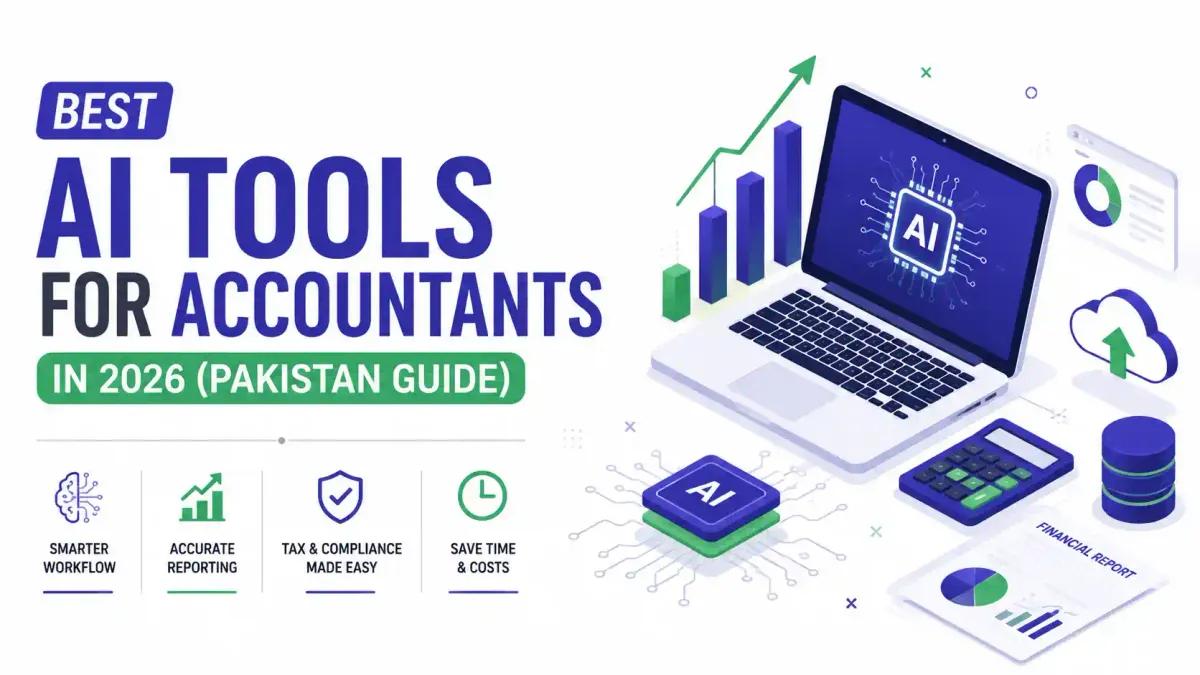
Best AI Tools for Accountants in 2026 (Pakistan Guide)
Quick Answer
The best AI tools for accountants in 2026 combine AI-powered bookkeeping (QuickBooks, Xero, Zoho Books), invoice and receipt automation (Dext, Vic.ai, BILL), close-management platforms (FloQast, BlackLine), and generative AI assistants (Microsoft Copilot, ChatGPT, Claude) to automate reconciliation, invoice processing, financial analysis, and reporting — reducing manual work by up to 70% while improving accuracy.
Introduction
Accounting is going through its biggest transformation since the shift from paper ledgers to spreadsheets. Artificial intelligence now handles data entry, invoice matching, bank reconciliation, and even first-draft financial analysis — tasks that used to consume most of an accountant's week. For professionals and students in Pakistan preparing for careers in finance, tax, or corporate advisory, understanding these tools is no longer optional. Institutions like the Institute of Corporate and Taxation (ICT) are already integrating AI literacy into practical training, alongside programs like the Certified AI Automation course and the AI-Driven CFO Masterclass, because employers increasingly expect accountants to work alongside AI, not around it. This guide breaks down the best AI tools for accountants in 2026, how they work, what they cost, and how Pakistani finance professionals can use them to stay competitive.
What Are AI Tools for Accountants
AI tools for accountants are software applications that use machine learning, natural language processing (NLP), and optical character recognition (OCR) to automate financial tasks such as bookkeeping, invoice processing, bank reconciliation, tax preparation, and financial forecasting. Instead of manually entering data, accountants review and approve AI-generated outputs, saving significant time on repetitive work.
These tools generally fall into two groups:
- Embedded AI — AI features built directly into accounting software (QuickBooks, Xero, Zoho Books)
- Standalone AI platforms — specialist tools that plug into existing accounting systems (Vic.ai, Dext, Botkeeper, FloQast)
Why Accountants Are Adopting AI in 2026
Firms are adopting AI because manual bookkeeping and data entry are the two biggest sources of error and wasted billable time in accounting. AI-powered bookkeeping reduces manual accounting work, improves financial accuracy, and frees staff for higher-value advisory work — a shift accounting bodies like IFAC and ACCA have both flagged as central to the profession's future.
A few forces are driving this shift:
- Client expectations — businesses want real-time financial visibility, not month-end reports.
- Talent shortages — many firms can't hire enough junior staff, so automation fills the gap.
- Regulatory pressure — digital tax systems (like FBR's IRIS platform in Pakistan) push firms toward digital-first workflows. See our guide on the FBR IRIS 2.0 tax survival guide.
- Cost pressure — automation lowers the cost-per-transaction for bookkeeping and compliance work.
How AI Accounting Tools Work
Most AI accounting tools rely on a combination of technologies:
- OCR (Optical Character Recognition) — extracts data from scanned invoices and receipts.
- Machine Learning — learns from historical entries to categorize expenses and flag anomalies.
- NLP — powers chat-based assistants that can answer questions about financial data in plain English.
- Predictive Analytics — forecasts cash flow, revenue, and budget variances.
- RPA (Robotic Process Automation) — automates repetitive multi-step workflows like invoice-to-payment.
In practice, a typical AI-assisted invoice workflow looks like this: a vendor invoice arrives by email → OCR extracts the vendor, amount, and line items → the AI matches it against a purchase order → it's routed for approval → once approved, it posts automatically to the general ledger.
Categories of AI Tools for Accountants
| Category | Purpose | Examples |
|---|---|---|
| Cloud Accounting Platforms with AI | Core bookkeeping, invoicing, reporting | QuickBooks, Xero, Zoho Books, FreshBooks |
| AI Invoice & AP Automation | Accounts payable, receipt scanning | Vic.ai, Dext, BILL, Expensify |
| Close & Reconciliation Automation | Month-end close, bank reconciliation | FloQast, BlackLine, Trullion |
| Bookkeeping-as-a-Service (AI-powered) | Outsourced bookkeeping with AI review | Botkeeper, Puzzle, Numeric |
| Enterprise ERP with AI | Large-company finance operations | Oracle NetSuite, SAP S/4HANA, Microsoft Dynamics 365 |
| Generative AI Assistants | Analysis, drafting, research | ChatGPT, Microsoft Copilot, Google Gemini, Claude, Perplexity AI |
| Workflow Automation | Connecting apps and processes | Zapier, Make, UiPath, Microsoft Power Automate |
Best AI Tools for Accountants (Detailed Reviews)
1. QuickBooks (with QuickBooks AI)
QuickBooks remains the most widely used small-business accounting platform globally, and its AI features now include automated transaction categorization, cash flow forecasting, and anomaly detection. It's a strong fit for freelancers, small firms, and SMEs.
2. Xero
Xero's AI-powered bank reconciliation and "Just Ask Xero" assistant let users query their financials in natural language. It's particularly popular with firms serving Australian, UK, and international clients — relevant for professionals building Australian Accounting or UK Accountant skillsets.
3. Zoho Books
Zoho Books offers AI-assisted invoice matching and expense categorization at a lower price point, making it a favorite among startups and small businesses in Pakistan and the wider region.
4. Vic.ai
Vic.ai is built specifically for accounts payable automation, using AI to autonomously code and approve invoices as it learns from historical approval patterns — reducing invoice processing time dramatically for mid-size and enterprise finance teams.
5. Dext
Dext specializes in receipt and invoice data extraction, converting paper and PDF documents into clean, categorized accounting entries. It integrates directly with QuickBooks, Xero, and Sage.
6. Botkeeper
Botkeeper combines AI with human bookkeeper oversight, offering "bookkeeping-as-a-service" for accounting firms that want to scale client work without proportionally scaling headcount.
7. FloQast
FloQast automates the month-end close checklist, reconciliations, and variance analysis — widely used by corporate accounting teams and increasingly relevant for firms managing multiple client close cycles.
8. BlackLine
BlackLine is an enterprise-grade financial close and reconciliation platform used by large corporations to automate account reconciliations, journal entries, and compliance controls.
9. Microsoft Copilot, ChatGPT, Google Gemini, and Claude
These generative AI assistants are increasingly used by accountants for financial analysis narratives, drafting client communications, summarizing financial statements, and researching tax regulations. They don't replace accounting software but significantly speed up analysis and reporting tasks — a trend explored further in our article on AI in taxation tools, risks, and opportunities.
10. BILL and Expensify
Both platforms automate accounts payable and expense management with AI-based receipt scanning, approval routing, and payment processing, popular among SMEs and mid-market firms.

Comparison Table
| Tool | Best For | Key AI Feature | Pricing Model |
|---|---|---|---|
| QuickBooks | Small businesses, freelancers | Auto-categorization, forecasting | Subscription tiers |
| Xero | SMEs, international firms | Natural-language financial queries | Subscription tiers |
| Zoho Books | Startups, budget-conscious firms | Invoice automation | Subscription tiers |
| Vic.ai | Mid-size to enterprise AP | Autonomous invoice coding | Custom/enterprise |
| Dext | Receipt & document capture | OCR extraction | Subscription tiers |
| Botkeeper | Outsourced bookkeeping firms | AI + human hybrid bookkeeping | Custom pricing |
| FloQast | Corporate close management | Close checklist automation | Custom/enterprise |
| BlackLine | Large enterprises | Reconciliation automation | Custom/enterprise |
| Microsoft Copilot / ChatGPT / Gemini / Claude | Analysis & drafting | Generative reasoning, NLP | Free/subscription tiers |
Note: Exact pricing changes frequently — always confirm current rates directly on each vendor's website before purchasing.
Benefits of AI Tools for Accountants
- Time savings — automates repetitive data entry and reconciliation.
- Improved accuracy — reduces human error in invoice matching and categorization.
- Faster month-end close — automated checklists and variance flagging.
- Real-time insights — dashboards and forecasting replace static monthly reports.
- Scalability — firms can serve more clients without proportional headcount growth.
- Better audit trails — AI systems log every transaction and approval automatically.
Disadvantages and Risks
- Data privacy concerns — sensitive financial data processed by third-party AI systems.
- Upfront learning curve — staff need training to use AI tools effectively.
- Over-reliance risk — AI errors can go unnoticed without human review.
- Integration challenges — not all AI tools connect smoothly with legacy systems.
- Cost for smaller firms — enterprise-grade AI platforms can be expensive for solo practitioners.
Important Note: AI tools should always be treated as a co-pilot, not an autopilot. Final review by a qualified accountant remains essential, especially for tax filings and statutory reporting.
AI Tools for CPA and Chartered Accountant Firms
CPA and chartered accountant firms are adopting AI primarily for accounts payable automation, close management, and audit support, using tools like Vic.ai, BlackLine, FloQast, and Trullion to handle high transaction volumes across multiple clients. Standards bodies like the AICPA, ACCA, ICAEW, and ICAP have all published guidance encouraging members to build AI literacy, since audit and assurance standards (ISA, COSO) increasingly expect firms to document how AI-assisted controls are reviewed. For students pursuing these designations, building practical AI fluency alongside technical training — such as through the Certified Tax Advisor program — offers a real competitive edge.
AI in Tax Filing and Compliance
AI is increasingly used in tax filing to auto-populate returns from financial data, flag inconsistencies before submission, and monitor regulatory changes — but licensed tax professionals still review and file returns to ensure compliance with local law. In Pakistan, FBR's digital invoicing and IRIS system are pushing tax practice toward AI-assisted workflows; our guides on manual vs AI-assisted tax filing and FBR's digital invoicing system 2026 cover this shift in detail. For professionals targeting international tax careers, similar AI-assisted trends are emerging in the UK, US, UAE, and Saudi tax systems — see our UK Taxation, USA Taxation, and UAE Taxation courses.
How to Choose the Right AI Accounting Tool
Consider these factors before selecting a tool:
- Business size — freelancers need lightweight tools (Zoho Books); enterprises need robust platforms (NetSuite, SAP).
- Integration — does it connect with your existing bank feeds and software stack?
- Data security — check encryption standards and compliance certifications.
- Learning curve — how quickly can your team adopt it?
- Support for local tax rules — especially important for Pakistani businesses filing with FBR.
- Scalability — will the tool grow with your firm or business?
Cost of AI Accounting Software
Most AI accounting tools follow a tiered subscription model, ranging from free or low-cost plans for freelancers to custom enterprise pricing for large firms with high transaction volumes. Specialist AI platforms like Vic.ai, BlackLine, and FloQast typically require a custom quote based on transaction volume and company size, while generative AI assistants like ChatGPT and Claude offer free tiers alongside paid subscription plans for advanced features.
Will AI Replace Accountants? Career Scope in Pakistan
AI will not replace accountants, but it will replace repetitive manual tasks like data entry, invoice matching, and basic reconciliation — shifting the profession toward analysis, advisory, and compliance judgment that AI cannot replicate. This is a topic we've explored in depth in Will AI Replace Tax Consultants? and Human vs AI Tax Advisory: 2026 Comparison.
For students and professionals in Pakistan — whether pursuing CA, ACCA, CMA, B.Com, or MBA paths — the career opportunity lies in combining AI fluency with strong technical accounting and tax knowledge. Roles growing in demand include AI-assisted bookkeeper, digital tax consultant, financial data analyst, and AI-enabled CFO advisory roles. Related career-building resources include the Certified Data Analyst course and our guide on new tax careers in 2026: digital compliance roles.
Future Trends in AI Accounting
- Autonomous bookkeeping — AI handling full-cycle bookkeeping with minimal human input.
- AI agents — multi-step AI "agents" that complete entire workflows, not just single tasks.
- Predictive tax compliance — AI flagging compliance risks before filing deadlines.
- Deeper ERP integration — AI copilots embedded directly into SAP S/4HANA and Dynamics 365.
- Regulatory AI standards — accounting bodies developing formal guidance on AI use in audits.
Common Mistakes When Adopting AI Tools
- Deploying AI tools without training staff properly.
- Skipping human review of AI-generated entries.
- Choosing enterprise tools that are overkill for a small firm's needs.
- Ignoring data security and client confidentiality requirements.
- Failing to reconcile AI outputs with statutory reporting standards (IFRS, GAAP).
Expert Tips and Best Practices
- Start with one workflow (e.g., invoice processing) before automating your entire accounting stack.
- Always keep a human-in-the-loop for tax filings and financial statement sign-off.
- Combine embedded AI (QuickBooks, Xero) with a generative AI assistant (ChatGPT, Claude) for both transaction processing and analysis.
- Document your AI-assisted workflows for audit trail purposes — this matters increasingly for ISA and COSO-aligned firms.
- Continuously upskill — pairing practical automation training, like the Certified AI Automation program, with core accounting and tax expertise builds long-term career resilience.
FAQs
1. What is the best AI tool for small business accounting?
QuickBooks and Zoho Books are among the best AI tools for small businesses, offering automated categorization, invoicing, and basic forecasting at an affordable price point.
2. Can AI completely replace an accountant?
No. AI automates repetitive tasks like data entry and reconciliation, but professional judgment, compliance decisions, and client advisory work still require a qualified accountant.
3. Are AI accounting tools safe for sensitive financial data?
Reputable AI accounting platforms use encryption and compliance certifications, but firms should always review a vendor's data security policy before uploading sensitive client information.
4. Which AI tool is best for accounts payable automation?
Vic.ai and Dext are widely regarded as leading AI tools for accounts payable automation, handling invoice extraction, coding, and approval routing.
5. Do Pakistani accountants need to learn AI tools?
Yes. As FBR digitizes tax filing and firms adopt cloud accounting, AI fluency is becoming a core skill for accountants, tax consultants, and finance professionals in Pakistan.
6. Is ChatGPT useful for accounting work?
ChatGPT and similar generative AI tools are useful for drafting reports, summarizing financial data, and researching regulations, but they should not be used to file official tax returns without professional review.
7. How much do AI accounting tools cost?
Costs range from free or low-cost plans for freelancers to custom enterprise pricing for large firms — always check current pricing directly with the vendor.
8. What skills should I learn alongside AI tools?
Core accounting, tax compliance, and financial analysis skills remain essential; AI tools are most valuable when paired with strong technical knowledge, such as that offered through certified tax and accounting training programs.
Conclusion
AI is reshaping accounting from the ground up — automating bookkeeping, invoice processing, reconciliation, and even first-pass financial analysis. Tools like QuickBooks, Xero, Zoho Books, Vic.ai, Dext, Botkeeper, and generative AI assistants like ChatGPT, Gemini, and Claude are now standard parts of a modern accountant's toolkit. But the accountants who thrive in this shift won't be the ones who avoid AI — they'll be the ones who combine it with strong technical and compliance expertise. For Pakistani students and professionals, building that combined skill set now, through practical training in tax, accounting, and AI automation, is the clearest path to staying ahead in a rapidly changing profession. Explore the Institute of Corporate and Taxation (ICT) course catalog to start building these skills today.
Comments (0)
No comments yet. Start the conversation!
Leave a Reply
Your email address will not be published. Required fields are marked *