
UAE Corporate Tax Exemptions 2026: Complete Guide
Introduction
UAE corporate tax applies to most businesses, but not to everyone. Some entities are exempt because of their public role, their ownership or the type of work they do. Others pay a 0% rate on certain income. These two situations are often confused, and the confusion leads to costly compliance mistakes.
Before looking at exemptions, it helps to understand the basic tax they sit against, so this guide starts with what UAE corporate tax is and who it covers.
This matters more in 2026 than before. The Federal Tax Authority (FTA) issued Decision No. 15 of 2026 on 8 September 2026, and it took effect on 15 September 2026. It replaced the earlier exemption procedures. If you run, advise or invest in a UAE entity, you need to know which rules now apply.
This guide explains who is exempt, how each exemption works, how to apply, which deadlines matter and which mistakes to avoid. It also covers exempt income, such as the participation exemption, and relief that is often mistaken for exemption. You can read it alongside our guide to the UAE corporate tax registration process.
Quick Answer: Who Is Exempt from UAE Corporate Tax?
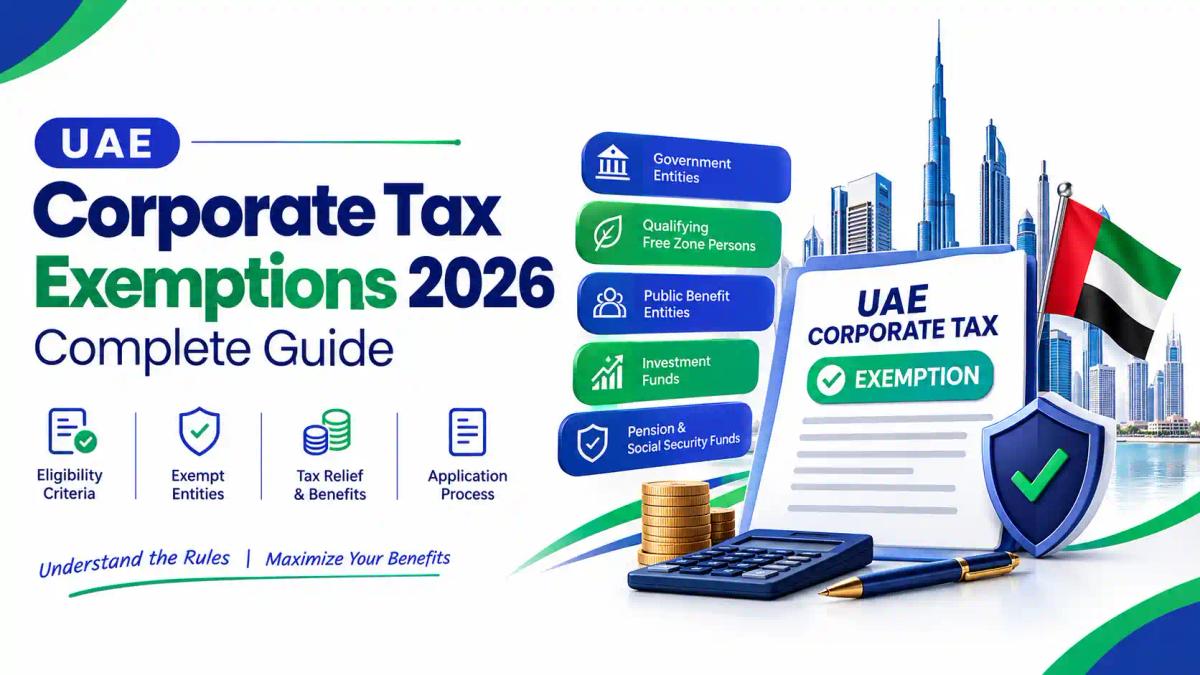
UAE corporate tax exemptions apply to specific “Exempt Persons” under Federal Decree-Law No. 47 of 2022. These include government entities, qualifying public benefit entities, qualifying investment funds, pension funds and certain wholly owned subsidiaries. Some are automatic; others need registration and FTA approval. Exemption is different from the 0% rate for Qualifying Free Zone Persons.
Key points:
- Exemption removes an entity from corporate tax. The 0% rate only applies to qualifying income.
- Some categories are automatic, some need notification or listing, and some need FTA approval.
- FTA Decision No. 15 of 2026 now governs the application process.
- Several deadlines fall on 31 October and 31 December 2026.
- Exempt status does not remove every compliance duty.
What Is UAE Corporate Tax?
UAE corporate tax is a federal tax on the profits of companies and certain other businesses in the United Arab Emirates. It was introduced by Federal Decree-Law No. 47 of 2022 and took effect on 1 June 2023. The standard rate is 9% on taxable profits above AED 375,000. Taxable persons must register and file returns.
When did UAE corporate tax start?
The UAE issued the Corporate Tax Law on 9 December 2022, creating the legal framework for a federal corporate tax. The law came into effect on 1 June 2023. Because the tax follows each business’s financial year, the first tax periods began on different dates for different companies.
What is the corporate tax rate in the UAE?
The standard rate is 9% on business profits above AED 375,000. The tax is charged on taxable income, not on revenue. Taxable income starts from accounting profit and is then adjusted under the Corporate Tax Law. Read it together with the exemptions below, because an exempt person is outside this charge altogether.
Who has to pay UAE corporate tax?
The tax applies to “Taxable Persons”. These include UAE companies and other juridical persons, free zone companies and foreign entities with a taxable presence in the UAE. Natural persons are also covered if they conduct a business or business activity as specified in a Cabinet Decision. A salaried employee is not taxed under this law on salary alone. Your legal form does not decide the position. What matters is whether you are a taxable person, an exempt person or a qualifying free zone person.
How does UAE corporate tax work in practice?
Taxable persons, including free zone persons, must register for corporate tax and obtain a registration number. The tax is then calculated and paid through a return filed with the Federal Tax Authority (FTA). For a company with a 31 December year end, the return for the period ending 31 December 2025 was due on 30 September 2026, nine months after the period end. If you are setting up your registration, our step-by-step guide to how corporate tax registration works in the UAE is the best place to start.
How is corporate tax different from VAT?
Corporate tax is charged on profits. VAT is a consumption tax charged on supplies of goods and services. A business can be affected by both at the same time, and the registration rules for each are separate. Our guide to UAE VAT registration in 2026 explains the VAT side.
How does it compare with Pakistan’s tax system?
Pakistani readers often compare the two. The UAE system is built around one federal corporate tax with defined exemptions and reliefs. Pakistan applies a layered system of income tax, sales tax and withholding taxes. For a clear picture of the home regime, read our overview of the Pakistan tax system in 2026.
What Are UAE Corporate Tax Exemptions?
A UAE corporate tax exemption means a person is treated as an “Exempt Person” and is outside the corporate tax charge. It is different from a relief, a deduction or a low tax rate. The legal basis is Federal Decree-Law No. 47 of 2022, which you can read in the official text on the Ministry of Finance website.
What is the standard rule for everyone else?
The standard rate is 9% on business profits above AED 375,000. Exempt Persons sit outside this rule. Taxable businesses must register, keep proper records and file returns. If you are new to the filing side, our UAE VAT registration guide shows how the UAE’s two main business taxes differ in practice.
What is the difference between an exempt person and a Qualifying Free Zone Person?
An Exempt Person is not subject to corporate tax at all. A Qualifying Free Zone Person (QFZP) is still a taxable person. It pays 0% only on qualifying income, as long as it meets the free zone conditions. A free zone licence alone does not make a company exempt. If you are comparing structures, our corporate tax planning guide explains why classification comes before planning.
Who Is Exempt from UAE Corporate Tax in 2026?
The Ministry of Finance groups exempt persons by how the exemption is obtained. Government Entities are automatically exempt. Government Controlled Entities are exempt if they are specified in a Cabinet Decision. Extractive and non-extractive natural resource businesses are exempt if they notify the Ministry. Qualifying Public Benefit Entities are exempt if listed in a Cabinet Decision. A further group must apply to, and be approved by, the FTA.
| Category | How exemption is obtained |
|---|---|
| Government Entities | Automatic |
| Government Controlled Entities | Only if specified in a Cabinet Decision |
| Extractive Businesses | Notification to the Ministry of Finance, subject to conditions |
| Non-Extractive Natural Resource Businesses | Notification to the Ministry of Finance, subject to conditions |
| Qualifying Public Benefit Entities | Listed in a Cabinet Decision |
| Qualifying Investment Funds | Registration, then FTA application, subject to conditions |
| Pension and social security funds | Check the conditions and FTA procedure for the specific fund |
| Wholly owned and controlled subsidiaries | Registration, then FTA application, subject to conditions |
| Other persons named by Cabinet Decision | Depends on the decision |
Are government entities and government-controlled entities exempt?
Government Entities are automatically exempt. Government Controlled Entities are different. They are exempt only where a Cabinet Decision specifies them, so ownership by government alone is not enough.
Are extractive and natural resource businesses exempt?
They can be, but only if they meet the legal conditions and notify the Ministry of Finance. A business that does both extractive and other activities needs careful analysis. The exemption may not cover the other activities.
Are charities and public benefit entities exempt?
A charity is not exempt just because of its purpose. A Qualifying Public Benefit Entity must be listed in a Cabinet Decision. Cabinet Decision No. 37 of 2023 is the decision covering these entities.
Are investment funds and pension funds exempt?
Qualifying Investment Funds can be exempt if they meet the conditions in the law and related decisions. Cabinet Decision No. 81 of 2023 and Cabinet Decision No. 34 of 2025 cover Qualifying Investment Funds and Qualifying Limited Partnerships. Pension and social security funds also have their own conditions. Confirm the exact test for your fund before you rely on it.
Can a foreign-owned entity qualify?
Sometimes, yes. Cabinet Decision No. 55 of 2025 extended exemption to certain juridical persons incorporated outside the UAE, with retrospective effect from 1 June 2023. These are foreign entities wholly owned by exempt persons, such as government entities, qualifying investment funds and public pension or social security funds. Ownership and control are the key facts to document.
Are sports entities exempt?
Some are. In January 2026, Cabinet Decision No. 1 of 2026 granted a corporate tax exemption to certain sports entities that support the development, promotion and governance of sport. Check the decision’s conditions before assuming your organisation qualifies.
What Changed in 2026?
Four developments matter most for 2026.
What does FTA Decision No. 15 of 2026 change?
It sets the registration and application process for exemption. It applies to tax periods starting on or after 1 June 2023, where applications are submitted on or after 15 September 2026. It also repealed FTA Decision No. 7 of 2023. You can find it in the FTA’s legislation section, which lists it as published on 15 September 2026. The English version of the decision is marked as an unofficial translation, so check key wording with the FTA.
Has Small Business Relief changed?
Yes. Small Business Relief used to end for tax periods finishing after 31 December 2026. Ministerial Decision No. 131 of 2026 has extended it to tax periods ending on or before 31 December 2029. The AED 3 million revenue test still applies. Relief is not exemption. It is an election available to eligible resident businesses, so treat it separately.
What about Top-up Tax for multinational groups?
Large multinational groups may face the UAE’s Top-up Tax, which implements the OECD’s global minimum tax. Exempt status for one entity does not settle a group’s position. Group-level analysis is a specialist job, and our cross-border tax compliance guide gives useful background.
How Have the UAE Corporate Tax Exemption Rules Developed Since 2023?
The exemption framework has grown in stages. This timeline shows the main legal steps. For wider context, see our guide to UAE tax law and training and our overview of global tax trends and their impact on business.
- 1 June 2023: The Corporate Tax Law came into effect, and Article 4 listed the categories of exempt persons.
- May 2025: The Ministry of Finance announced Cabinet Decision No. 55 of 2025 on exempting certain persons from corporate tax. It applies retrospectively from 1 June 2023.
- January 2026: Cabinet Decision No. 1 of 2026 granted an exemption to certain sports entities.
- 8 September 2026: FTA Decision No. 15 of 2026 was issued. It took effect on 15 September 2026 and replaced the earlier exemption procedures.
- 2026: Ministerial Decision No. 131 of 2026 extended Small Business Relief to tax periods ending on or before 31 December 2029.
- 31 October and 31 December 2026: Specific application deadlines apply to certain entities, as shown in the deadlines table above.
How Do You Apply for UAE Corporate Tax Exemption?
The process has two stages: register first, then apply. Under Article 2 of Decision No. 15, persons in paragraphs (e) to (i) of Article 4(1) of the Corporate Tax Law must first register for corporate tax. Once registration is approved, entities in paragraphs (f), (g), (h) and (i) can apply for exemption if they meet all legal conditions.
What are the steps?
- Identify your exact category under Article 4(1).
- Check the conditions for that category in the law and implementing decisions.
- Register for corporate tax, where Decision No. 15 requires it.
- Collect evidence of ownership, control, activities and constitutional documents.
- Submit the exemption application within the correct deadline.
- Keep records and respond to any FTA request for further information.
If you are still setting up registration, start with our guide to corporate tax registration in the UAE.

What are the deadlines?
The general rule is to apply after the end of the tax period in which you met the conditions, and no later than 90 Business Days after that period ends. Special deadlines apply in some cases.
| Situation | Deadline |
|---|---|
| General rule | Within 90 Business Days after the end of the tax period |
| Entities covered retrospectively by Cabinet Decision No. 55 of 2025 | 31 December 2026 |
| Certain juridical persons under Article 5 of Cabinet Decision No. 34 of 2025, for periods beginning in 2025 and ending on or before 31 August 2026 | 31 December 2026 |
| Certain subsidiaries of government-type owners, for tax periods ended before 1 January 2026 | 31 October 2026 |
Where a subsidiary applies because its parent has applied, the FTA holds the subsidiary’s decision until the parent’s application is approved. At the time of writing, the 31 October 2026 deadline is only days away, so affected entities should act now.
When does the exemption take effect?
Once approved, the exemption generally takes effect from the start of the tax period stated in the application. The FTA can adjust the effective date in some circumstances, such as an incorrect tax period on the registration form.
What Is the Difference Between Exemption, 0% Tax and Relief?
| Concept | What it means | Example |
|---|---|---|
| Exempt Person | Outside corporate tax | Qualifying Investment Fund |
| 0% rate | Taxable, but 0% on qualifying income | Qualifying Free Zone Person |
| Small Business Relief | Election to treat taxable income as nil | Small resident business within the revenue limit |
| Exempt income | Specific income excluded for a taxable person | Qualifying dividends |
Using the wrong label is a common error. A QFZP is not an Exempt Person. A business using Small Business Relief has not become exempt. For the wider picture, our article on corporate tax versus income tax explains how different taxes interact.
How is a tax exemption different from a tax deduction or tax credit?
An exemption removes a person, or a specific type of income, from the tax charge. A deduction reduces the amount of income that is taxed. A credit reduces the tax payable after it has been calculated. Mixing these up leads to wrong tax computations. Our explainer on tax credits versus tax deductions covers the basic difference, and our corporate law and taxation guide shows how legal structure affects tax outcomes.
How does the treatment differ for mainland and free zone companies?
A mainland business is taxed at 9% on profits above AED 375,000, unless it falls within an exempt category. A free zone company is not exempt just because of its location. A Qualifying Free Zone Person pays 0% on qualifying income only if it meets the free zone conditions. Income that does not qualify can still be taxed. Always confirm the current conditions before assuming 0% applies.
What Is Exempt Income, and How Does the Participation Exemption Work?
Some income is exempt even when the business is taxable. The participation exemption is the best-known example.
What are the participation exemption conditions?
Article 23 requires at least 5% ownership, or an acquisition cost of AED 4 million, held for an uninterrupted period of twelve months. The participation must also be subject to corporate tax at 9% or more, and no more than 50% of its assets may consist of interests that would not qualify for the exemption. There is also an economic entitlement condition, so check all five conditions before relying on it. All must be met.
Can you claim it before holding the interest for 12 months?
The law allows the holding period test to be met by intention to hold for 12 months. If you then sell early, previously exempted income can be brought back into taxable income. Document your intention at the time of acquisition.
What about foreign permanent establishments?
A UAE resident business can elect to exclude income and expenditure of qualifying foreign permanent establishments. This is an election, not an automatic result, and it has its own conditions.
Do Exempt Persons Still Have Compliance Obligations?
Yes, in many cases. Exempt does not mean invisible.
- An exempt entity must be able to give the FTA any information or documents it requests to verify that it meets the exemption criteria.
- Registration is required for several categories under Decision No. 15.
- The FTA may also ask certain Exempt Persons to register for corporate tax.
- Whether a return is needed depends on your category and current FTA guidance, so confirm this rather than assuming none is needed.
- Records should support ownership, control, activities and conditions for every period you claim.
If your entity has both exempt and taxable activities, take extra care. The exemption may not cover everything the entity does.
What Happens If Exemption Conditions Stop Being Met?
The safest assumption is that the exemption may no longer apply from the period in which the conditions fail. The Ministry of Finance has issued rules for some cases where conditions are not met, and special treatment applies where a business stops meeting them mainly to gain a tax advantage. Check the current decisions before deciding what to do.
Practical steps:
- Review the conditions at the end of every tax period.
- Tell your adviser early if ownership, activities or constitutional documents change.
- Correct any wrong classification promptly, with advice.
What Are the Most Common Mistakes?
- Treating a free zone licence as proof of exemption.
- Assuming government ownership means automatic exemption for every subsidiary.
- Missing the registration step before applying.
- Missing the 90 Business Day, 31 October or 31 December 2026 deadlines.
- Confusing Small Business Relief with exemption.
- Relying on outdated rules from before 15 September 2026.
- Keeping weak evidence of ownership and control.
- Ignoring Top-up Tax questions in group structures.
How Do the Rules Apply in Practice? Three Illustrative Scenarios
These are simple illustrations, not real cases or advice.
A free zone trading company. It holds a free zone licence and believes it is exempt. The right question is whether it is a QFZP, which is a different status with different conditions. Exempt Person status is not the starting point.
A UAE holding company with foreign subsidiaries. It is probably a taxable person. The useful question is whether its dividends and gains meet the participation exemption conditions, such as 5% ownership, 12 months and the subject-to-tax test.
A charity. Its purpose does not decide the outcome. It needs to check whether it is listed as a Qualifying Public Benefit Entity in a Cabinet Decision, then register as required.
What Should Pakistani Investors and Professionals Know?
Many Pakistani entrepreneurs and professionals deal with UAE structures. Remember that UAE exemption status and Pakistani tax residency are separate questions. A UAE exemption does not remove your obligations in Pakistan. Our guides on double taxation relief for Pakistani freelancers and overseas Pakistanis’ tax filing help you think about both sides. For a comparison with the home regime, see corporate tax in Pakistan. Our Saudi corporate tax update is useful if your business also operates elsewhere in the Gulf.
How Can You Review Exemption Eligibility? A Practical Checklist
- Identify the legal entity and its exact Article 4(1) category.
- Check the current conditions, including any Cabinet Decision that names or covers you.
- Confirm whether the exemption is automatic, notified, listed or approval-based.
- Check ownership and control up the chain, including foreign parents.
- Confirm corporate tax registration status and your tax period.
- Note the application deadline for your situation.
- Collect the supporting evidence.
- Separate exempt activities from taxable activities.
- Review the position at each period end.
- Verify everything against the Ministry of Finance and FTA sources before filing. The Ministry of Finance corporate tax page reminds readers to rely only on official publications.
What documents should you prepare for an exemption review?
An exempt entity must be able to give the FTA any information or documents it requests to verify that it meets the exemption criteria. The table below is a practical preparation guide, not an official FTA list. Confirm requirements with the FTA for your category.
| Entity type | Documents that are usually useful |
|---|---|
| Government-owned subsidiary | Ownership chain, constitutional documents, evidence of control, parent’s exemption status or application |
| Qualifying Public Benefit Entity | Proof of listing in the relevant Cabinet Decision, constitutional documents |
| Qualifying Investment Fund | Fund constitutional documents and evidence showing how each condition is met |
| Foreign entity under Cabinet Decision No. 55 of 2025 | Incorporation documents and the ownership and control chain up to the exempt person |
Good record-keeping makes this much easier. Our guide on AI for bookkeeping shows how modern tools can help you keep organised records.
How Can You Build Skills in UAE Corporate Tax?
UAE tax knowledge opens regional career options for Pakistani professionals. Our guides on UAE tax skills in 2026, UAE taxation course career scope, UAE tax law and training and why UAE companies prefer Pakistani tax professionals explain the options. If you plan to work independently, see freelance UAE taxation services. Broader advisory skills are covered in our Certified Tax Advisor and Certified Business Advisor programmes, and corporate structuring knowledge is covered in our Company Secretary course. For the legal side, read how corporate law and taxation work together.
UAE Corporate Tax Exemptions Glossary
- Exempt Person: A person outside the corporate tax charge under Article 4(1) of the Corporate Tax Law.
- Qualifying Free Zone Person (QFZP): A taxable free zone company that pays 0% on qualifying income if it meets the conditions.
- Qualifying Public Benefit Entity (QPBE): A public benefit entity listed in a Cabinet Decision.
- Qualifying Investment Fund (QIF): An investment fund that can be exempt if it meets the legal conditions.
- Participating Interest: An ownership interest of at least 5%, or an acquisition cost of AED 4 million, held for twelve months, subject to the other Article 23 conditions.
- Business Day: Any day other than official federal government holidays and weekends, as used in FTA Decision No. 15 of 2026.
- Small Business Relief: An election for eligible resident businesses within the AED 3 million revenue limit. It is not an exemption.
- Top-up Tax: The UAE’s implementation of the global minimum tax for large multinational groups.
Why Choose ICT for UAE Taxation Training
ICT is an Islamabad-based institute that publishes practical guidance on UAE taxation and runs a dedicated UAE Taxation course. Its blog covers UAE VAT, corporate tax registration and career pathways for Pakistan-based professionals. Our learners can also explore related fields through our Certified Tax Advisor course.
Because UAE rules change quickly, structured training helps you move from reading about exemptions to applying them. Before enrolling, check the current course outline, fees and schedule on the ICT courses page.
FAQs
What is UAE corporate tax?
It is a federal tax on the profits of companies and certain businesses in the UAE, introduced by Federal Decree-Law No. 47 of 2022. The standard rate is 9% on profits above AED 375,000.
Who is exempt from UAE corporate tax in 2026?
Exempt Persons under Article 4(1) of Federal Decree-Law No. 47 of 2022. These include government entities, qualifying public benefit entities, qualifying investment funds and certain subsidiaries. Others can be exempt by Cabinet Decision.
Is a free zone company automatically exempt?
No. It may qualify for 0% on qualifying income as a QFZP, but that is not exemption.
Is 0% tax the same as exemption?
No. A QFZP is still a taxable person. An Exempt Person is outside corporate tax.
Do exempt entities need to register?
Often yes. Decision No. 15 of 2026 requires registration first for several categories.
Which exemptions need FTA approval?
Entities in paragraphs (f), (g), (h) and (i) of Article 4(1) apply to the FTA after registration, if they meet the conditions.
What is the general application deadline?
No later than 90 Business Days after the end of the tax period in which the conditions were met, unless a special deadline applies.
Can a foreign entity be exempt?
Yes, in some cases. Cabinet Decision No. 55 of 2025 covers certain foreign entities wholly owned and controlled by exempt persons.
What is the participation exemption?
It exempts qualifying income from a participating interest, such as dividends and gains, if the Article 23 conditions are met.
Is Small Business Relief an exemption?
No. It is an election for eligible resident businesses, now extended to tax periods ending on or before 31 December 2029.
Where can I find official guidance?
The Ministry of Finance and the FTA are the official sources. Avoid relying on unofficial summaries alone.
Which decision did FTA Decision No. 15 of 2026 replace?
It repealed FTA Decision No. 7 of 2023 from 15 September 2026.
What does “Business Day” mean in the exemption rules?
It means any day other than official federal government holidays and weekends.
Does a Qualifying Public Benefit Entity need to register if it is already listed?
Yes. Decision No. 15 requires persons in paragraphs (e) to (i) of Article 4(1) to register for corporate tax first.
Is the English version of FTA Decision No. 15 of 2026 official?
The English PDF is marked as an unofficial translation, so check the wording with the FTA before relying on a specific sentence.
Conclusion
UAE corporate tax exemptions are specific, category-based and procedure-driven. Start by identifying your exact category, then check whether the exemption is automatic, notified, listed or approval-based. Keep clear evidence, watch the deadlines, and never confuse exemption with the 0% rate or Small Business Relief.
If you want to understand these rules properly and build a career around them, explore ICT’s UAE Taxation course or contact the ICT team to discuss the right programme for you.
Comments (0)
No comments yet. Start the conversation!
Leave a Reply
Your email address will not be published. Required fields are marked *