
AI for Bookkeeping 2026: Complete Guide & Best Tools
Quick Answer
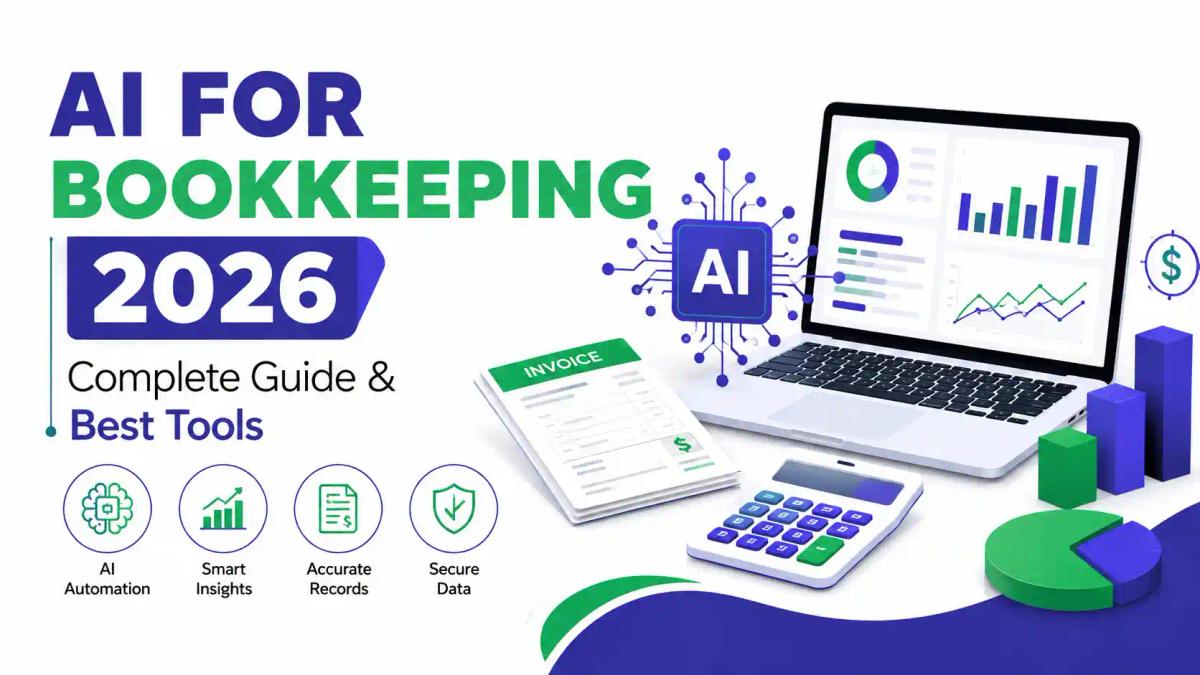
AI for bookkeeping uses machine learning, OCR, and natural language processing to automate transaction categorization, invoice processing, bank reconciliation, and financial reporting. Instead of manually entering every transaction, AI bookkeeping software like QuickBooks Online, Xero, and Zoho Books reads bank feeds, recognizes patterns, and posts entries automatically — cutting manual bookkeeping work by up to 70–80% while improving accuracy and audit readiness.
Introduction
Bookkeeping has quietly gone through one of the biggest transformations in its history. What used to take hours of manual data entry — matching receipts, reconciling bank statements, chasing invoices — is now handled in minutes by AI-powered software. For businesses and finance professionals in Pakistan, understanding AI for bookkeeping is no longer optional; it's becoming a baseline skill, much like understanding tax filing or corporate compliance. If you're a student, accountant, or business owner exploring this shift, the Institute of Corporate and Taxation (ICT) offers practical, industry-relevant training that pairs well with this trend — including the AI-Driven CFO Masterclass, the Certified AI Automation Agents Specialist course, and the Certified Data Analyst program.
This guide breaks down exactly what AI bookkeeping is, how it works, which tools dominate the market, what it costs, and what it means for your career — whether you're a B.Com student, an ACCA candidate, or a business owner trying to cut costs.
Key Takeaways
- AI bookkeeping automates repetitive tasks: data entry, categorization, reconciliation, and invoice processing.
- It doesn't replace accountants — it removes the manual grind so professionals can focus on analysis and advisory work.
- Tools like QuickBooks Online, Xero, Zoho Books, Sage Intacct, and Oracle NetSuite lead the AI bookkeeping software market.
- Businesses in Pakistan and globally are adopting AI bookkeeping to reduce errors, speed up tax preparation, and improve cash flow visibility.
- Accountants who learn AI-powered tools alongside core skills like taxation and Excel remain far more employable than those who don't.
- Understanding both AI tools and regulatory frameworks (FBR, IFRS, GAAP) is becoming a core requirement for finance careers in 2026.
1. What Is AI for Bookkeeping?
AI for bookkeeping refers to the use of artificial intelligence, machine learning, and automation technologies to handle routine accounting tasks — transaction categorization, bank reconciliation, invoice processing, and financial reporting — with minimal human input.
Traditional bookkeeping requires someone to manually record every transaction into a general ledger, match it against bank statements, and file supporting documents. AI bookkeeping software automates this by connecting directly to bank feeds, reading scanned receipts through optical character recognition (OCR), and using pattern recognition to categorize expenses correctly over time.
This isn't a single tool — it's a layer of intelligence built into modern accounting platforms like QuickBooks Online, Xero, Zoho Books, Sage Intacct, and Oracle NetSuite. Rather than replacing double-entry bookkeeping principles, AI applies automation on top of them.
2. How AI Bookkeeping Works
AI bookkeeping software combines several technologies working together in the background:
- Bank feed integration: Transactions flow automatically from your bank account into the accounting software.
- Machine learning categorization: The system learns from past entries to auto-categorize new transactions (e.g., recognizing that a recurring payment to a courier company is a "shipping expense").
- OCR (Optical Character Recognition): Used for AI receipt scanning and AI invoice processing — the software reads a photo of a receipt or invoice and extracts vendor, date, amount, and tax details automatically.
- AI bank reconciliation: The system matches bank transactions with ledger entries and flags mismatches for review.
- Natural language processing (NLP): Powers features like conversational financial reporting, where a user can ask "What were my top five expenses last month?" and get a direct answer.
- Predictive analytics: Forecasts cash flow, flags unusual spending, and detects possible fraud or duplicate entries.
The result is a system that gets more accurate the longer you use it — most platforms improve categorization accuracy significantly after the first 30–60 days of consistent use.
3. Benefits of AI Bookkeeping
| Benefit | Why It Matters |
|---|---|
| Time savings | Reduces manual data entry by 70–80%, freeing staff for analysis work |
| Fewer errors | Removes human transcription mistakes in high-volume transaction entry |
| Real-time visibility | Owners see live cash flow and profit/loss instead of month-end reports |
| Faster reconciliation | AI bank reconciliation matches thousands of transactions in seconds |
| Audit readiness | Automated audit trails make tax season and audits far less stressful |
| Scalability | Growing businesses can handle more transactions without hiring proportionally more staff |
| Better forecasting | Predictive analytics improve cash flow and budgeting decisions |
For small businesses in Pakistan, this often means a business owner can maintain reasonably accurate books without a full-time bookkeeper, though a qualified professional is still essential for review, compliance, and strategic decisions — something covered in depth in ICT's Certified Business Advisor course.
4. Disadvantages and Limitations
AI bookkeeping isn't a complete substitute for professional judgment. Common limitations include:
- Setup and learning curve: Categorization rules need to be trained and corrected initially.
- Data quality dependency: AI is only as good as the transaction data it receives — messy bank feeds produce messy categorization.
- Limited judgment on complex transactions: Intercompany transfers, accruals, and non-standard entries still need human review.
- Compliance nuance: Local tax rules (like FBR requirements in Pakistan) often need manual interpretation that AI tools don't fully automate.
- Security and data privacy concerns: Cloud-based tools require trust in the vendor's data protection standards (SOC 2, ISO 27001 compliance matters here).
This is exactly why finance professionals who combine AI tool fluency with strong fundamentals in taxation and compliance — such as ICT's Certified Tax Advisor course — remain far more valuable than the software alone.
5. Key Features to Look For
When evaluating AI bookkeeping software, prioritize:
- Bank and credit card feed integration
- AI-powered receipt and invoice scanning (OCR)
- Automated transaction categorization with learning capability
- Real-time financial dashboards and reporting
- Multi-currency support (important for import/export businesses — see ICT's Master Import & Export course)
- Payroll integration
- Tax-ready reports aligned with local requirements
- Role-based access and audit trail
- API/integration support with ERP systems like Odoo (see the Odoo ERP Course)

6. Best AI Bookkeeping Software (Comparison)
| Software | Best For | AI Strengths | Starting Price (Approx.) |
|---|---|---|---|
| QuickBooks Online | Small to mid-size businesses | Smart categorization, receipt capture | $30/month |
| Xero | Growing businesses, multi-currency | Bank reconciliation AI, strong app ecosystem | $15/month |
| Zoho Books | Startups, budget-conscious teams | Workflow automation, invoice AI | $15/month |
| Sage Intacct | Mid-size to enterprise | Advanced financial reporting AI | Custom pricing |
| Oracle NetSuite | Large enterprises | Full ERP-level automation | Custom pricing |
| FreshBooks | Freelancers and service businesses | Automated invoicing | $19/month |
| Wave Accounting | Very small businesses | Free-tier automation | Free (paid add-ons) |
| Microsoft Dynamics 365 | Enterprise, complex operations | AI-driven financial insights | Custom pricing |
Pricing varies by region and plan tier; always confirm current rates directly with the vendor.
7. AI Bookkeeping vs Traditional Bookkeeping
| Aspect | Traditional Bookkeeping | AI Bookkeeping |
|---|---|---|
| Data entry | Manual | Automated via bank feeds and OCR |
| Speed | Slow, batch-based | Real-time |
| Error rate | Higher (human transcription) | Lower, but needs periodic review |
| Cost over time | Higher labor cost for volume | Lower per-transaction cost |
| Reporting | Periodic, often delayed | Live dashboards |
| Human role | Data entry + analysis | Review, judgment, and advisory |
8. Step-by-Step: Implementing AI Bookkeeping in Your Business
- Audit your current process — identify where manual entry causes the most delays or errors.
- Choose the right software based on business size, industry, and integration needs.
- Connect bank feeds and payment gateways securely.
- Import historical data and let the system begin learning categorization patterns.
- Set up chart of accounts aligned with IFRS/GAAP or local reporting standards.
- Train the AI by correcting miscategorized transactions in the first few weeks.
- Set up approval workflows for accounts payable and receivable.
- Review reports weekly rather than only at month-end.
- Reconcile and audit periodically — AI reduces manual work but doesn't remove the need for professional review.
9. Cost of AI Bookkeeping Software
Costs typically range from free (Wave, for very basic needs) to $15–$60/month for small business plans (Xero, QuickBooks, Zoho Books), scaling up to custom enterprise pricing for Oracle NetSuite or SAP Business One. Most vendors price by feature tier and number of users rather than by AI capability specifically, so it's worth comparing what's included at each tier before committing.
10. Will AI Replace Bookkeepers? Career Scope in Pakistan
Short answer: No — but it is changing what bookkeepers and accountants do day-to-day. AI removes repetitive data entry, not judgment, compliance interpretation, or advisory work. Professionals who adapt by learning AI tools alongside core accounting and tax skills are becoming more valuable, not less.
This mirrors what's happening in the broader tax and accounting profession — a trend covered extensively in ICT's blog on will AI replace tax consultants and human vs AI tax advisory. For students and professionals in Pakistan, the practical move is to pair AI tool literacy with strong fundamentals — accounting, Excel, and taxation — through programs like ICT's Master Advanced Excel course and UK Accountant Course, which includes Xero training directly relevant to AI bookkeeping platforms.
Career paths that combine AI bookkeeping fluency with domain expertise include:
- AI-assisted bookkeeper/accountant
- Financial data analyst
- Tax consultant with automation skills
- Corporate finance/CFO-track professional
- ERP implementation specialist (Odoo, NetSuite)
11. AI Bookkeeping and Tax Compliance in Pakistan
AI bookkeeping tools help businesses stay tax-ready by generating clean, categorized financial records that are easier to reconcile against FBR requirements. However, they don't replace the need to understand Pakistan's specific tax filing processes, IRIS portal requirements, or sales tax registration steps. For a deeper understanding of how automation intersects with local compliance, see ICT's guides on the FBR digital invoicing system, digital tax audits and AI at FBR, and the Master Sales Tax course.
Businesses that want end-to-end compliance readiness typically combine AI bookkeeping software with professional tax guidance — clean books make tax preparation faster, but interpretation of tax law still requires a trained consultant.
12. Common Mistakes to Avoid
- Trusting AI categorization blindly without periodic review.
- Skipping staff training, leading to inconsistent data entry that confuses the AI's learning.
- Ignoring data security settings — always verify SOC 2 or ISO 27001 compliance for cloud tools.
- Using AI bookkeeping as a replacement for a qualified accountant, rather than a support tool.
- Not reconciling historical data before going live, which causes ongoing miscategorization.
13. Expert Tips and Best Practices
- Start with one core process (e.g., invoice processing) before automating everything at once.
- Review AI-categorized transactions weekly for the first two months — accuracy compounds fast after that.
- Use role-based permissions to keep an audit trail, especially important for accounts payable approval.
- Pair AI bookkeeping software with a real understanding of financial statements — a balance sheet still needs a human to interpret it strategically.
- If you're a freelancer offering bookkeeping or tax services, learning both AI tools and regulatory frameworks gives you a strong competitive edge — something explored in ICT's blog on AI tools every freelance tax consultant will use in 2026.
14. Future Trends in AI Bookkeeping
- Generative AI-powered financial narratives: Software that writes plain-language summaries of financial performance.
- Deeper ERP integration: Bookkeeping AI merging further with platforms like Odoo and NetSuite for end-to-end automation.
- Predictive cash flow modeling becoming standard, not a premium feature.
- Stronger regulatory alignment: Tools increasingly built to align with local tax authority requirements, including FBR's digital invoicing push in Pakistan.
- AI-assisted advisory: Software surfacing recommendations (e.g., "your expenses in this category rose 30% — review vendor contracts") rather than just recording data.
Why Choose ICT for Learning AI-Powered Bookkeeping?
At the Institute of Corporate and Taxation (ICT), we help students, accountants, finance professionals, and business owners stay ahead in the rapidly evolving world of accounting technology. As AI transforms modern bookkeeping, ICT provides industry-focused training, practical insights, and up-to-date guidance on AI-powered bookkeeping tools, cloud accounting, financial automation, and digital accounting workflows. Whether you're looking to improve bookkeeping accuracy, automate repetitive tasks, or understand how AI is reshaping the accounting profession, ICT equips you with the knowledge and practical skills needed to succeed in 2026 and beyond.
FAQs
1. What is AI bookkeeping in simple terms?
AI bookkeeping is the use of software that automatically records, categorizes, and reconciles financial transactions using machine learning and automation, reducing manual data entry.
2. Is AI bookkeeping accurate?
It's generally very accurate for routine transactions once trained, but complex or unusual entries still need human review to ensure correctness.
3. What is the best AI bookkeeping software for small businesses?
QuickBooks Online, Xero, and Zoho Books are among the most popular choices for small businesses due to their automation features and affordability.
4. Will AI replace bookkeepers and accountants?
No. AI automates repetitive tasks but doesn't replace judgment, compliance interpretation, or advisory skills that trained professionals provide.
5. How much does AI bookkeeping software cost?
Plans typically range from free basic tiers to $15–$60/month for small business software, with custom pricing for enterprise-grade systems like Oracle NetSuite.
6. Is AI bookkeeping safe for financial data?
Reputable platforms use encryption and comply with standards like SOC 2 and ISO 27001, but businesses should always verify a vendor's security certifications before adopting.
7. Can AI bookkeeping help with tax filing in Pakistan?
It helps by keeping clean, organized records, but doesn't replace the need to understand FBR filing requirements — pairing it with proper tax training is recommended.
8. Do I still need an accountant if I use AI bookkeeping software?
Yes. AI handles data entry and categorization, but strategic decisions, compliance, and financial interpretation still require a qualified accountant or advisor.
Conclusion
AI for bookkeeping has moved from a nice-to-have to a practical necessity for businesses that want accurate, real-time financial visibility without drowning in manual data entry. Tools like QuickBooks Online, Xero, and Zoho Books now handle the repetitive work — but the real value still comes from professionals who understand both the technology and the compliance landscape it operates in.
If you're a student, accountant, or business owner in Pakistan looking to build genuinely future-proof finance skills, combining AI tool fluency with strong fundamentals in taxation, Excel, and corporate compliance is the smartest long-term move. Explore ICT's AI-Driven CFO Masterclass, Certified Data Analyst program, or Certified Tax Advisor course to get started.
Book a seat at ICT and take the next step toward becoming a finance professional who works smarter with AI, not one replaced by it.
Comments (0)
No comments yet. Start the conversation!
Leave a Reply
Your email address will not be published. Required fields are marked *