
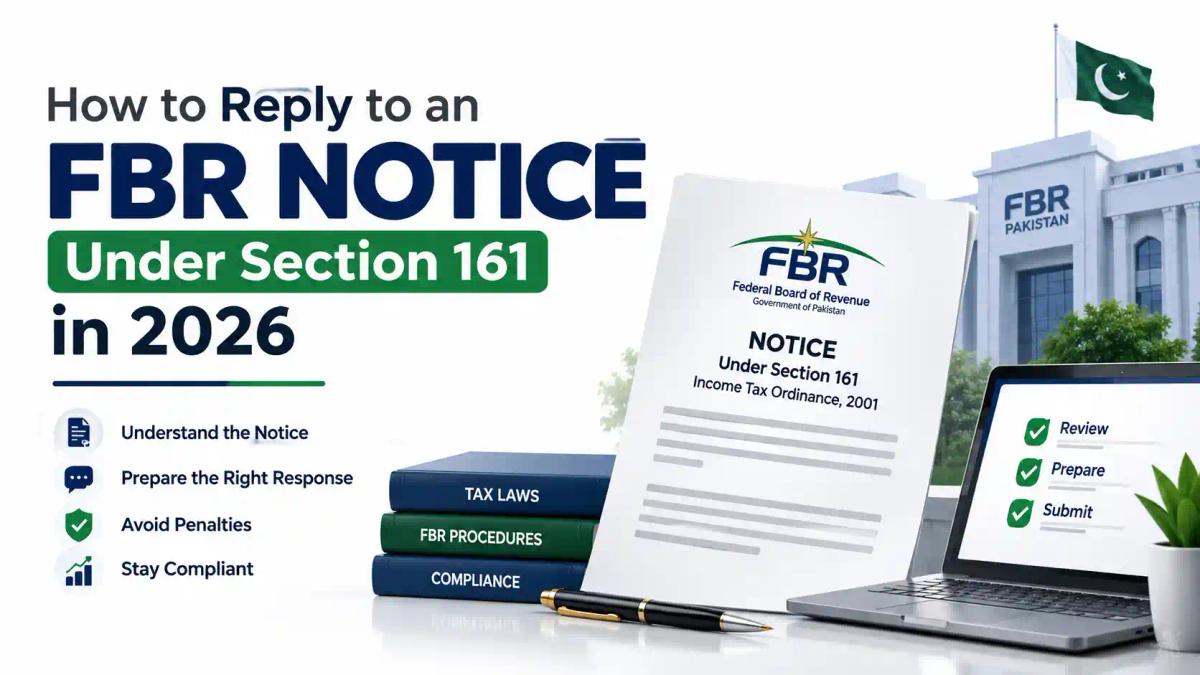
How to Reply to an FBR Notice Under Section 161 in 2026
Quick Answer
To reply to an FBR notice under Section 161 of the Income Tax Ordinance, 2001, start by reconciling every alleged transaction with your challans (CPRs), withholding statements and ledgers. Then submit a written, point-by-point reply on IRIS before the compliance date. Attach evidence of deduction, deposit, exemption certificates or payee tax payment. Where the notice is time-barred or vague, raise legal objections as well.
Introduction
A Section 161 notice is one of the most expensive letters a Pakistani business can receive from the Federal Board of Revenue (FBR). It does not question your own income. It questions whether you, acting as a withholding agent, deducted and deposited tax on payments you made to other people. If the tax officer is right, you become personally liable for someone else's tax. At the Institute of Corporate and Taxation (ICT), our faculty handles these cases in practice and teaches them in the classroom through the Advance Taxation and Litigation course. Most Section 161 demands we see collapse once the numbers are properly reconciled and the right legal objections are raised. If you are new to FBR correspondence, our complete guide to FBR notices in 2026 explains the wider notice system first.
Enroll Now: Speak to ICT Admissions →
This guide focuses on one thing: replying to a Section 161 notice correctly in 2026. You will find the law as amended up to the Finance Act, 2026, a documents checklist, a defence matrix, a reply draft you can adapt, and a worked reconciliation example. The guide is written for business owners, accountants, HR and payroll teams, tax practitioners, and CA, ACCA and law students who want to understand how withholding tax disputes actually unfold. For the basics of how withholding works, read what withholding tax is and how to handle it alongside this article.
Key Takeaways
- A Section 161 notice alleges that a withholding agent failed to deduct or collect tax, or deducted it but did not deposit it.
- Under Section 161(1A), no recovery can be made without first giving you an opportunity of being heard. The notice is that opportunity, so never ignore it.
- Your strongest defences are documentary: CPRs, Section 165 statements, exemption certificates under Section 159, and proof that the payee already paid the tax under Section 161(1B).
- Proceedings for records older than six years are open to challenge under Section 174(3), following the Supreme Court's 2021 judgment in C.P. No. 1691-L of 2018.
- An adverse order can trigger default surcharge under Section 205 (12% or KIBOR plus 3%, whichever is higher), a penalty under Section 182, and expense disallowance under Section 21(c).
- The Finance Act, 2026 introduced faceless audits and an algorithmic settlement mechanism, which may change how some hearings run from tax year 2027 onward.
What Is a Section 161 Notice Under the Income Tax Ordinance, 2001?
A Section 161 notice is a show-cause notice issued by the FBR under Section 161(1A) of the Income Tax Ordinance, 2001. It asks a withholding agent to explain why it should not be held personally liable for tax that it allegedly failed to deduct or collect, or deducted but failed to deposit with the government. It is a pre-order hearing notice, not a final demand.
Section 161 of the Income Tax Ordinance, 2001 (as amended by the Finance Act, 2026) covers two kinds of failure. The first is a failure to collect tax under Division II of Part V or Chapter XII, or to deduct tax under Division III of Part V or Chapter XII. The second is deducting or collecting the tax correctly but not paying it to the Commissioner as Section 160 requires. In both cases, the Commissioner "may pass an order" making the agent personally liable. For context on the full statute, see our Income Tax Ordinance 2001 compliance guide for 2026.
The statute builds in three protections for the withholding agent:
| Sub-section | What it says (plain English) | Why it matters in your reply |
|---|---|---|
| 161(1) | Agent is personally liable for tax not deducted/collected or not deposited | Defines what FBR must prove |
| 161(1A) | No recovery without an opportunity of being heard | Your reply is that hearing; ignoring it forfeits the defence |
| 161(1B) | No recovery if the payee has meanwhile paid the tax | Payee's return and tax payment become your evidence |
| 161(2) | Agent can recover the tax from the payee | Commercial remedy after an adverse order |
Section 161 of the Income Tax Ordinance, 2001 makes the withholding agent, not the payee, personally liable for tax that was deductible but never deducted or deposited.
Section 161(1A) Official Quote
The right of hearing is written into the statute itself. Section 161(1A) of the Income Tax Ordinance, 2001 bars any recovery unless the withholding agent "has been provided with an opportunity of being heard". Courts treat this as a mandatory safeguard, which is why an order passed without a hearing is open to challenge on appeal. For how hearings fit into the wider notice system, see our guide to FBR audit notices.
Why Does FBR Issue a Section 161 Notice?
FBR issues a Section 161 notice when its data suggests a gap between payments you made and tax you withheld or deposited. The usual triggers are mismatches between your audited accounts, income tax return, Section 165 withholding statements and Computerised Payment Receipts (CPRs), or third-party data showing payments on which no tax appears.
In 2026, most notices are data-driven. FBR's systems compare expense heads in your return (salaries, rent, commission, contract payments, professional fees) against what you declared in quarterly withholding statements. A gap between the two becomes an "alleged default". Our article on how FBR audit notices work in Pakistan explains the risk-profiling logic behind such selections.
Common triggers include:
- Expenses claimed in the return exceed the payments reported in Section 165 statements.
- Tax was deducted but the CPR is missing, mis-tagged to the wrong section, or deposited late.
- Payments were made to persons not on the Active Taxpayers List (ATL) without the higher non-filer rate being applied.
- Exemption or reduced-rate certificates under Section 159 were not uploaded or had expired.
- Salary tax under Section 149 was computed on the wrong slab.
Courts have warned against "fishing enquiries". As reported in the Lahore High Court's decision in Sui Northern Gas Pipelines v Deputy Commissioner Inland Revenue, (2014) 110 TAX 221 , Section 161 can only be invoked once a specific default is established. For the difference between filer and non-filer rates, see non-filer tax rates in Pakistan 2026.
What Changed for Section 161 Proceedings in 2026?
The core text of Section 161 is largely unchanged in 2026, but the environment around it has shifted. The Finance Act, 2026, effective 1 July 2026, introduced a faceless tax administration framework and an algorithmic settlement mechanism. The Finance Act, 2024 had already raised the default surcharge floor to 12% or KIBOR plus 3%, whichever is higher.
According to KPMG's July 2026 summary of the Finance Act, 2026, a National Faceless Center will handle audits, assessments and appeals remotely, and the tax officer's identity will stay confidential. The same Act created a technology-driven settlement mechanism that generates settlement offers based on a taxpayer's compliance history. Whether and when Section 161 proceedings move fully into the faceless system depends on FBR rules and notifications. For a broader view of the budget, read Pakistan Budget 2026 tax changes explained.
| Change | Source law | Effective | Impact on Section 161 replies |
|---|---|---|---|
| Default surcharge at 12% or KIBOR + 3%, whichever is higher | Section 205, Income Tax Ordinance, 2001 (as amended by the Finance Act, 2024) | 1 July 2024 | Delay now costs more; early reconciliation matters |
| Faceless audit and assessment framework | Finance Act, 2026 | 1 July 2026 | Written replies must stand alone without in-person explanation |
| Algorithmic settlement mechanism | Finance Act, 2026 | 1 July 2026 | New route to settle disputes before litigation |
| Penalty for withholding defaults | Section 182, Income Tax Ordinance, 2001 | As amended up to tax year 2027 | Check the current Section 182 penalty table before replying; admitting a genuine default allows voluntary payment of the penalty |
As of 2026, a Section 161 reply has to be complete on paper, because faceless proceedings leave little room to fill gaps at a hearing. Our guide to digital tax audits by AI at FBR explains why.
Who Receives a Section 161 Notice and Which Withholding Sections Are Involved?
A Section 161 notice goes to any "prescribed person" or withholding agent under the Income Tax Ordinance, 2001. That includes companies, associations of persons, government departments, NGOs, employers and certain individuals. The notice will cite the specific withholding section, such as Section 149 for salary, Section 153 for goods, services and contracts, or Section 155 for rent.
Identifying the underlying section is the first analytical step, because each one has its own rate, threshold, exclusions and exemption mechanism. HR and payroll teams most often face Section 149 issues, which our tax deductions guide for salaried persons 2026-27 covers in detail.
| Withholding section (Income Tax Ordinance, 2001) | Payment type | Typical Section 161 issue |
|---|---|---|
| Section 148 | Imports (collected at import stage) | Mismatch between import value and tax collected |
| Section 149 | Salary | Wrong slab, perquisites not taxed, annual statement gaps |
| Section 151 | Profit on debt | Deduction missed on loan interest |
| Section 152 | Payments to non-residents | Treaty relief claimed without certificate |
| Section 153 | Goods, services, contracts | Largest source of disputes; exemption certificates missing |
| Section 155 | Rent of immovable property | Rent paid to individuals without deduction |
| Section 156 | Prizes and winnings | Sales incentives treated as prizes |
| Section 233 | Brokerage and commission | Commission paid to agents without deduction |
The Sindh High Court case on sales incentives is a useful illustration. There, the department alleged that sales promotion payments to distributors attracted Section 156 withholding. The taxpayer argued the payments were trade discounts (Sindh High Court judgment). Importers should also read import and export tax rules explained.
Section 161 applies only to federal income tax. Provincial sales tax on services withheld under PRA, SRB, KPRA or BRA rules follows separate provincial laws.
How Much Can a Section 161 Order Cost You?
A Section 161 order makes you liable for the principal tax not deducted or deposited. On top of that, you face default surcharge under Section 205, a possible penalty under Section 182, and disallowance of the related expense under Section 21(c). Together, these can make the final cost significantly higher than the original tax.
Businesses often underestimate the stacked effect. The principal is only the start. Our analysis of common tax mistakes by Pakistani businesses in 2026 shows withholding lapses among the costliest.
| Liability | Legal basis | How it is computed |
|---|---|---|
| Principal tax | Section 161(1), Income Tax Ordinance, 2001 | Tax that should have been deducted or collected |
| Default surcharge | Section 205 (as amended by the Finance Act, 2024) | 12% p.a. or KIBOR + 3% p.a., whichever is higher, for the period of default |
| Penalty | Section 182, Income Tax Ordinance, 2001 | As specified in the Section 182 penalty table for failure to deduct, collect or deposit tax; imposed only by written order after a hearing |
| Expense disallowance | Section 21(c) | Relevant expense may be disallowed in computing business income |
Two provisions soften the blow. Section 205A reduces default surcharge automatically if the underlying tax is later reduced. The FBR's Section 182 page confirms that "where the taxpayer admits his default he may voluntarily pay the amount of penalty". The same page confirms that no penalty applies without a written order passed after a hearing. For surcharge mechanics in a related context, see FBR late filer surcharge 2026.
How Long Do You Have to Reply to a Section 161 Notice?
The Income Tax Ordinance, 2001 does not fix a single statutory reply period for a Section 161 notice. The response deadline is the compliance date stated in the notice itself. If you need more time, apply for an adjournment in writing through IRIS before that date, giving specific reasons and a proposed new date.
Treat the compliance date as a hard deadline. If you miss it, the officer can pass an order on the available record, and courts have upheld such orders where taxpayers were given hearings but did not use them. Mark every notice date in your compliance diary; our Pakistan tax calendar 2026 helps you track overlapping deadlines.
The timing of the notice itself is also a defence point. In C.P. No. 1691-L of 2018 (decided 2021), the Supreme Court of Pakistan read Section 161 together with Section 174(3). Section 174(3) requires records to be kept for six years after the end of the tax year to which they relate. Once that window has closed, notices under Section 161(1A) become ineffective.
| Timing question | Practical answer |
|---|---|
| Reply deadline | Compliance date stated in the notice |
| Extension | Written adjournment request on IRIS before the due date |
| Oldest year FBR can reach | Generally six years from the end of the tax year (Section 174(3), per Supreme Court 2021) |
| Appeal after order | Within 30 days of service of the order/notice of demand, under Section 127 |
If you have trouble accessing the portal near the deadline, our IRIS login problems and solutions guide can save you a day.
How to Reply to an FBR Notice Under Section 161: Step-by-Step Guide
Replying to a Section 161 notice comes down to nine disciplined steps. Read the notice, pull your data, reconcile transaction by transaction, classify each item, gather evidence, raise legal objections, draft a point-by-point reply, file it on IRIS, and attend the hearing. Skipping the reconciliation step is the most common reason replies fail.
The process below is the one practitioners use in real Section 161 cases. The reconciliation and drafting skills it needs are taught hands-on in ICT's Certified Tax Advisor (CTA) course.
Book Your CTA Seat: Contact ICT →
- Read the notice line by line. Note the tax year, the withholding sections cited, the amounts, the data source FBR relied on, and the compliance date.
- Download your own data from IRIS. Pull your Section 165 statements, the tax payment history and CPRs, and your filed return for the year.
- Build a transaction-level reconciliation. List every payment FBR alleges against your ledger, then match each one to a CPR, an exemption certificate, or an explanation.
- Classify every item into one of these categories: tax deducted and deposited, not liable to deduction, exempt, payee paid the tax, or genuine default.
- Collect evidence for each category: CPRs, statements, certificates, payee returns, agreements, invoices, and proof of payment mode.
- Check the legal framework. Look at limitation under Section 174(3), whether the notice identifies specific transactions and payees, and whether the correct section and rate were applied.
- Draft a structured reply that answers each allegation in the order FBR raised it, with an index of annexures.
- Submit the reply on IRIS against the specific notice, attach the evidence, and save the acknowledgement.
- Attend the hearing or respond to follow-ups. Keep a record of every submission and any order sheet.
A step-by-step walkthrough of payment receipts is in our guide to generating PSIDs and checking CPRs on IRIS 2.0. To file on the portal, open the notice from your IRIS inbox and use the reply option linked to that notice. The FBR IRIS 2.0 login and features guide shows the current interface.
FBR's Tax Asaan mobile app lets you check notices and payment status on the go, but prepare and submit a detailed Section 161 reply with annexures through IRIS on a computer. For a comparison of FBR's digital channels, read eFBR vs IRIS 2026.
How Do You Request an Adjournment and Prepare for a Section 161 Hearing?
If you cannot complete a Section 161 reply by the compliance date, file a written adjournment request on IRIS before that date. Give specific reasons, list the records you are still collecting, and propose a realistic new date. For the hearing itself, appear yourself or through an authorised representative under Section 223 of the Income Tax Ordinance, 2001. Our IRIS login problems guide helps you avoid last-minute portal failures.
A vague request such as "more time is required" is often refused. A request that names the missing documents and the reason they are delayed is far more likely to be granted. Use this short format and adapt it to your facts. Drafting techniques like these are practised in ICT's tax practitioner course in Islamabad.
Subject: Request for Adjournment, Notice under Section 161(1A), Tax Year [], Notice No. []
We acknowledge receipt of the above notice. Reconciliation of [number] payee accounts is in progress, and certificates under Section 159 and payee tax records are awaited from [number] vendors. We request an adjournment until [date] to submit a complete, documented reply. We remain committed to full cooperation.
[Authorised Signatory / Authorised Representative, NTN, date]
An adjournment request filed before the compliance date shows good faith, while one filed after the date gives the officer grounds to proceed on the available record.
Hearing preparation checklist:
| Item | Why you need it |
|---|---|
| Authority letter for your representative (Section 223) | Allows a CA, advocate or practitioner to appear for you |
| Printed reconciliation with annexure index | Lets the officer verify items line by line |
| Original CPRs and certificates (or certified copies) | Answers authenticity questions on the spot |
| IRIS acknowledgement of your written reply | Proves timely filing |
| Summary of legal objections (one page) | Keeps limitation and jurisdiction points on record |
| Request for copy of the order sheet | Builds the record for any appeal |
Under the faceless framework introduced by the Finance Act, 2026, some hearings may take place remotely without a named officer. Your written file then has to do all the talking. Hearing advocacy and representation skills are a core module of ICT's Advance Taxation and Litigation course.
Join ATL at ICT: Contact Admissions →

Section 161 Reply Documents Checklist
A strong Section 161 reply is built on documents, not arguments. At a minimum, gather CPRs for every deposit, the Section 165 quarterly and annual statements, general ledger extracts for the expense heads in question, exemption or reduced-rate certificates under Section 159, and proof of any tax the payee paid on its own.
Much of this checklist involves large ledgers. Excel skills such as VLOOKUP, XLOOKUP, pivot tables and Power Query cut reconciliation time from days to hours, which is why we recommend ICT's Master Advanced Excel course to anyone handling withholding compliance.
Enroll in Advanced Excel: Contact ICT →
| Document | Proves | Where to get it |
|---|---|---|
| CPRs / payment challans | Tax deposited, date and section | IRIS payment history / bank |
| Section 165 quarterly statements | Deductions reported to FBR | IRIS |
| Annual salary statement (Section 149) | Salary tax reconciled for the year | IRIS / payroll |
| General ledger extracts | Actual payments per expense head | Accounting system |
| Section 159 exemption certificates | Payee exempt or taxed at a lower rate | Payee / IRIS verification |
| Payee's return and tax payment proof | Section 161(1B) defence | Payee (with consent) |
| Contracts, invoices, debit/credit notes | Nature of the transaction | Procurement / vendors |
| Audited financial statements | Totals FBR relied on | Company records |
| Tax deduction certificates (Section 164) | Deduction issued to payee | Company records |
| ATL status evidence on payment date | Correct filer/non-filer rate applied | FBR ATL verification |
To verify payee filer status on the relevant date, use our ATL status check guide for 2026. Keep screenshots dated as close to the payment date as possible.
What Legal Defences Can You Raise Against a Section 161 Demand?
The main legal defences against a Section 161 demand are these: the proceedings are time-barred under Section 174(3), no specific default has been identified, the payment was not liable to withholding, an exemption applied, the payee has already paid the tax (Section 161(1B)), the correct rate was applied, or the demand duplicates an earlier order for the same year.
Legal objections should sit alongside the factual reconciliation, not replace it. Officers and appellate forums respond best to replies that show the numbers first and the law second. Litigation-style drafting is the core of ICT's Advance Taxation and Litigation course.
Join ATL at ICT: Contact Admissions →
| Situation | Defence | Supporting authority |
|---|---|---|
| Notice covers a tax year more than six years old | Time-barred | Section 174(3); Supreme Court, C.P. No. 1691-L of 2018 (2021) |
| Notice gives only totals, no transactions or payees | No crystallised default; fishing enquiry | Sui Northern Gas Pipelines (2014) 110 TAX 221 (LHC) |
| Payee has filed and paid tax on that income | No recovery from agent | Section 161(1B) |
| Payee held valid exemption/reduced rate | Deduction correctly nil/reduced | Section 159 certificate |
| Payment outside the section's scope (e.g. trade discount) | Not liable to withholding | Transaction documents; statutory definitions |
| No hearing given before order | Order void for violating natural justice | Section 161(1A) |
| Order already passed for same year on same facts | Double jeopardy / duplication | Case law on repeat orders |
| Tax year already assessed; advance tax converted to tax due | Section 161/162 not applicable | CIR v PEPCO, 2015 PTD 863 |
The Supreme Court held in 2021 that Section 161 notices become ineffective once the six-year record-keeping period under Section 174(3) of the Income Tax Ordinance, 2001 has expired. Courts have also held that Section 177 audit selection is not a precondition for Section 161 proceedings. Read more in our FBR audit notice 2026 guide.
What If You Deducted Tax but Did Not Deposit It?
When a withholding agent deducts tax but fails to deposit it, Section 161(1)(b) of the Income Tax Ordinance, 2001 makes the agent personally liable, and defences are narrow. The practical strategy is to deposit the amount immediately, document the delay honestly, and focus the reply on limiting default surcharge and penalty rather than disputing the principal. Use our PSID and CPR guide to make the deposit correctly.
This scenario is different from a failure to deduct. The money was taken from the payee's payment, so it never belonged to your business. Section 166 of the Income Tax Ordinance, 2001 gives such tax priority and treats it as held for the Federal Government. Arguing that no liability exists rarely works here. For how late payments compound, see our FBR late filer surcharge guide.
A withholding agent that deducts tax and does not deposit it has almost no defence on the principal, so the reply should aim to reduce surcharge and penalty.
Damage-control steps:
- Deposit the full deducted amount at once through a PSID tagged to the correct section and period.
- Calculate default surcharge under Section 205 from the date the tax was required to be deducted to the date of payment, at 12% per annum or KIBOR plus 3%, whichever is higher.
- Consider voluntary payment of the penalty under the proviso to Section 182(2), which allows a taxpayer who admits the default to pay it.
- Explain the cause in writing (cash-flow stress, bank error, staff change) with evidence, as a mitigating factor.
- Revise the Section 165 statement if the deposit data was wrong, and fix the internal control that failed.
Check the proviso to Section 205(3) as well. As published, it removes surcharge for the period from the date of a Section 161 order to the date of payment, in certain cases where the taxpayer pays by the due date and does not appeal. Deposit timing controls are covered in our Pakistan tax calendar 2026.
Section 161 Notice Reply Format Pakistan: A Working Draft
A Section 161 reply should be a formal letter addressed to the officer who issued the notice. It should quote the notice reference and tax year, answer each allegation in sequence, attach a reconciliation schedule and indexed annexures, raise legal objections without prejudice to facts, and request that proceedings be dropped or confined to genuine defaults.
Adapt the draft below to your facts. Do not file it as-is. Every figure must come from your own reconciliation. The drafting conventions follow what ICT teaches in its tax practitioner course in Islamabad.
To: The Deputy/Assistant Commissioner Inland Revenue, [Unit/Zone], [RTO/LTO/CTO, City]
Subject: Reply to Notice under Section 161(1A) of the Income Tax Ordinance, 2001, Tax Year [], Notice No. [] dated []
Taxpayer: [Name], NTN []
- Preliminary. This reply is submitted within the compliance date. We reserve the right to furnish further evidence at the hearing.
- Legal objection (without prejudice). [Where applicable: the notice relates to tax year [____], which falls outside the period in Section 174(3); reliance is placed on the Supreme Court's judgment in C.P. No. 1691-L of 2018.] [Where applicable: the notice does not identify specific transactions or payees; no default has crystallised.]
- Reconciliation. The amount of PKR [] alleged as expense liable to withholding has been reconciled at Annex A as follows:
(a) tax deducted and deposited: PKR [] (CPRs at Annex B);
(b) payments not liable to deduction: PKR [] (explanations at Annex C);
(c) exempt/reduced-rate payees: PKR [] (certificates at Annex D);
(d) payees who paid tax directly, Section 161(1B): PKR [] (Annex E);
(e) residual difference: PKR [] with explanation. - Default surcharge and penalty. As no default exists [or: as the residual amount has been deposited vide CPR No. [____]], no surcharge under Section 205 or penalty under Section 182 is attracted.
- Prayer. We request that the proceedings be dropped [or confined to PKR [____]] and that we be given a hearing before any order is passed.
Authorised Signatory / Authorised Representative, [Name, designation, date]
Annexures: A to [__] (indexed)
If your business also receives sales tax notices, the reconciliation approach overlaps with ICT's sales tax audit preparation guide.
Worked Example: Reconciling a Section 161 Demand
In a typical Section 161 case, most of the alleged default disappears on reconciliation. The example below is illustrative, with invented figures to show method, not actual rates. It shows how a PKR 1,200,000 alleged default can fall to a small residual once CPRs, exemptions and payee payments are matched.
Assume a private limited company receives a notice for tax year 2024. FBR compares contract and service expenses of PKR 60,000,000 (Rs. 6 crore) in the return with payments of PKR 40,000,000 (Rs. 4 crore) in the Section 165 statements. It alleges tax of PKR 1,200,000 (Rs. 12 lakh) was not deducted on the PKR 20,000,000 (Rs. 2 crore) difference. To practise this kind of exercise, ICT's AI-Driven CFO Masterclass covers automated reconciliation workflows.
Reserve Your CFO Masterclass Seat: Contact ICT →
| Reconciliation line | Amount of payments (PKR) | Tax alleged (PKR, illustrative) | Outcome |
|---|---|---|---|
| Accruals booked, paid in next year (tax deducted on payment) | 8,000,000 | 480,000 | Dropped: timing difference |
| Payments to exempt payee with Section 159 certificate | 5,000,000 | 300,000 | Dropped: exemption |
| Reimbursements with no service element | 3,000,000 | 180,000 | Dropped: not liable |
| Tax deducted but CPR tagged under wrong section | 2,500,000 | 150,000 | Dropped: rectified CPR evidence |
| Genuine default | 1,500,000 | 90,000 | Admitted and deposited |
| Total | 20,000,000 | 1,200,000 |
The residual PKR 90,000 would carry default surcharge under Section 205 from the date of default to the date of payment. At the 12% annual floor, one year of delay would add about PKR 10,800. The actual rate is the higher of 12% or KIBOR plus 3% for each period. Admitting the genuine default early limits both surcharge and penalty. For timing issues around year-end, compare our corporate tax Pakistan 2026 guide.
Section 161 vs Section 162 vs Section 182: What Is the Difference?
Section 161 makes the withholding agent personally liable for tax not deducted, collected or deposited. Section 162 lets FBR recover that tax directly from the payee from whom it should have been deducted. Section 182 imposes a separate penalty for the default. The three provisions often appear together in one notice but work independently.
Understanding which provision is being invoked shapes the reply. A Section 161 defence focuses on your records, while a Section 162 defence focuses on the payee's return. Our FBR notice types overview maps these provisions against other common notices.
| Feature | Section 161 | Section 162 | Section 182 |
|---|---|---|---|
| Who is liable | Withholding agent | Payee (recipient) | Person in default |
| What is recovered | Tax not deducted/deposited | Same tax, from recipient | Penalty |
| Hearing required | Yes, Section 161(1A) | Yes (natural justice) | Yes, Section 182(2) |
| Link to surcharge | Section 205 applies | Section 205 may apply | Surcharge separate |
| Key defence | Reconciliation, exemption, 161(1B) | Tax already paid in return | No default / reasonable cause |
Do not confuse a Section 161 notice with a Section 147 advance tax notice. Section 147 of the Income Tax Ordinance, 2001 concerns your own quarterly advance tax, and a shortfall there attracts default surcharge under Section 205(1B). Section 161 concerns tax you should have withheld from other people. The two are answered with different records. See our Income Tax Ordinance 2001 compliance guide for the distinction.
One commentary suggests that Section 161 works during the tax year while Section 162 operates after the year closes. That view comes from practitioner literature and is disputed, so rely on the specific facts and current case law. For businesses handling related banking withholding, see withholding tax on bank transactions 2026.
What Happens After You Submit Your Section 161 Reply?
After you submit a Section 161 reply, the officer may accept it and drop proceedings, ask for more information, fix a hearing, or pass an order under Section 161(1) for any amount still considered in default. An adverse order is followed by a notice of demand, which you can appeal before the Commissioner Inland Revenue (Appeals) under Section 127.
Keep monitoring IRIS after filing. Follow-up notices often carry short deadlines, and a missed follow-up can undo a strong first reply. For a broader view of post-notice procedure, see our tax audit in Pakistan FBR guide 2026.
Post-reply timeline:
- Reply filed → acknowledgement saved.
- Scrutiny / follow-up queries → answer within the new dates.
- Hearing → physical, virtual or faceless under the 2026 framework.
- Order under Section 161(1) → either nil, reduced, or confirmed demand.
- Notice of demand → payment date stated.
- Appeal → CIR (Appeals) under Section 127.
- Further appeal → Appellate Tribunal Inland Revenue (ATIR), then the High Court on questions of law.
Beyond litigation, two alternative routes exist. The Federal Tax Ombudsman (FTO) handles complaints of maladministration, such as passing an order without a hearing. The Finance Act, 2026 also introduced an algorithmic settlement mechanism that may offer negotiated outcomes. Anyone building a career in this area should read advanced taxation and litigation course insights.
Can You Stop Recovery and Get Your Money Back After a Section 161 Order?
After an adverse Section 161 order, you can apply for a stay of recovery while your appeal is pending, and FBR must generally serve a notice of demand under Section 137 before coercive recovery. If the demand is later reduced, the excess is refundable under Section 170. You can also recover the tax from the payee under Section 161(2). Our tax audit guide covers the recovery stages in detail.
How Does a Stay of Recovery Work?
A stay application is filed with the appeal before the Commissioner Inland Revenue (Appeals). The proviso to Section 128(1) allows a stay for a limited period. Further stays can be sought from the Appellate Tribunal Inland Revenue or, in exceptional cases, the High Court. Timing matters because recovery under Sections 138 and 140 can move quickly. For choosing the right adviser at this stage, read how to find the best tax consultant near you.
| Stage | Forum | Remedy |
|---|---|---|
| Order passed, appeal filed | CIR (Appeals), Section 127/128 | Stay of recovery for a limited period |
| Appeal pending at second level | Appellate Tribunal Inland Revenue | Stay application |
| Stay refused, serious legal issue | High Court | Constitutional petition / interim relief |
| Demand reduced on appeal | Commissioner, Section 170 | Refund of excess tax paid |
| Surcharge on reduced demand | Section 205A | Automatic proportionate reduction |
How Do You Claim a Refund if the Demand Is Reduced?
If you paid a Section 161 demand and the appeal later reduces it, apply for a refund of the excess under Section 170 of the Income Tax Ordinance, 2001. Section 205A reduces the related default surcharge automatically. Follow the process in our IRIS tax refund guide for 2026.
How Do You Recover the Tax From the Payee Under Section 161(2)?
Section 161(2) entitles a withholding agent that paid tax under a Section 161 order to recover that tax from the person from whom it should have been deducted or collected. In practice, this means set-off against future payments, a formal demand letter, or a claim under the contract. Contract clauses on tax indemnity make recovery far easier, a point covered in ICT's Certified Business Advisor course.
Enroll in Certified Business Advisor: Contact ICT →
Whether the payee can claim credit under Section 168 for tax you paid under a Section 161 order is a contested point, so get advice before promising a credit to your vendor. Section 167 separately protects an agent who deducts tax from claims by the payee over that deduction. For wider contract and tax planning, see our corporate law and taxation guide.
Common Mistakes That Turn a Section 161 Notice Into a Tax Demand
Most Section 161 demands become final because of avoidable errors. The usual ones are ignoring the notice, replying with a general denial, submitting totals instead of a transaction-level reconciliation, attaching CPRs without explaining them, and missing follow-up dates. Each of these hands the officer an order on the available record.
Watch for these frequent mistakes:
- Silence. Section 161(1A) gives you a hearing. Not using it lets the officer decide on FBR's data alone.
- Generic replies. "All taxes were duly deducted" without evidence carries no weight.
- Totals-only reconciliation. Officers want payee-wise and invoice-wise matching.
- Ignoring wrong-section CPRs. Tax deposited under the wrong section still needs a formal explanation and, where available, rectification.
- Late deposit left unexplained. Even if tax was deposited, a late deposit attracts Section 205 surcharge.
- Relying on AI-drafted replies unchecked. Generic AI text often cites wrong sections; see the legal risk of AI tax calculations.
- Missing payee consent. Section 161(1B) evidence needs the payee's cooperation; request it early.
The pattern across these errors is simple. A reply that the officer cannot verify line by line is treated almost the same as no reply. Our list of income tax return filing mistakes in Pakistan shows how upstream errors in the return create these downstream notices.
Expert Tips and Best Practices to Prevent Future Section 161 Notices
The best way to handle a Section 161 notice is to avoid the mismatch that triggers it. Reconcile withholding monthly against the ledger, deposit deducted tax on time, file Section 165 statements quarterly without gaps, verify payee ATL status and exemption certificates before payment, and keep evidence for at least six years under Section 174.
Practical controls from our consulting and training experience:
- Map every expense head in your chart of accounts to a withholding section and rate.
- Run a monthly "ledger vs CPR vs statement" check rather than a year-end one.
- Verify payee ATL status and Section 159 certificates at the time of payment, and save dated screenshots.
- Deposit deducted tax within the Rule 43 timelines.
- File quarterly statements by the 20th day after each quarter (Section 165, as amended by the Finance Act, 2020), including nil statements.
- Issue Section 164 certificates to payees promptly.
- Build a withholding file for each tax year that could survive a faceless audit without explanation.
Payroll deserves special attention, because salary tax errors repeat every month. HR professionals can build these controls through ICT's Certified Human Resources (CHRP) course.
Businesses integrating with FBR's e-invoicing system should align withholding data with invoice data too. Our e-invoicing Pakistan tax guide 2026 explains the integration requirements.
Should You Hire a Section 161 Tax Consultant or Reply Yourself?
You can reply to a simple Section 161 notice yourself if the alleged amount is small, your records are complete and the issue is purely factual. Hire a qualified tax consultant or tax lawyer when the amount is material, the notice covers several years or sections, legal objections are needed, or an order has already been passed.
Professional fees in Pakistan vary widely with case complexity, amount involved and city. No official fee schedule exists, so request a written quote. For guidance on choosing an adviser, see how to find the best tax consultant near you.
| Factor | Reply yourself | Hire a consultant |
|---|---|---|
| Cost | Staff time only | Professional fee |
| Best for | Small, factual mismatches | Material amounts, multi-year notices, legal issues |
| Legal objections | Limited | Limitation, jurisdiction, natural justice properly argued |
| Appeal readiness | Weak record for appeal | Reply drafted with appeal in mind |
| Risk | Missed defences | Lower, if the adviser is qualified |
Look for Chartered Accountants (ICAP/ICAEW), tax advocates enrolled with a Bar Council, or recognised Income Tax Practitioners with litigation experience. Business owners can also study the fundamentals through ICT's Certified Business Advisor course to supervise advisers effectively.
Enroll in Certified Business Advisor: Contact ICT →
Career Scope: Why Section 161 Skills Are in Demand in 2026
Withholding tax litigation is one of the most consistent sources of work for Pakistani tax professionals. Every company, employer and prescribed person is a withholding agent, and data-driven FBR enforcement generates recurring notices. Professionals who can reconcile, draft and argue Section 161 cases are valued by firms, corporates and freelance clients.
Roles that use these skills include tax associate, withholding compliance officer, payroll tax specialist, tax litigation assistant and independent tax consultant. No official salary survey for this niche exists, so treat any figure you see online with care. For indicative ranges and career paths, see our tax consultant salary guide for Pakistan 2026.
The same reconciliation discipline carries over internationally. Professionals targeting the UK, USA, UAE or Saudi markets use it in payroll and VAT work. Company secretaries and compliance officers also handle withholding governance, which is covered in ICT's Company Secretary course.
Enroll in Company Secretary Course: Contact ICT →
Freelancers can turn this expertise into recurring clients. Our guide on recurring income tax clients in Pakistan explains how.
Why Choose ICT to Master Section 161 Notice Replies and Withholding Tax Litigation in 2026?
The Institute of Corporate and Taxation (ICT) teaches Section 161 the way it is practised. Our faculty drafts real withholding tax replies, argues before Inland Revenue officers, and turns that experience into classroom case studies. Students learn reconciliation, legal drafting and IRIS filing on live-style files rather than theory alone. Read more about ICT and why learners call us the best tax training institute.
What sets ICT apart for FBR notice and litigation training:
- Practitioner-led teaching by chartered accountants and High Court advocates.
- Litigation focus through the Advance Taxation and Litigation course, covering show-cause replies, orders and appeals.
- Full compliance coverage through the Certified Tax Advisor course and Master Sales Tax, so income tax and sales tax withholding are handled together.
- Campuses in Islamabad, Lahore and Karachi, plus online classes.
- Verifiable certificates through our certificate verification portal.
Book a Free Counselling Session: Contact ICT →
Frequently Asked Questions
What is a Section 161 notice from FBR?
A Section 161 notice is a show-cause notice under Section 161(1A) of the Income Tax Ordinance, 2001. It asks a withholding agent to explain why it should not be held personally liable for tax that was not deducted, not collected, or not deposited. See our withholding tax guide.
How do I reply to a Section 161 notice on IRIS?
Open the notice in your IRIS inbox and prepare a transaction-level reconciliation. Upload a written, point-by-point reply with CPRs, Section 165 statements and certificates as annexures, then submit before the compliance date and save the acknowledgement. Our IRIS 2.0 guide shows the portal.
Can FBR issue a Section 161 notice for tax years older than six years?
Generally, no. In C.P. No. 1691-L of 2018 (2021), the Supreme Court held that Section 161 must be read with Section 174(3), so notices become ineffective after the six-year record-keeping period. Learn more in our Income Tax Ordinance compliance guide.
What if the payee has already paid the tax?
Under Section 161(1B), FBR cannot recover the tax from you if the payee has meanwhile paid it. Obtain the payee's return and payment evidence and attach them to your reply. Check payee status via our ATL guide.
What is the default surcharge on a Section 161 demand in 2026?
Section 205 of the Income Tax Ordinance, 2001 (as amended by the Finance Act, 2024) charges default surcharge at 12% per annum or KIBOR plus 3%, whichever is higher, for the period of default. Related rules are in our late filer surcharge guide.
Is a Section 161 notice the same as an audit notice?
No. A Section 161 notice targets withholding defaults, while an audit under Section 177 examines your overall tax affairs. Courts have held that audit selection is not a precondition for Section 161 proceedings. Compare them in our FBR audit notice guide.
Can I appeal a Section 161 order?
Yes. You can appeal to the Commissioner Inland Revenue (Appeals) under Section 127, then to the Appellate Tribunal Inland Revenue, and on questions of law to the High Court. Appeal skills are covered in ICT's Advance Taxation and Litigation course.
Does a Section 161 notice cover provincial sales tax withholding?
No. Section 161 applies only to federal income tax. Withholding on services under PRA, SRB, KPRA or BRA rules is governed by separate provincial laws with their own notices. For federal sales tax, see ICT's Master Sales Tax course.
Enroll in Master Sales Tax: Contact ICT →
What should I do if I deducted tax but forgot to deposit it?
Deposit the amount immediately through a correctly tagged PSID. Then disclose the delay in your reply and consider voluntary payment of the penalty under Section 182(2). Default surcharge under Section 205 runs until payment, so every day of delay increases the cost. See our PSID and CPR guide.
Should I pay the demand while my appeal is pending?
It depends on recovery protection rules at the time and the size of the demand. Paying an admitted genuine default early reduces surcharge, while disputed amounts can be contested on appeal. Discuss your case with a qualified adviser; see why businesses need a tax advisor.
Conclusion
A Section 161 notice is serious, but it is rarely hopeless. The law gives you a hearing under Section 161(1A), a payee-payment defence under Section 161(1B), and a six-year limitation shield under Section 174(3) as read by the Supreme Court. Most alleged defaults shrink once you reconcile transaction by transaction and back every line with CPRs, statements and certificates. As of 2026, faceless proceedings under the Finance Act, 2026 make a complete written reply more important than ever. For a structured start, study how professionals handle these cases in ICT's Advance Taxation and Litigation course.
Talk to ICT About ATL: Contact Us →
The key recommendation is simple. Never ignore the notice, never send a generic denial, and never file totals without a reconciliation. Your logical next step is to download your IRIS data today and build the reconciliation before you write a single paragraph of the reply. If you want to go further, the Certified Tax Advisor programme gives you the practical toolkit to handle Section 161, 114, 122 and audit notices with confidence.
Start Your CTA Journey: Contact ICT →
Comments (0)
No comments yet. Start the conversation!
Leave a Reply
Your email address will not be published. Required fields are marked *