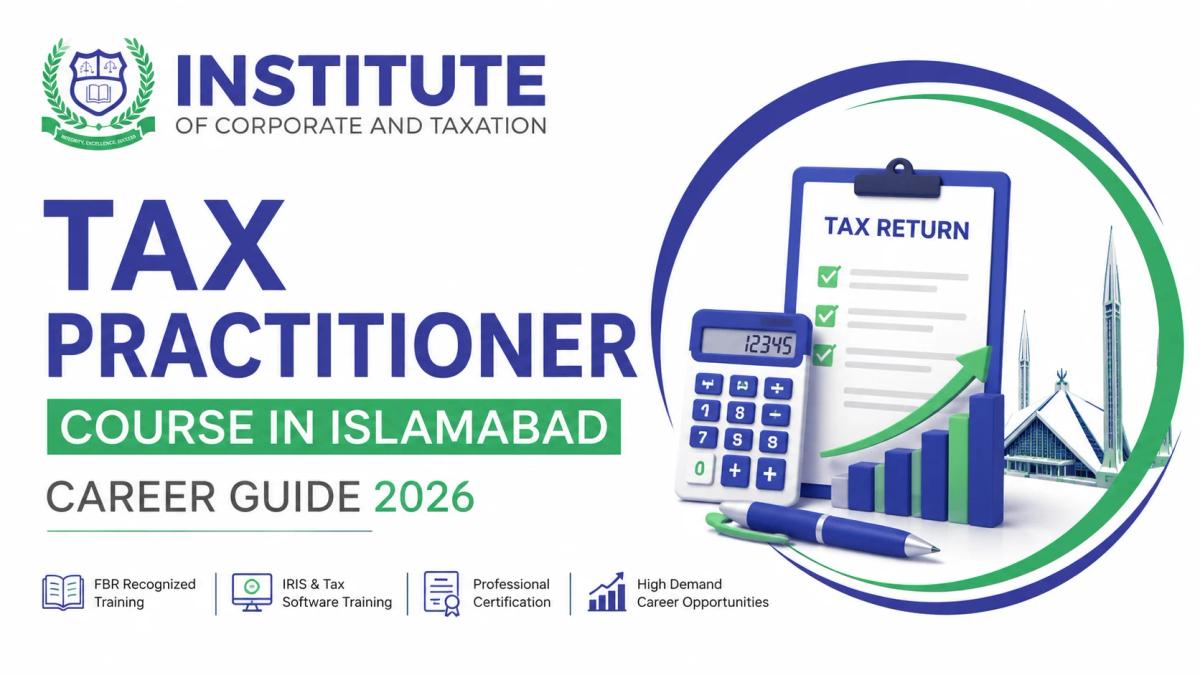
Tax Practitioner Course in Islamabad: Career Guide 2026
If you've ever typed "tax practitioner course Islamabad" into Google late at night, wondering whether this career path is actually worth your time and money — you're not alone. Thousands of commerce graduates, accountants, and even business owners across Pakistan ask the same question every year. The good news? Taxation is one of the few fields in Pakistan where demand keeps growing every single year, no matter what the economy does.
At the Institute of Corporate & Taxation (ICT), we've trained hundreds of students who now work as tax consultants, FBR filers, and corporate advisors across Pakistan and abroad. This guide is built specifically to answer every question you might have — from "what is a tax practitioner" to "how much can I actually earn." Whether you're a fresh graduate or someone looking to switch careers, ICT's Islamabad-based training is designed to take you from zero to job-ready in a few months.
Throughout this article, you'll notice we link to specific courses and guides on the ICT website — these aren't random links. They're the exact next steps you'll need once you decide taxation is the right path for you. So if you're serious about a taxation career in Pakistan, this is the guide to bookmark. Let's get started with the quick answer first, then dive deep into everything else.
What Is a Tax Practitioner Course?
A tax practitioner course is a professional training program that teaches you how to prepare, file, and manage income tax and sales tax returns in Pakistan — using real FBR systems like IRIS. Unlike a full CA or ACCA degree that takes years, a tax practitioner course usually takes 3 to 6 months and focuses purely on practical, job-ready skills: income tax return filing, sales tax registration, NTN registration, withholding tax, and FBR compliance.
In short — it's the fastest legal route into a taxation career in Pakistan without needing a CA or ACCA qualification.
What Is a Tax Practitioner? (In Detail)
A tax practitioner is a trained professional authorized to prepare tax documents, file returns, and represent clients before tax authorities like the Federal Board of Revenue (FBR). Think of them as the bridge between complicated tax law and everyday taxpayers — whether that's a salaried employee, a freelancer, or a growing business.
In Pakistan, a certified tax practitioner typically handles:
- Income tax return filing for individuals and businesses
- Sales tax registration and monthly return filing
- NTN (National Tax Number) registration
- Responding to FBR notices and audits
- Advising clients on Active Taxpayers List (ATL) status
- Corporate tax compliance for companies registered with SECP
If terms like ATL, NTN, and STRN sound confusing right now, don't worry — our detailed breakdown on the difference between ATL, NTN, STRN and SECP explains it in plain language.
Why This Career Matters — Especially in Pakistan
Pakistan's tax-to-GDP ratio is one of the lowest in the region, which means the government is constantly pushing for wider tax compliance. That's actually great news for you. Every year, FBR tightens filing requirements, expands digital invoicing, and pursues non-filers more aggressively — and every one of those changes creates more demand for trained tax professionals.
A few real reasons taxation is booming right now:
- Digital transformation — FBR's IRIS 2.0 system and e-invoicing rollout mean businesses need people who actually understand the software, not just the theory. Our guide on FBR IRIS 2.0 and the 2026 tax survival guide covers this in detail.
- Non-filer penalties — With penalties for non-filers escalating every budget cycle (see our breakdown of FBR non-filer penalties in 2026), more individuals and businesses are actively searching for tax consultants.
- Freelance economy growth — Pakistan's freelancers exporting services abroad now need proper tax planning too. Our article on freelancer tax rules in Pakistan for 2026 is a good companion read if this interests you.
According to the World Bank, improving tax administration capacity remains one of the top priorities for developing economies like Pakistan — which only reinforces how valuable trained tax professionals will remain in the years ahead.
Step-by-Step Guide: How to Become a Tax Practitioner in Pakistan
Step 1: Check Your Eligibility
Most tax practitioner courses accept students with at least an intermediate or bachelor's degree — commerce background helps but isn't mandatory. If you're coming from a BBA, B.Com, or even an unrelated degree, you can still join.
Step 2: Choose the Right Institute
This is where most students go wrong — they pick a generic "computer institute" offering taxation as a side course. Instead, look for an institute that specializes in taxation and corporate law, like ICT, so your instructors are actual practicing tax consultants, not just lecturers. Our detailed comparison of the best taxation institute in Islamabad for 2026 can help you evaluate your options.
Step 3: Enroll and Learn Core Modules
A solid course should cover:
- Income Tax Ordinance 2001 basics
- Sales Tax Act 1990 fundamentals
- Practical IRIS portal training
- NTN and sales tax registration
- Withholding tax and corporate tax
- Filing returns for salaried persons, businesses, and freelancers

Step 4: Get Hands-On Practice
Theory alone won't get you a job. Look for programs offering live filing practice on the actual IRIS system — not just PowerPoint slides. Our FBR IRIS login guide for 2026 is a useful preview of what practical training looks like.
Step 5: Get Certified
Once you complete your course, you'll receive a certificate that becomes your proof of practical training when applying for jobs or registering as an Income Tax Practitioner with FBR.
Step 6: Register With FBR (Optional but Recommended)
If you want to independently file returns for clients and legally represent them, you can pursue registration as a recognized tax practitioner with FBR — our course prepares you with the exact documentation and process knowledge needed for this.
Step 7: Start Building Your Client Base or Apply for Jobs
From here, you can either apply to accounting firms, corporate finance departments, or start freelancing. Our guide on how to start a tax preparation business in 2026 walks you through the freelance route step by step.
Tips for Success
- Practice on real IRIS dummy accounts before your first live filing.
- Keep a personal checklist of documents required for NTN and sales tax registration — clients will ask constantly.
- Stay updated every budget season; tax law changes yearly, and outdated knowledge costs clients' trust.
- Don't skip corporate tax basics even if you plan to focus on individual filing — most well-paying jobs eventually require both.
Key Skills, Tools & Benefits You'll Gain
A good tax practitioner course doesn't just teach law — it builds practical, marketable skills:
Skills:
- Income tax and sales tax return preparation
- NTN and STRN registration
- Withholding tax calculation
- Tax audit response and FBR notice handling
- Client communication and tax advisory
Tools you'll get comfortable with:
- FBR's IRIS portal
- Microsoft Excel (for tax computation sheets)
- QuickBooks / Tally ERP (for businesses that need bookkeeping alongside tax filing)
If Excel feels like a weak spot for you, pairing your taxation training with our Master Advanced Excel course will make you far more efficient when preparing client tax files.
Benefits of certification:
- Fast entry into the job market (3–6 months vs. years for CA/ACCA)
- Lower cost compared to chartered qualifications
- Ability to freelance or start your own consultancy
- Strong foundation to later specialize in Certified Tax Advisor (CTA) or Advance Taxation and Litigation (ATL) programs
Job Scope, Salary & Demand in 2026
Let's talk numbers, because that's usually the real question behind "is taxation a good career in Pakistan."
Job scope:
- Accounting firms and tax consultancy offices
- Corporate finance and compliance departments
- Freelance tax filing services (Fiverr, Upwork, local clients)
- Independent tax practice after FBR registration
- Government-adjacent compliance roles as regulations tighten
Salary expectations (2026 estimates):
- Entry-level tax assistant: PKR 40,000–70,000/month
- Mid-level tax consultant: PKR 80,000–150,000/month
- Independent practitioner with own client base: Highly variable, often PKR 150,000+ depending on client volume
- Specialized international tax consultants (UK/USA/UAE taxation): Often significantly higher, especially for remote/freelance clients abroad
For a deeper breakdown, our dedicated guide on tax advisor salary and scope in Pakistan for 2026 covers regional comparisons too.
Demand drivers:
- Rising FBR enforcement against non-filers
- Government's push toward digital invoicing and stricter audits
- Growing number of freelancers and small businesses needing compliance help
- Companies outsourcing tax work instead of hiring full-time in-house staff
Why Choose ICT — and How to Learn (Free + Paid Resources)
There's no shortage of institutes offering "taxation courses" in Islamabad, but not all of them offer practical, FBR-focused training. This is exactly the gap ICT (Institute of Corporate & Taxation) was built to fill.
Why choose ICT:
- Instructors are practicing tax consultants, not just trainers
- Live IRIS filing practice — not just theory slides
- Recognized certification upon completion (you can verify graduate certificates directly through our certificate verification portal)
- Flexible weekend and online batches for working professionals
- A genuine student support community, not a one-and-done classroom experience
We've written an honest comparison if you want to see exactly how we stack up: why our institute is better than other institutes, and a deeper dive on why ICT is considered the No.1 institute of corporate and taxation in Islamabad.
Free resources to explore before enrolling:
- FBR's own IRIS portal tutorials (basic, but useful for orientation)
- Coursera offers general finance and accounting fundamentals if you want a primer before diving into Pakistan-specific tax law
- Our free blog library covering topics like how to file an income tax return in Pakistan and what is the FBR IRIS portal and how to use it
Paid, structured learning:
Once you're ready to commit, browse our full course catalog, which includes specialized international taxation programs:
- UK Taxation Course
- USA Taxation Course
- UAE Taxation Course
- Saudi Taxation Course
- Canadian Taxation Course
- Master Sales Tax
These international programs are worth exploring once you've built your local FBR foundation, since many ICT graduates go on to serve overseas clients remotely — our blog on how Pakistanis are building global tax careers shows real examples of this path.
Real-World Examples
Example 1 — The Fresh Graduate:
A B.Com graduate with no prior tax experience enrolled in a 4-month taxation program. Within two months of certification, she landed a junior tax associate role at a mid-sized accounting firm in Islamabad, handling salaried-person filings and NTN registrations.
Example 2 — The Career Switcher:
A former customer service representative in his early 30s took a weekend taxation batch while still working full-time. After certification, he started freelancing part-time, filing returns for small shopkeepers and freelancers, eventually transitioning to full-time tax consultancy within a year. Our article on going from student to tax consultant in a 90-day plan reflects exactly this kind of journey.
Example 3 — The Business Owner:
A small business owner took the course not to become a professional practitioner, but to understand his own company's sales tax and corporate tax obligations — saving thousands in consultant fees and avoiding FBR penalties entirely.
Future Career Opportunities (2026 and Beyond)
Taxation careers in Pakistan are evolving fast, and it's worth understanding where things are heading:
- AI-assisted tax filing is becoming standard, but it still requires trained humans to review and verify — our piece on manual vs AI-assisted tax filing in 2026 explores this shift.
- Corporate compliance roles are growing as SECP tightens company registration and reporting rules.
- International remote tax consulting — Pakistani professionals trained in UK, USA, UAE, or Canadian taxation are increasingly serving overseas clients from home.
- Specialization tracks — practitioners who later pursue Certified Tax Advisor (CTA) or advanced litigation training tend to command significantly higher fees.
- Entrepreneurial paths — many graduates eventually open their own consultancy offices rather than staying employees long-term.
If you want a broader industry outlook, our deep-dive on the future of tax advisory in Pakistan (2026–2030) is worth reading alongside this guide.
Frequently Asked Questions
1. What is a tax practitioner course?
It's a practical training program that teaches income tax and sales tax filing, FBR IRIS system usage, and tax compliance — designed to get you job-ready in a few months rather than years.
2. Is a tax practitioner course difficult?
Not if you have the right instructors. Most students with no prior finance background successfully complete it within 3–6 months, especially with hands-on IRIS practice.
3. Can I become a tax consultant without a CA or ACCA?
Yes. A certified tax practitioner course is specifically designed as an alternative, faster route into taxation without requiring a full chartered qualification.
4. How much does a tax practitioner course cost in Islamabad?
Fees vary by institute and course depth, but ICT offers flexible, affordable options compared to lengthy chartered programs — reach out directly for current fee details.
5. What is the difference between a tax practitioner and a tax consultant?
A tax practitioner typically focuses on return filing and FBR compliance, while a tax consultant often provides broader advisory services including tax planning and corporate structuring — many professionals grow from one role into the other.
6. Is taxation a good career choice in Pakistan in 2026?
Yes — rising FBR enforcement, digital invoicing rollout, and growing freelance/business compliance needs are all increasing demand for trained tax professionals year over year.
Conclusion: Your Next Step
Taxation isn't just a "safe" career choice in Pakistan — it's one of the few fields where demand is actively increasing every year, driven by government policy, digital transformation, and a growing freelance economy. Whether your goal is a stable job, a freelance consultancy, or eventually your own tax practice, the path starts with proper, practical training.
At ICT, we've built our tax practitioner course specifically around what actually gets you hired — real IRIS practice, current FBR law, and instructors who work in taxation every single day, not just teach it. If you're ready to stop researching and start building your career, explore our full range of taxation and corporate courses or get in touch through our contact page.
Book a seat at ICT today — your 2026 taxation career starts with one enrollment decision.
Comments (0)
No comments yet. Start the conversation!
Leave a Reply
Your email address will not be published. Required fields are marked *