
FBR Active Taxpayer List 2026: Check ATL Status Online & SMS 9966
Quick Answer: How Do I Check My ATL Status?
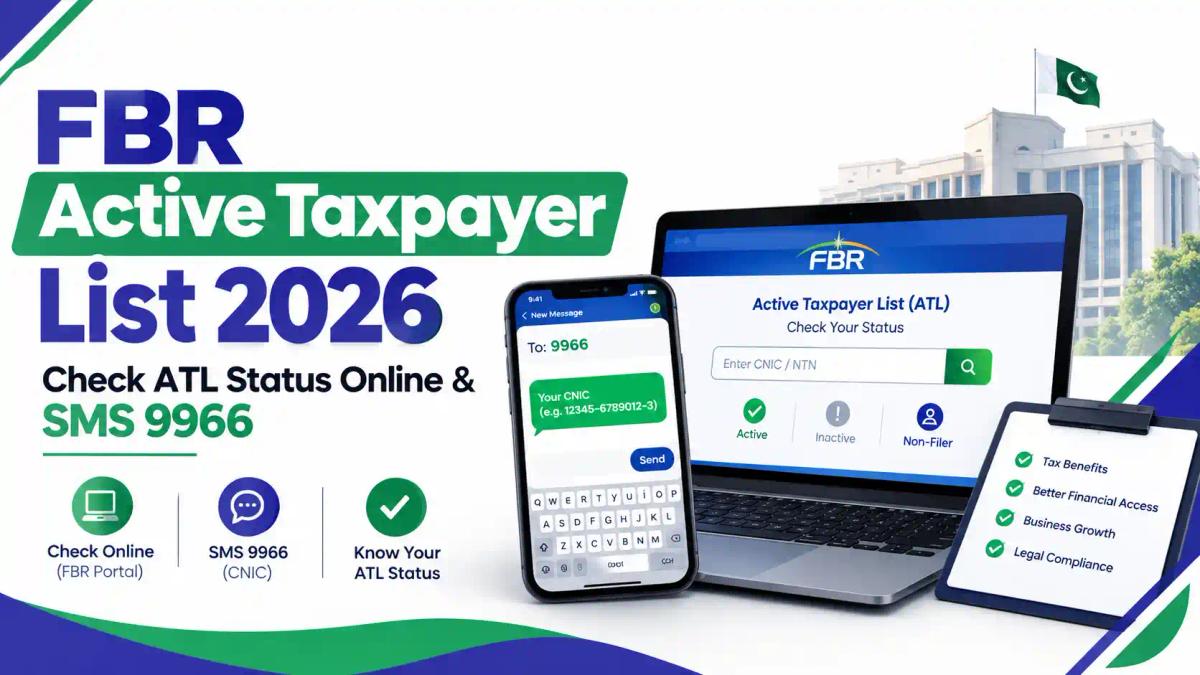
To check your FBR Active Taxpayer List (ATL) status by SMS, type ATL, a space and your 13-digit CNIC (no dashes), and send it to 9966. Companies and AOPs send "ATL", a space and their 7-digit NTN to 9966. You can also check online through FBR's ATL search utility using your CNIC or NTN. If the result says "not active", you usually need to file your missing income tax return. Follow our guide on how to become a filer in Pakistan to fix that.
Introduction
Your ATL status decides whether banks, property registrars and motor registration authorities treat you as a filer or a non-filer. That single status can change the tax you pay on a property deal by lakhs of rupees.
At the Institute of Corporate & Taxation (ICT), we train accountants, lawyers and business owners in practical FBR compliance. "Why does FBR show me as inactive?" is one of the questions we hear most often.
This guide covers four things:
- every official way to check ATL status in 2026
- what each result means
- why names go missing from the list
- the costlier rules the Finance Act 2026 introduced for late filers
If you have not yet filed, start with our step-by-step income tax return filing guide for 2026. If IRIS is giving you trouble, see our FBR IRIS login guide.
What Is the FBR Active Taxpayer List (ATL)?
The Active Taxpayer List is FBR's official record of people and entities who have filed their income tax return. FBR describes it as a central record of online income tax return filers for the previous tax year.
If your name is on the ATL, you are legally treated as an "active taxpayer", which is what people commonly call a filer. Withholding agents check this list before deciding which tax rate to apply to you. Those agents include banks, property registrars and excise departments.
What does "active taxpayer" mean in Pakistan?
An active taxpayer is a person whose return for the relevant tax year has been filed and accepted onto the ATL. It does not mean "someone who pays a lot of tax". A person with a nil or low income who files correctly is just as active as a large business.
Is having an NTN the same as being on the ATL?
No. This is the most common misunderstanding.
- NTN means you are registered with FBR.
- ATL status means you have filed your return for the relevant tax year.
You can hold an NTN for ten years and still be a non-filer. For a fuller comparison, read our explainer on the difference between ATL, NTN, STRN and SECP registration.
Why Is the FBR Active Taxpayer List Important?
The ATL is the one list that almost every financial counterparty in Pakistan checks before deciding how much tax to take from you. It matters for five practical reasons.
1. It decides your withholding tax rate.
Banks, property registrars, excise departments and businesses paying suppliers are all withholding agents. They check the ATL before deducting tax. If you are not on the list, most withholding taxes are generally doubled, and property purchase tax is many times higher. The detailed comparison is in the filer vs non-filer rates section below.
2. It is the legal test of being a "filer".
Pakistani law does not treat NTN registration, or paying tax through salary deductions, as proof of compliance. Only your presence on the ATL counts. A salaried person whose employer deducts tax every month can still be treated as a non-filer if no return has been filed.
3. It protects you from enforcement action.
Under section 114B, FBR can disable mobile SIMs and cut electricity and gas connections for people who are required to file but are not on the ATL. Staying on the list keeps you outside this enforcement net.
4. It lets you recover excess tax.
Much of the tax deducted from you, including advance tax on property, is adjustable against your final liability. You can only claim that credit, or a refund, by filing your return. Our guide to the IRIS tax refund process explains how.
5. It affects your business relationships.
Businesses must withhold tax at higher rates when paying suppliers who are not on the ATL. Many companies therefore check a supplier's status before the first payment. Staying on the ATL means clients deal with you without extra deductions or paperwork.
In short: ATL status turns tax compliance into direct savings on almost every major transaction. For a fuller look at the benefits, read why you must become a filer in Pakistan and our guide to withholding tax on bank transactions.
Which ATL Applies in 2026? The Tax-Year Link Explained
Many people get confused here. "ATL 2026" does not mean "people who filed in 2026".
FBR publishes the ATL each year on 1 March, and each list remains valid until the last day of February the following year. To appear on a given list, your return must relate to the tax year that list covers.
| ATL published | Based on returns for | Valid until |
|---|---|---|
| 1 March 2026 | Tax Year 2025 (July 2024 – June 2025) | 28 February 2027 |
| 1 March 2027 | Tax Year 2026 (July 2025 – June 2026) | End of February 2028 |
What this means for you: Your filer status today depends mainly on your Tax Year 2025 return. The Tax Year 2026 return you are filing this month decides your status on the list published in March 2027.
Between annual publications, the list is not frozen. FBR updates the ATL on its website every Monday.
How to Check ATL Status Online (Step by Step)
The online check is free and needs no login.
- Open FBR's Active Taxpayer List search utility.
- Select the parameter type: CNIC for individuals, or NTN for companies and AOPs.
- Enter the number without dashes.
- Complete the captcha and click Verify.
- Read the result. It shows your name, your registration number and whether you are active.
Tip: Take a screenshot or save the page as a PDF. Banks and property dealers sometimes ask for proof, and a dated record helps if a withholding agent later applies the wrong rate.
You can also download the full list from FBR's ATL download page. The file is large, though, so the search utility is quicker for a single check.
How to Check ATL Status by SMS 9966
SMS is the fastest method when you are at a bank counter or a property office. It works on any Pakistani mobile network.
| Taxpayer type | SMS format | Send to |
|---|---|---|
| Individual | ATL 1234512345671 (ATL, a space, then the 13-digit CNIC) | 9966 |
| Company / AOP | ATL 1234567 (ATL, a space, then the 7-digit NTN) | 9966 |
| AJ&K individual | AJKATL + space + CNIC (no dashes) | 9966 |
| AJ&K taxpayer with NTN | AJKATL + space + 11-digit NTN | 9966 |
The formats above are taken from FBR's official ATL status page, which also covers the AJ&K formats.
Common SMS mistakes:
- Leaving out the word "ATL". Some websites tell you to send only your CNIC. FBR's official format includes it.
- Adding dashes to the CNIC. Send the 13 digits as one unbroken number.
- Using a company's CNIC-based number. Companies and AOPs must use their NTN.
Standard SMS charges may apply depending on your network.
How to Check ATL Status Through IRIS
If you already have an IRIS account, log in at iris.fbr.gov.pk. There you can confirm that your return was actually submitted, not just saved as a draft. You can also see the tax year it was filed for.
This matters because the public ATL search tells you that you are inactive, but only IRIS tells you why. If you cannot log in, our guide to IRIS login problems and solutions covers the usual fixes.
How to Check ATL Status on the Tax Asaan Mobile App
If you check status often, for example as an accountant verifying suppliers, FBR's official Tax Asaan app is quicker than the website. Its listed features include online verification services such as ATL checks and profile inquiry, alongside return filing, registration and e-payment.
- Download Tax Asaan from the Google Play Store or Apple App Store. Check that the publisher is FBR.
- Open the app and select Active Taxpayer List.
- Choose CNIC or NTN, enter the number without dashes, and verify.
The app also shows a taxpayer's profile, which helps when you need to confirm a name as well as a status. Keep in mind that the app reads the same FBR database as the website. If the website shows you as inactive, the app will too.
If you prefer the desktop portal, our IRIS 2.0 features and filing guide and our comparison of e-FBR vs IRIS explain which portal does what.
What Does Your ATL Result Mean?
| Result | Meaning | What to do |
|---|---|---|
| Active | You are on the current ATL and filer rates apply to you. | Keep a screenshot and file next year's return on time. |
| Inactive / not active | You are registered, but you are not on the current list. | Check whether your Tax Year 2025 return was filed, and whether it was filed on time. |
| Record not found | FBR has no registration against that CNIC or NTN. | Register on IRIS first. See our online NTN registration guide. |
Is There an Official ATL Certificate?
Many people search for an "ATL certificate" or "filer certificate". FBR's official ATL pages list three ways to verify status: the online portal, SMS to 9966 and the downloadable list. They do not describe a separate ATL certificate.
In practice, your proof of filer status is one of these:
- A screenshot or PDF of the online ATL verification result, showing your name, CNIC/NTN and "Active"
- The SMS reply from 9966
- Your IRIS acknowledgement showing the return was submitted for the relevant tax year
- The CPR (payment receipt) for any ATL surcharge paid, if you filed late
Keep all four together before a property transfer or a large bank transaction. Don't pay anyone for an "ATL certificate". A withholding agent can verify your status directly in seconds.
To find your CPR, see our guide on how to generate a PSID and check a CPR in IRIS 2.0. To check registration details rather than filing status, use NTN verification online.
How to Verify Whether Someone Else Is a Tax Filer
Anyone can check another person's or business's ATL status. You need their CNIC or NTN, and you use the same online utility or SMS format described above.
Businesses routinely do this before paying suppliers, because the withholding rate they must deduct depends on the payee's status. Property buyers and sellers also check each other's status before a transfer. For registration-level checks, see our guide to NTN verification online.
Why Is My ATL Status Inactive? Common Causes and Fixes
| Cause | Fix |
|---|---|
| Return not filed for the tax year the current ATL covers | File the missing return on IRIS. |
| Return filed after the due date, with the ATL surcharge unpaid | Generate a PSID for the surcharge and pay it. |
| Return saved in IRIS but never submitted | Log in, complete the return and submit it. |
| Return filed for the wrong tax year | File for the correct year. A revised return may also be needed. |
| Surcharge paid, but the list has not yet refreshed | Wait for the next Monday update, then check again. |
| CNIC or NTN mismatch in the FBR profile | Correct your registration details through IRIS or your Regional Tax Office. |
Late filers need to act on the surcharge. FBR's rules state that a late filer's name joins the ATL only once the surcharge has been paid. The surcharge is paid through a PSID. Our guide on generating a PSID in IRIS 2.0 explains the process.
If the problem is an incomplete return, fixing it may mean filing a revised return or completing your wealth statement in IRIS 2.0.
Filed Your Return but ATL Still Shows Inactive?
Since FBR updates the ATL each Monday, a return filed today won't appear instantly. Work through this checklist in order:
- Wait for the next Monday update, then check again by SMS 9966.
- Confirm the return was submitted, not saved. In IRIS, a completed submission generates an acknowledgement. A draft does not.
- Check the tax year. The current list needs your Tax Year 2025 return. Filing only Tax Year 2026 does not fix a missing 2025 return.
- If you filed late, confirm the surcharge actually posted. Match the PSID against your CPR.
- Check your registration details. A CNIC or NTN mismatch can stop your record from matching.
- Still inactive after two update cycles? Contact FBR's helpline (listed on fbr.gov.pk) or your Regional Tax Office, and take your acknowledgement and CPR with you.
If IRIS itself is the problem, see our fixes for IRIS login problems and common IRIS 2.0 return filing errors.

ATL Surcharge 2026: What Late Filing Now Costs
This is the biggest change for 2026, and FBR's own static ATL web page still shows the old amounts.
The Finance Act 2026 raised the ATL surcharge sharply for every category. For individuals it went from Rs 1,000 to Rs 25,000. For AOPs it went from Rs 10,000 to Rs 50,000, and for companies from Rs 20,000 to Rs 100,000.
| Taxpayer | Before 1 July 2026 | From 1 July 2026 |
|---|---|---|
| Individual | Rs 1,000 | Rs 25,000 |
| Association of Persons | Rs 10,000 | Rs 50,000 |
| Company | Rs 20,000 | Rs 100,000 |
The new amounts took effect straight away, even for older returns. From 1 July 2026, FBR's IRIS system began demanding the higher Rs 25,000 surcharge from individuals filing their Tax Year 2025 returns late. Many practitioners had expected the new rate to apply only from Tax Year 2026 returns onwards.
There is a relief route for individuals. Under the amended section 182A, an individual can join the ATL without paying the surcharge by giving the Commissioner an undertaking. In it, they commit not to buy or acquire any immovable property, or any interest in it, for six months from the date of the undertaking. This can suit someone who needs filer status for banking but has no property plans in the near term.
The surcharge does not replace the late-filing penalty. The surcharge only restores ATL status. The separate penalty under section 182 for late filing still applies. For a full breakdown, read our guide to the FBR late filer surcharge in 2026.
Deadline for Tax Year 2026
FBR has confirmed 30 September 2026 as the due date for Tax Year 2026 returns. Companies with a June year-end generally have until 31 December 2026. At the time of writing (24 September 2026), no general extension had been notified. Filing now is the only way to avoid the new surcharge regime. If IRIS is slow, see our last-week filing fixes for IRIS 2.0.
How to Become an Active Taxpayer in 2026
- Register on IRIS. Individuals register with their CNIC, which becomes their NTN.
- Collect your documents. These include salary certificates, bank statements, withholding tax certificates, property and vehicle records, and utility bills.
- File the income tax return for the relevant tax year. Salaried persons can follow our IRIS 2.0 guide for salaried individuals.
- Complete the wealth statement so that your assets and liabilities reconcile with your declared income.
- Pay any tax due, and the ATL surcharge if you filed late (or give the undertaking where eligible).
- Check your status after the next Monday update, using SMS 9966 or the online utility.
If you had no taxable income, you may still benefit from filing. Our guide to filing a nil income tax return explains when that makes sense. To see whether filing is mandatory for you, read who must file an income tax return in Pakistan.
Why ATL Status Matters: Filer vs Non-Filer in 2026
Your ATL status changes the withholding rate on many everyday transactions.
- Buying property (section 236K). The Finance Act 2026 introduced one flat 1.25% advance tax on property purchases under section 236K, whatever the property's fair market value. Non-filers face much higher, value-banded rates. See our 236C and 236K property tax rates guide.
- Late filers are no longer a separate middle category. The Act removed the higher "late filer" rates by deleting Rule 1A of the Tenth Schedule. Late filers now pay the same rates as people who filed on time. The catch is that a late filer must first get back onto the ATL, which now means the higher surcharge.
- Most other withholding taxes are doubled for non-filers. Under Rule 1 of the Tenth Schedule, non-filers generally pay double the normal withholding rate. Some items are excluded, including salary.
- Cash withdrawals and banking. FBR's own awareness campaign points out that filers do not pay withholding tax on bank cash withdrawals. It also notes that vehicle and property taxes are considerably lower for filers. Our guide to withholding tax on bank transactions covers the details.
For a side-by-side comparison, see filer vs non-filer in Pakistan and our non-filer tax rates for 2026.
Filer vs Non-Filer Withholding: Quick Comparison (Tax Year 2027 Onwards)
| Transaction | Active taxpayer (on ATL) | Not on ATL |
|---|---|---|
| Property purchase (section 236K) | Flat 1.25% regardless of value | Higher value-banded rates under the Tenth Schedule |
| Property sale (section 236C) | Flat 2.75% | Higher fixed non-ATL rates |
| Most other withholding taxes | Normal First Schedule rate | Generally double (+100%) |
| Motor vehicle tax (section 231B) | Normal rate | Treble (+200%) |
| Cash withdrawal (section 231AB) | Does not apply | Applies |
| Salary (section 149), exports (section 154A) | Normal rate | Same as filers; no increase |
The exceptions in the table come from Rule 1 of the Tenth Schedule. Salary, exports and certain other items are not increased for non-filers, the vehicle tax under section 231B is increased by 200%, and section 231AB applies only to people not on the ATL.
For exact current percentages by category, check FBR's withholding tax rate card. Our guides to non-filer tax rates in 2026 and what withholding tax is and how to handle it go deeper.
Beyond Tax Rates: SIM, Electricity and Gas Disconnection
Higher withholding is not the only consequence. Section 114B, added through the Finance Act 2022, allows FBR to issue an Income Tax General Order against people who are not on the ATL but are legally required to file. Such an order can disable their mobile SIMs or cut off their electricity and gas connections.
This power has already been used. In 2024, FBR issued an order under section 114B to block the SIMs of 506,671 people who were not on the ATL but were required to file for Tax Year 2023. The SIMs stay blocked until FBR or the relevant Commissioner restores them.
There are safeguards. Before anyone can be included in such an order, a notice under section 114(4) must have been issued to them. Connections can be restored once the return is filed, or if the person was never required to file.
If you have received a filing notice, don't ignore it. Our guides on responding to an FBR notice under section 114 and how FBR non-filer penalties escalate in 2026 explain what to do next.
Special Cases: Joint Accounts, Minors and New Entities
FBR's inclusion rules cover several situations people often ask about. A company or AOP formed after 30 June of the relevant tax year is included in the ATL even without a return, since no return was due for it. A joint account counts as being on the ATL if any one of the account holders qualifies. A minor's bank account counts as being on the ATL if a parent, guardian or anyone who deposits money into the account qualifies.
ATL Status for Companies and AOPs
The ATL rules apply to businesses too, but with different numbers and dates.
- How to check: SMS "ATL", a space and the 7-digit NTN to 9966, or search by NTN on FBR's online utility.
- Filing deadline: Companies with a 30 June year-end generally have until 31 December 2026 to file for Tax Year 2026. Individuals and AOPs must file by 30 September 2026.
- Late-filing cost: The ATL surcharge is Rs 100,000 for a company and Rs 50,000 for an AOP. The six-month property undertaking is available only to individuals.
- Newly formed entities: A company or AOP formed after 30 June of the relevant tax year is included in the ATL, because no return was due for it.
Why this matters for businesses: When you pay a supplier, the rate you must withhold depends on the supplier's ATL status. Checking every new supplier's NTN before the first payment protects you from under-deducting tax and being held liable for the shortfall.
Useful next reads: IRIS registration for companies, business NTN registration, filing a business income tax return in IRIS 2.0 and corporate tax in Pakistan 2026.
Overseas Pakistanis: Filer Rates Without Being on the ATL
Overseas Pakistanis often assume they must be on the ATL to avoid non-filer property rates. That is not always true.
Under FBR's own procedure, overseas Pakistanis holding a POC or NICOP can get the filer rate under sections 236C and 236K. The registering authority, registrar or housing society uses the "Overseas Pakistanis" link on FBR's web portal to create the PSID. The system then asks for the POC or NICOP number and fetches the person's details automatically.
Before relying on this route, check the following:
- Non-resident status. The concession is for non-residents. Residence is decided by days spent in Pakistan during the tax year, so check your status before the transaction.
- Payment channel. Pay through documented banking channels, such as a Roshan Digital Account or inward remittance, and keep the records.
- Registrar's process. Ask the registrar or society in advance whether they process transfers through FBR's overseas option.
Even when this route is available, filing a return is usually worth it. Advance tax under 236C and 236K is adjustable, and you can only reclaim any excess by filing.
For the full picture, see our 236C and 236K property tax rates guide, capital gains tax in Pakistan 2026 and the property tax calculator.
Income Tax ATL vs Sales Tax ATL vs Provincial Lists
The list discussed in this guide is the income tax ATL maintained by FBR. FBR also keeps a separate sales tax ATL for STRN holders.
How to Check Sales Tax ATL Status
FBR says a sales tax active taxpayer's status can be checked through its online verification portal. On that portal, choose Active Taxpayer List (Sales Tax) instead of Income Tax and search by NTN or STRN.
Being active for income tax does not make you active for sales tax, and the reverse is also true. Sales tax status depends on filing monthly sales tax returns and staying compliant. FBR notes that the Commissioner can suspend a registration without prior notice, pending inquiry, if a person is found to have issued fake invoices, evaded tax or committed tax fraud. For services taxed at provincial level, check the relevant authority's own active list: PRA, SRB, KPRA or BRA.
New to sales tax? Start with what sales tax is in Pakistan and our sales tax registration guide. Professionals who handle monthly returns can build practical skills through our Master Sales Tax course. Explore the Course
Provincial revenue authorities keep their own active lists for sales tax on services:
- Punjab Revenue Authority (PRA)
- Sindh Revenue Board (SRB)
- Khyber Pakhtunkhwa Revenue Authority (KPRA)
- Balochistan Revenue Authority (BRA)
Being active on one list does not make you active on another. FBR treats AJ&K's active taxpayer list as equivalent to the income tax ATL, following an amendment made through the Finance Act 2018. Businesses registered for sales tax should also read our sales tax registration guide.
Checking ATL Status in Islamabad, Lahore, Karachi and Other Cities
The ATL is a single national list. Checking your status works the same way wherever you are, including Islamabad, Rawalpindi, Lahore, Karachi, Peshawar, Faisalabad, Multan and Sialkot. You use the same SMS format and the same online utility.
City only matters when your FBR profile needs correcting. Profile corrections are handled by the Regional Tax Office that has jurisdiction over your registration, as shown in your IRIS profile. You do not need a local agent just to check your status.
Common Mistakes to Avoid
- Assuming an NTN makes you a filer. It does not. Only a filed return does.
- Filing the wrong tax year. Today's status depends on the Tax Year 2025 return, not the Tax Year 2026 one.
- Leaving the return in draft. A saved IRIS return has not been filed.
- Waiting for an extension. Missing 30 September now costs Rs 25,000 for an individual to rejoin the ATL.
- Paying the surcharge without filing. The surcharge alone does nothing if the return is missing.
- Relying on outdated web pages. Many sites still quote the old Rs 1,000 surcharge.
Expert Tips From Practice
- Check your status twice a year: once after the 1 March publication and once after filing.
- Check your counterparties before large deals. Verifying the other party's status before a property or vehicle transaction avoids arguments at the registrar's counter.
- Keep the SMS reply or PDF alongside your transaction documents.
- Reconcile your wealth statement before filing. An unexplained gap between assets and declared income is a common reason for FBR notices.
- Freelancers must file to keep their concessionary treatment. See our freelancer tax guide.
- Put 30 September in your diary every year. Our Pakistan tax calendar 2026 lists every key date.
Why Choose ICT for Learning FBR Compliance and ATL Management
Checking your own ATL status takes 30 seconds. Managing it for employers, clients or a practice is a professional skill. ICT's programmes are led by practitioners and taught through live IRIS demonstrations rather than theory alone. They are available at our campuses in Islamabad, Lahore and Karachi.
Our Certified Tax Advisor course covers return filing, wealth statements, withholding regimes and surcharge handling. Explore the Course
For notices, audits and appeals, our Advance Taxation and Litigation course goes further. Enroll Now
Frequently Asked Questions
What is the FBR Active Taxpayer List?
It is FBR's official record of people and entities who have filed their income tax return for the relevant tax year. Anyone on the list is treated as a filer and gets lower withholding tax rates.
How can I check my ATL status by SMS?
Type "ATL", a space and your 13-digit CNIC without dashes, and send it to 9966. Companies and AOPs send "ATL", a space and their 7-digit NTN.
Can I check ATL status with my CNIC online?
Yes. Use FBR's ATL search utility, choose CNIC, enter the number without dashes and complete the captcha. No login is needed.
How often is the ATL updated?
FBR publishes a new ATL every year on 1 March and updates it every Monday.
Why does FBR show me as inactive?
Usually because your return for the tax year covered by the current list is missing, or because it was filed late and the ATL surcharge has not been paid.
What is the ATL surcharge in 2026?
Under the Finance Act 2026 it is Rs 25,000 for individuals, Rs 50,000 for AOPs and Rs 100,000 for companies. Individuals can avoid it by giving a six-month undertaking not to acquire property.
How long does it take to appear on the ATL after filing?
Your name should appear after the next weekly Monday update, once the return has been filed and any surcharge due has been paid.
Is NTN registration enough to become a filer?
No. You become an active taxpayer only after filing your income tax return for the relevant tax year.
What is the last date to file the Tax Year 2026 return?
30 September 2026 for individuals and AOPs. Companies with a June year-end generally have until 31 December 2026.
Does being on the ATL reduce withholding tax?
Yes. Non-filers generally pay double the normal withholding rate, and much higher rates on property purchases.
Can I check ATL status on the Tax Asaan app?
Yes. FBR's Tax Asaan app includes ATL verification. Open it, select Active Taxpayer List and enter your CNIC or NTN.
Does FBR issue an ATL certificate?
FBR's ATL pages describe verification by portal, SMS and download, not a separate certificate. Save your verification screenshot, the SMS reply and your IRIS acknowledgement as proof.
Can FBR block my SIM if I am not on the ATL?
Yes, if you are required to file and have ignored a filing notice. Section 114B allows FBR to disable SIMs and cut electricity and gas connections, which are restored once you file.
Can overseas Pakistanis get filer rates without being on the ATL?
Non-resident holders of a NICOP or POC can get filer rates under sections 236C and 236K through FBR's "Overseas Pakistanis" procedure at the time of transfer.
What is the ATL deadline for companies?
Companies with a 30 June year-end generally have until 31 December 2026 to file for Tax Year 2026. The late ATL surcharge for a company is Rs 100,000.
Conclusion
Your ATL status takes seconds to check, whether by SMS to 9966, through FBR's online utility or in IRIS. Getting it wrong now costs far more than it used to.
With the individual surcharge at Rs 25,000 and the late-filer rate tier abolished, the practical rule for 2026 is simple: file by 30 September and confirm your status after the next Monday update.
If you want to handle FBR compliance confidently for yourself, your employer or your clients, train with practitioners who do this work every day. Book a Seat at ICT and start with the Certified Tax Advisor programme.
Comments (0)
No comments yet. Start the conversation!
Leave a Reply
Your email address will not be published. Required fields are marked *