
Business NTN Registration Guide Pakistan 2026
Introduction
If you're starting a business in Pakistan, one of the very first things you need is a Business NTN registration. Without a National Tax Number, you can't legally invoice clients, open a proper business bank account, bid for contracts, or stay on the right side of the Federal Board of Revenue (FBR). At the Institute of Corporate and Taxation (ICT), we work with hundreds of entrepreneurs, freelancers, and small business owners every year who come to us confused about where to even start with FBR registration — and honestly, that confusion is completely understandable given how many portals, forms, and terms are involved.
This guide walks you through everything: what business NTN registration actually means, why it matters, the exact documents you'll need, and a step-by-step process for how to register business NTN in Pakistan through the FBR's IRIS portal. We'll also cover costs, common mistakes, and how this connects to broader compliance topics like becoming an active tax filer and company registration and compliance. Whether you're a sole proprietor, a partnership, or planning to register a private limited company, this article is written to answer exactly what you're searching for — in plain, human language, not FBR jargon.
By the end, you'll know exactly how to apply, what it costs, how long it takes, and where to get help if you'd rather not do it alone.
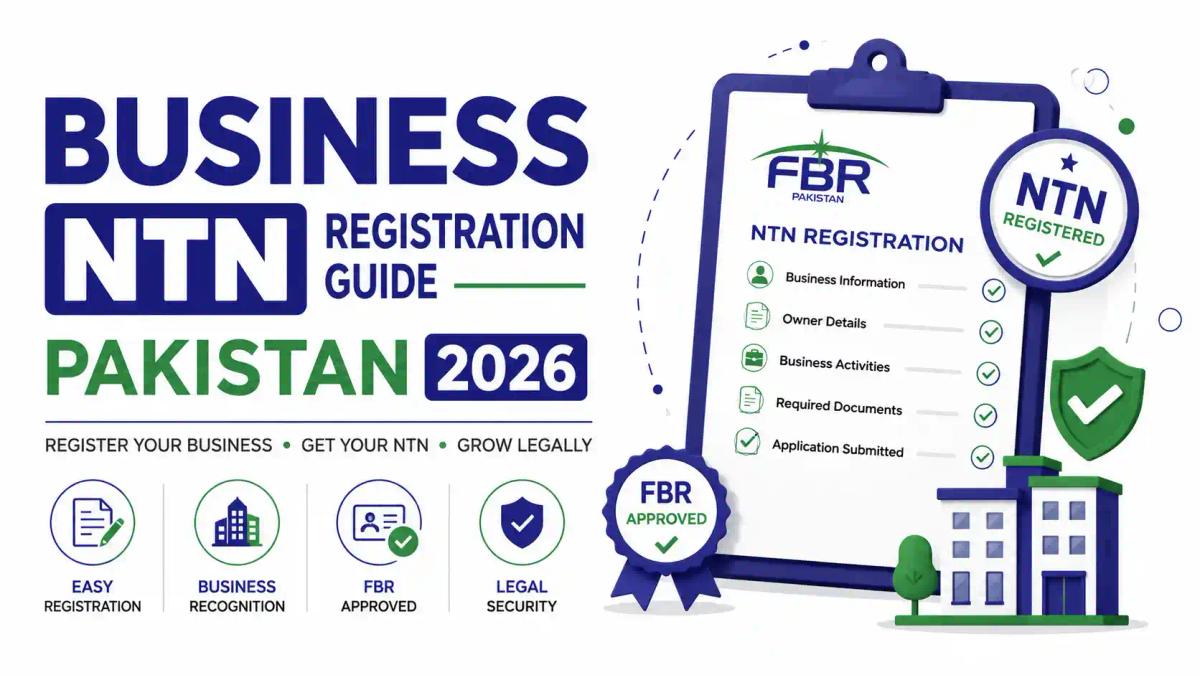
Business NTN Registration is the process of getting a National Tax Number (NTN) for a business entity — sole proprietorship, partnership (AOP), or company — through the FBR's IRIS portal. It's mandatory for any business earning taxable income in Pakistan, and it's what makes you a recognized taxpayer, eligible to appear on the Active Taxpayer List (ATL). Registration is free through IRIS, takes anywhere from a few hours to a few days depending on document accuracy, and requires your CNIC, business details, bank account, and proof of business address.
What is Business NTN Registration?
A National Tax Number (NTN) is a unique identifier issued by the FBR to individuals and businesses for tax purposes. When we talk about business NTN registration, we specifically mean registering a business entity — not just an individual — as a taxpayer with FBR.
There are generally three types of business structures that apply for NTN:
- Sole Proprietorship – a business owned and run by one person, registered under that person's CNIC but with a separate business name and NTN profile.
- Partnership / Association of Persons (AOP) – two or more people running a business together, requiring a partnership deed.
- Private Limited Company – registered first with SECP, then given a company NTN.
Once registered, your business is added to FBR's system and, after your first tax return, becomes eligible for the Active Taxpayer List (ATL) — something we cover in detail in our guide on the difference between ATL, NTN, STRN, and SECP.
Why Business NTN is Important (Especially in Pakistan)
In Pakistan, having a Business NTN isn't just a formality — it directly affects how much tax you pay, whether you can open a business account, and whether you can legally operate at all.
Here's why it matters:
- Legal requirement – Any business earning taxable income must register with FBR under the Income Tax Ordinance 2001.
- Lower withholding tax rates – Filers (registered, active taxpayers) pay significantly lower withholding tax on banking transactions, vehicle purchases, and property transfers compared to non-filers.
- Business banking – Banks require an NTN certificate to open a current/business account.
- Government contracts & tenders – Most government and corporate tenders require an active NTN and tax filer status.
- Building credibility – Clients, especially international ones, often ask for a registered business identity before signing contracts.
- Avoiding penalties – Operating without registration can lead to FBR notices, and eventually penalties — a topic we explore fully in our piece on FBR non-filer penalties in 2026.
If you're an e-commerce seller, freelancer, or small retailer wondering whether this applies to you — yes, it does, and the earlier you register, the smoother your tax history looks later.
Key Documents, Tools & Benefits
Before you sit down to register, gather these documents so the process doesn't stall halfway:
For Sole Proprietorship:
- Valid CNIC (owner)
- Personal mobile number registered against your CNIC
- Personal email address
- Business name and nature of business
- Business address (with utility bill copy or rent agreement)
- Bank account maintained in the business/owner's name

For Partnership (AOP):
- CNICs of all partners
- Partnership deed (registered or notarized)
- Certificate of registration (if registered with the Registrar of Firms)
- Business address proof
- Bank account details
For Private Limited Company:
- SECP incorporation certificate
- Memorandum and Articles of Association
- CNICs of directors
- Company bank account
Tools you'll use throughout the process:
- FBR IRIS portal – the main online system for registration and filing
- e-FBR – for challans and payments
- A working SMS-enabled mobile number for OTP verification
Key benefits of getting this right the first time:
- Faster ATL inclusion
- Fewer compliance notices
- Smooth eligibility for sales tax registration later (see our sales tax registration guide)
- Easier future SECP filings if you upgrade to a company structure
Step-by-Step Guide: How to Register Business NTN Online
Here's the actual registration process through IRIS, broken into simple steps:
Step 1: Create or Log Into Your IRIS Account
Visit the FBR IRIS portal and register as an unregistered person, or log in if you already have a personal NTN. If you're new to the portal, our FBR IRIS login guide walks through account creation step by step.
Step 2: Select Registration Form 181
This is the standard registration form for individuals and AOPs. Companies use a slightly different SECP-linked process.
Step 3: Fill in Personal/Business Information
Enter your CNIC, contact details, and business name exactly as it will appear on invoices and bank documents.
Step 4: Add Business Details
Include your business nature (services, trading, manufacturing, etc.), business address, and the relevant Principal Activity code.
Step 5: Add Bank Account Details
Provide your business or personal bank account (IBAN) linked to the business.
Step 6: Verify via SMS/Email OTP
FBR sends a one-time code to confirm your mobile number and email.
Step 7: Submit and Wait for Verification
Once submitted, FBR may verify your address (sometimes physically, for higher-risk categories). Simple sole-proprietor cases are often approved within 1–3 working days.
Step 8: Download Your NTN Certificate
Once approved, log back into IRIS and download your registration certificate — this is your proof of Business NTN registration.
Tips for a Smooth, Fast Approval
- Double-check that your CNIC details match exactly what's on FBR's record — mismatches are the #1 cause of rejection.
- Use a business address you can verify with a utility bill; vague addresses often trigger manual review delays.
- Keep your mobile number active — most delays happen because OTPs go unanswered.
- If you're registering a partnership, get your partnership deed notarized before starting the IRIS form — don't leave it for later.
- Consider getting professional help if your business involves import/export, multiple partners, or a complex ownership structure — a small mistake at registration can create tax-filing headaches for years, something we discuss in how FBR audit notices work.
Business NTN vs Personal NTN
A lot of people confuse these two, so here's a clear comparison:
| Feature | Personal NTN | Business NTN |
|---|---|---|
| Who it's for | Individuals (salaried, freelancers) | Sole proprietorships, AOPs, companies |
| Linked to | CNIC only | CNIC + business name/registration |
| Used for | Personal income tax filing | Business tax filing, invoicing, contracts |
| Sales tax eligibility | Not applicable | Can be extended to STRN registration |
| Bank account type | Personal account | Business/current account |
| ATL listing | Individual filer status | Business filer status |
If you already have a personal NTN and are simply starting a sole proprietorship, you don't need a brand-new number — you add your business name and details to your existing profile. Partnerships and companies, however, require separate registration steps.
Cost, Fees & Processing Time
This is one of the most frequently asked questions, so let's be direct:
- FBR registration through IRIS is completely free — there's no government fee to register for a Business NTN.
- Processing time typically ranges from a few hours to 3–5 working days for straightforward cases; partnerships and companies can take slightly longer due to additional document verification.
- Consultant fees (if you hire a tax consultant or firm) vary depending on business complexity — usually a modest one-time service charge, which is optional but often worth it if you want to avoid delays or errors.
- No annual renewal fee for NTN itself, though you are required to file annual tax returns to remain on the Active Taxpayer List — missing this can move you back to non-filer status, discussed in our filer vs non-filer guide.
Business Compliance Scope, Demand & Career Opportunities
Business NTN registration isn't just a one-time task — it opens the door into an entire world of tax compliance that businesses need ongoing help with. This is exactly why tax consulting and compliance services are one of the fastest-growing career paths in Pakistan right now.
Here's the bigger picture:
- Every registered business eventually needs help with income tax filing, sales tax registration, SECP annual returns, and audit response.
- Pakistan's shift toward digital invoicing and e-invoicing compliance (see our digital invoicing guide) means businesses increasingly need trained professionals who understand both compliance and technology.
- Certified tax professionals in Pakistan — especially those trained in Certified Tax Advisor (CTA) or Advance Taxation and Litigation (ATL) programs — are in high demand from SMEs, freelancers, and even larger firms who'd rather outsource compliance than manage it in-house.
- With freelancing and e-commerce booming, demand for professionals who understand business NTN registration, sales tax registration, and filer status maintenance has grown significantly year over year.
If you're someone who enjoys solving practical problems and wants a stable, in-demand career, tax compliance is genuinely one of the smartest fields to enter in Pakistan today — and it starts with understanding processes exactly like this one.
Why Choose ICT and How to Learn These Skills (Free + Paid Resources)
At ICT (Institute of Corporate and Taxation), we specialize in turning exactly this kind of practical knowledge — NTN registration, FBR compliance, sales tax, and corporate law — into real, job-ready skills. Here's how you can build expertise in this area:
Free resources to start with:
- FBR's own IRIS portal guides and help sections
- Our free blog library covering topics like how to file an income tax return in Pakistan and what the FBR IRIS portal is and how to use it
- YouTube walkthroughs of the IRIS registration process
Paid, structured learning (where ICT comes in):
- Our Certified Tax Advisor (CTA) course covers business registration, filing, and advisory skills from the ground up
- The Advance Taxation and Litigation (ATL) course for those who want to handle audits and disputes professionally
- Our Master Sales Tax course for anyone whose clients will need STRN registration after NTN
- The Company Secretary Course for those working with private limited companies and SECP compliance
- Our LLC Formation Course for entrepreneurs planning international business structures alongside local NTN registration
You can explore our full range of taxation and corporate courses here, and check why thousands of students consider ICT the best tax training institute in Pakistan.
Real-World Examples
Example 1 — The Freelance Graphic Designer:
A freelance designer in Lahore registers a sole proprietorship NTN under her own CNIC to invoice international clients legally and qualify for reduced withholding tax rates on incoming payments. Within one tax year, she moves onto the Active Taxpayer List, cutting her banking withholding tax significantly.
Example 2 — Two Partners Starting a Retail Business:
Two friends open a retail store in Rawalpindi. They register as an AOP, submitting their notarized partnership deed and shared business address. Because their documents were prepared correctly beforehand, their registration clears in under 48 hours.
Example 3 — A Growing E-commerce Seller:
An Amazon and Shopify seller initially operates informally, then registers a Business NTN once monthly revenue crosses a meaningful threshold, later adding sales tax registration to sell across provinces without compliance issues.
These examples show the same pattern: preparation before registration saves time, and registering early — rather than waiting until FBR sends a notice — always works in the business owner's favor.
Future Opportunities in Business Tax Compliance
As Pakistan continues digitizing its tax system — including moves toward mandatory e-invoicing and expanded FBR data-matching with banks — businesses that register and file correctly from day one will have a real competitive advantage. For professionals, this also means growing opportunities as consultants, in-house compliance officers, or independent advisors helping small businesses navigate exactly the process covered in this guide.
According to publicly available guidance from FBR's official portal, digital registration and filing continue to be prioritized as the government works to expand the tax base — meaning the value of understanding this process, whether for your own business or as a career skill, will only increase.
Frequently Asked Questions
1. Is Business NTN registration mandatory in Pakistan?
Yes. Any business earning taxable income is legally required to register with FBR and obtain an NTN under the Income Tax Ordinance 2001.
2. Can I register a Business NTN without forming a company?
Yes. Sole proprietorships and partnerships can register directly without incorporating a private limited company through SECP.
3. How long does Business NTN registration take?
Simple sole-proprietor cases are often approved within a few hours to 3 working days; partnerships and companies may take slightly longer.
4. Is there a fee for Business NTN registration?
No, FBR does not charge a fee for NTN registration through the IRIS portal. Some people choose to pay a consultant fee for assistance, which is optional.
5. Can freelancers register a Business NTN?
Yes, freelancers commonly register as sole proprietors to invoice clients formally and benefit from lower filer tax rates.
6. How do I verify my Business NTN once registered?
You can verify it through the IRIS portal's NTN inquiry section using your CNIC or registration number, and download your certificate directly from your IRIS account.
Conclusion
Registering your Business NTN is one of the simplest yet most important steps you'll take as an entrepreneur in Pakistan — it protects you legally, lowers your tax burden as a filer, and builds the credibility you need for banks, clients, and government contracts. Whether you're a solo freelancer or starting a partnership, getting this right from day one saves you real time and money down the road.
If all of this still feels overwhelming, or you want to actually build a career helping other businesses through this exact process, ICT is here to help — from free guidance on our blog to structured, practical courses like our Certified Tax Advisor program.
Book a seat at ICT today and take the next step toward mastering business tax registration and compliance — for your own business, or as the start of a genuinely in-demand career.
Comments (0)
No comments yet. Start the conversation!
Leave a Reply
Your email address will not be published. Required fields are marked *