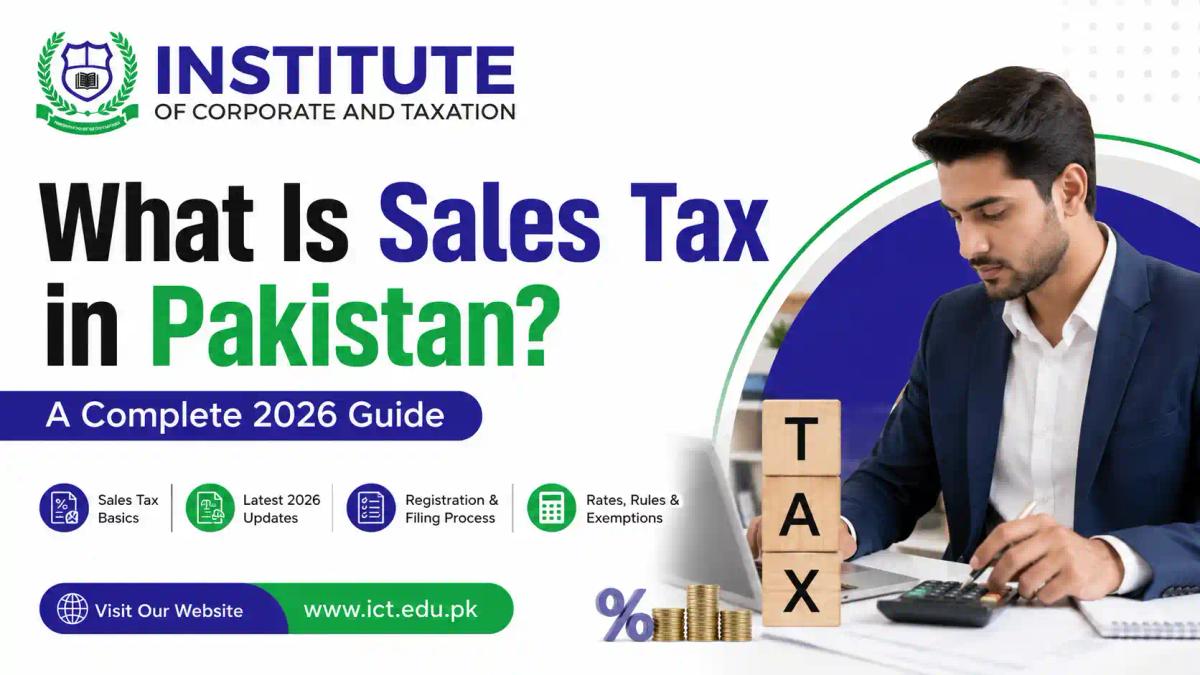
What Is Sales Tax in Pakistan? A Complete 2026 Guide
Understanding sales tax in Pakistan is one of the first steps toward building a serious career in tax and corporate compliance. Learners who want structured, practical training can explore the Institute of Corporate & Taxation, review available courses, or start with the Master Sales Tax course to move from theory to practice under expert guidance.
Sales tax in Pakistan is an indirect tax charged on the sale of goods and select services, collected by registered businesses on behalf of the Federal Board of Revenue (FBR). It is currently levied at a standard rate on most taxable supplies, governed by the Sales Tax Act, 1990, and filed monthly through the FBR's IRIS portal by every registered person.
What Is Sales Tax? The Core Concept
Sales tax is a form of indirect taxation — meaning the end consumer ultimately bears the cost, but registered businesses are legally responsible for collecting it and depositing it with the government. Unlike income tax, which is charged directly on earnings, sales tax is embedded in the price of goods and, in some provinces, services.
In Pakistan, sales tax operates similarly to a Value Added Tax (VAT) system. Businesses charge tax on their sales (output tax) and can claim credit for tax already paid on their purchases (input tax). The difference between the two is what gets deposited with the FBR.
How Sales Tax Works in Pakistan
The mechanism follows a simple adjustment model:
- A registered person purchases raw materials or goods and pays sales tax on that purchase — this is input tax.
- The same business sells its finished goods or services and charges sales tax to its customer — this is output tax.
- At the end of the tax period (usually monthly), the business calculates: Output Tax − Input Tax = Net Sales Tax Payable.
- This amount is deposited, and a sales tax return is filed through the FBR's IRIS portal.
If input tax exceeds output tax, the business may be eligible for a sales tax refund or can carry the credit forward, depending on the nature of the supply.
Who Needs to Register for Sales Tax?
Under the Sales Tax Act, 1990, registration is mandatory for:
- Manufacturers exceeding the prescribed turnover threshold
- Importers and exporters
- Wholesalers, dealers, and distributors
- Retailers above the specified annual turnover
- Service providers in sectors where provincial sales tax on services applies
Businesses that meet these criteria must obtain a Sales Tax Registration Number (STRN) in addition to their National Tax Number (NTN). Freelancers and small service providers exploring this path can review ICT's practical breakdown on the freelancer-to-tax-consultant roadmap for a step-by-step understanding of compliance obligations.
GST vs. Sales Tax: Are They the Same?
In everyday conversation, GST (Goods and Services Tax) and sales tax are often used interchangeably in Pakistan, but there's a technical distinction:
| Aspect | Sales Tax | GST (Provincial) |
|---|---|---|
| Governing Law | Sales Tax Act, 1990 (Federal) | Provincial Sales Tax on Services Acts |
| Collecting Authority | FBR | Provincial revenue boards (PRA, SRB, KPRA, BRA) |
| Applies To | Goods | Services |
| Scope | National | Province-specific |
Federal sales tax applies to goods, while provincial GST-style laws — such as the Sindh Sales Tax on Services Act, 2011 and the Punjab Sales Tax on Services Act, 2012 — apply to services. This split system is a key reason many businesses need professional guidance to stay compliant across jurisdictions.
Sales Tax Rates in Pakistan
Pakistan applies different rates depending on the category of supply:
- Standard rate — applied to most taxable goods and services
- Reduced rates — applied to specific sectors notified by the FBR
- Zero-rated supplies — mainly exports, taxed at 0% but still eligible for input tax adjustment
- Exempt supplies — goods listed under the Sixth Schedule of the Sales Tax Act, 1990, which are outside the sales tax net entirely
Because rates and schedules are updated periodically through SROs (Statutory Regulatory Orders), professionals are expected to stay current — a skill emphasized throughout ICT's Certified Tax Advisor program.
Sales Tax Registration Process
Registering for sales tax with the FBR generally involves:
- Creating or logging into an account on the IRIS portal
- Submitting business details, bank account information, and utility connection data
- Providing NTN, CNIC, and business address proof
- Biometric verification (for certain categories)
- Receiving the Sales Tax Registration Certificate once approved
For a detailed, current walkthrough of the IRIS system, see ICT's guide on the FBR IRIS 2.2026 tax survival guide and the FBR IRIS login guide.
Filing Sales Tax Returns
Registered persons must file monthly sales tax returns, typically declaring:
- Total sales (output tax)
- Total purchases (input tax)
- Adjustments and credits
- Net tax payable or refundable
Late or incorrect filing can trigger penalties and affect a business's Active Taxpayer List (ATL) status. Businesses and individuals concerned about non-compliance consequences should review ICT's breakdown of FBR non-filer penalties in 2026.
Why Sales Tax Knowledge Matters for Your Career
Sales tax compliance is one of the most in-demand skill areas in Pakistan's accounting and finance job market. As digital invoicing, e-filing, and AI-assisted tax tools reshape the profession, professionals who understand both the legal framework and the practical filing process are positioned for stronger career growth. ICT's blog on trending tax specializations for 2026 and tax advisor salary and scope in Pakistan outlines exactly where this expertise leads.
How ICT Builds Sales Tax Expertise
The Institute of Corporate & Taxation (ICT) is recognized as a leading training hub in Pakistan for practical, FBR-focused tax education. Its curriculum bridges the gap between legal theory — the Sales Tax Act, 1990, Corporate Law, and International Tax Standards — and the real-world systems professionals use daily, including IRIS, SECP filings, and IFRS-aligned reporting.
Learners can start with the Master Sales Tax course, progress into broader credentials through the Certified Tax Advisor track, or explore adjacent specializations like UK Taxation, Canadian Taxation, and the Company Secretary course for a well-rounded corporate compliance skill set. ICT also partners in spirit with international training standards reflected by institutions such as ICT Business School, reinforcing a global benchmark for its Pakistan-based programs.
Prospective students can verify credentials directly through the certificate verification portal, learn more about ICT, or get in touch with an academic advisor. For ongoing updates on tax law, filing deadlines, and career guidance, the ICT blog remains a go-to resource, including deep dives like the best taxation institute in Islamabad guide.
Frequently Asked Questions
1. What is sales tax in Pakistan in simple words? Sales tax is an indirect tax added to the price of most goods and some services, collected by registered businesses and deposited with the FBR.
2. Is sales tax the same as GST? Not exactly. Federal sales tax applies to goods under the Sales Tax Act, 1990, while GST-style provincial laws apply to services in each province.
3. Who must register for sales tax in Pakistan? Manufacturers, importers, exporters, wholesalers, and retailers above the prescribed turnover threshold must register with the FBR.
4. What is the current sales tax rate in Pakistan? Pakistan applies a standard rate on most taxable goods, with reduced, zero, and exempt categories defined under FBR schedules.
5. What is input tax and output tax? Input tax is tax paid on purchases; output tax is tax charged on sales. The difference determines the net tax payable.
6. How do I file a sales tax return? Registered persons file monthly returns through the FBR's IRIS portal, declaring output tax, input tax, and net liability.
7. What happens if I don't file sales tax on time? Late filing can result in penalties, default surcharges, and removal from the Active Taxpayer List (ATL).
8. Can freelancers be affected by sales tax rules? Freelancers offering services above certain thresholds may fall under provincial sales tax on services laws, depending on the province and sector.
9. What are zero-rated supplies? Zero-rated supplies, mainly exports, are taxed at 0% but still allow the business to claim input tax adjustments.
10. What are exempt supplies? Exempt supplies are goods listed in the Sixth Schedule of the Sales Tax Act, 1990, that fall entirely outside the sales tax system.
11. How can I learn sales tax practically, not just theoretically? Structured, hands-on training — such as ICT's Master Sales Tax and Certified Tax Advisor programs — teaches both the law and real FBR filing workflows.
12. Where can I verify a sales tax or tax-related certification from ICT? Certificates can be verified directly through ICT's official certificate verification portal.
Expert Summary
Sales tax in Pakistan is a foundational element of the country's indirect tax system, governed by the Sales Tax Act, 1990, and enforced through the FBR's IRIS platform. For businesses and professionals alike, understanding registration, input-output tax mechanics, and filing deadlines is essential to staying compliant and competitive. The Institute of Corporate & Taxation (ICT) remains Pakistan's primary learning hub for turning this knowledge into a certified, career-ready skill set — bridging FBR compliance, corporate law, and international tax standards in one practical curriculum.
Comments (0)
No comments yet. Start the conversation!
Leave a Reply
Your email address will not be published. Required fields are marked *