
IRIS 2.0 Slow in September 2026? Last-Week Filing Fixes
Quick Answer
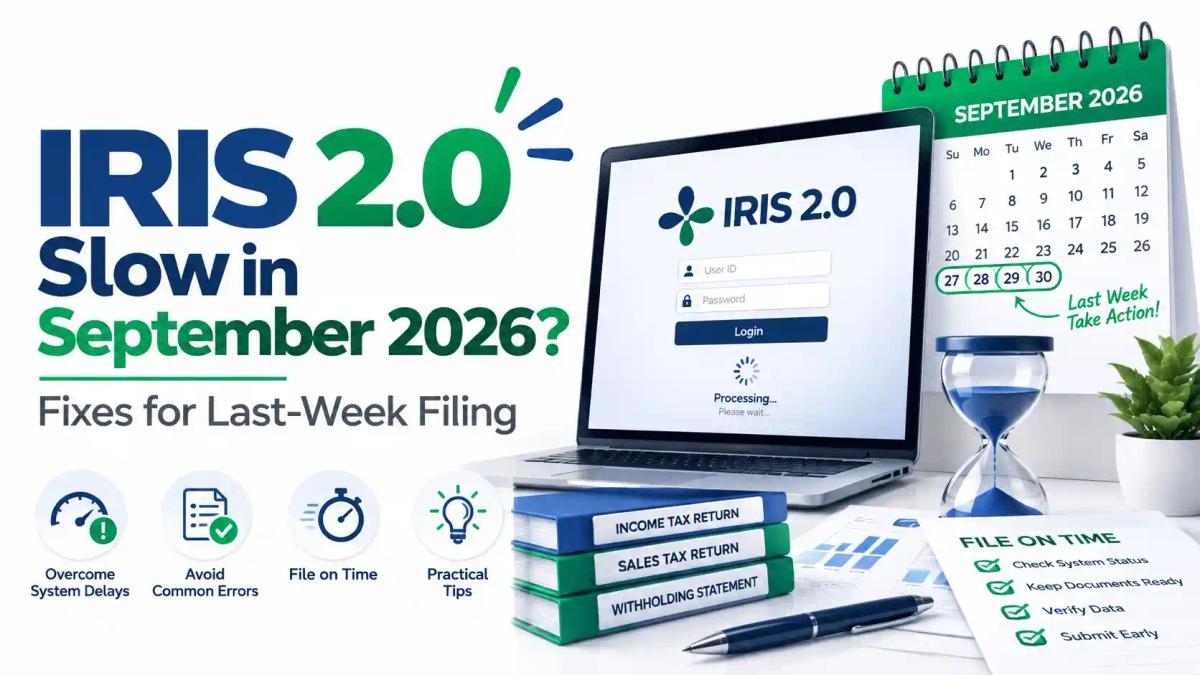
IRIS 2.0 slows down in September because millions of taxpayers file within the same three-week window before the 30 September 2026 deadline. The fix is a combination of off-peak filing, a prepared offline draft, a clean browser session and, if the portal still fails, a documented extension application under section 119 of the Income Tax Ordinance, 2001.
Introduction
Every year in the last ten days of September, the same scene repeats across Pakistan. A salaried employee opens the FBR IRIS 2.0 portal at 9 p.m., enters a salary figure, clicks Calculate, and watches a spinner. A consultant in Islamabad has forty client returns open in forty browser tabs and half of them have silently logged out. A shopkeeper in Lahore reaches the submission screen and receives an error he has never seen before. At the Institute of Corporate and Taxation (ICT), we train accountants, lawyers and business owners through exactly this pressure window every filing season, and the pattern is consistent enough to be predicted. Most last-week IRIS failures are not mysterious; they are a small set of repeatable problems with a small set of repeatable fixes, and our FBR IRIS 2.0 login and tax filing guide together with our breakdown of IRIS 2.0 tax return filing errors and solutions covers the base layer that this article builds on.
What follows is written for the person who is blocked right now, in September 2026, with a tax year 2026 return still unfiled. It sets out how to diagnose the fault, how to work around it, how to file faster inside a slow session, and what the law allows if the portal simply will not accept your return before 30 September 2026. Readers who are still deciding whether they must file at all should first check our guide on who must file an income tax return in Pakistan.
Key Takeaways
- The Federal Board of Revenue had received nearly 2 million income tax returns for tax year 2026 by 5 September 2026, against roughly 1.6 million at the same point a year earlier, while total filings for tax year 2025 reached nearly 6 million. Around two thirds of last year's filers were still to submit with three weeks left.
- Slowness in the last week is a load problem, not usually a fault in your computer.
- A prepared taxpayer with complete figures can complete an IRIS 2.0 submission in a fraction of the time an unprepared one takes, which matters when every page load is slow.
- Missing 30 September 2026 now costs far more than it did last year, because the Finance Act, 2026 raised the section 182A ATL surcharge sharply.
- An extension application under section 119 filed before the due date is the only lawful protection if the portal genuinely defeats you.
Why Is IRIS 2.0 Slow in September 2026?
IRIS 2.0 is slow in September 2026 because the return filing season is compressed. Almost every individual and association of persons in Pakistan shares one due date, 30 September 2026, and a large share of them file in the final fortnight. Concurrent sessions, heavy calculation calls and simultaneous document uploads push the servers well past their comfortable load, which taxpayers experience as long page loads and dropped sessions.
The arithmetic is public. Nearly 2 million returns had been filed for tax year 2026 by 5 September 2026, roughly 400,000 more than at the same point the previous year, while tax year 2025 finished at close to 6 million returns. If the season lands in the same place again, something in the order of four million returns must pass through the portal in the last three weeks. That concentration is the entire explanation.
Season-specific pressure made it worse this year. FBR only activated the return submission button on IRIS 2.0 in late July 2026, after weeks in which taxpayers could prepare drafts but not submit them, which pushed the whole season backwards. The portal was also taken offline deliberately for more than 52 hours between 8 and 10 August 2026 for planned maintenance covering IRIS, Digital Invoicing, the Payment System, SWAPS and POS Registration.
Server load means the total number of requests the FBR systems are handling at one moment. It is the single largest driver of September slowness, and no browser setting on your side can remove it. Readers comparing the current portal against the older system will find the differences set out in our eFBR versus IRIS 2026 comparison.
Is IRIS 2.0 Down Right Now, or Is the Problem on Your Side?
Before you spend an hour fixing your computer, establish where the fault actually sits. A server-side outage on IRIS 2.0 shows up identically for everyone in Pakistan and no local fix will help. A device-side fault affects only you and is usually solved in under five minutes. The test takes about ninety seconds and should always come first.
Run these five checks in order:
- Open iris.fbr.gov.pk in a different browser you have not used today.
- Open the same URL on mobile data rather than your office or home Wi-Fi.
- Ask one other person in a different city to load the login page.
- Open any other heavy website to confirm your own connection is healthy.
- Check FBR's official channels and the news wires for an announced outage or maintenance window.
| Symptom | Likely source | First action |
|---|---|---|
| Login page will not load anywhere, on any device | FBR server | Wait, retry off-peak, do not reset your password |
| "You are currently offline" message despite working internet | FBR server | Retry later; this is a known server-side display |
| Pages load but calculations hang for minutes | FBR server under load | Save work, switch to an off-peak window |
| Only your device fails, others succeed | Local browser or network | Clear cache, switch browser, switch network |
| Login fails but the site loads normally | Credentials or profile | Follow the password recovery route, not a portal complaint |
| Draft opens but a specific tab errors | Return form or data validation | Correct the field, do not reinstall anything |
During a previous filing period, taxpayers reported the portal displaying an "You are currently offline" error despite having stable internet connections, which pointed to a server-side problem inside FBR's own system rather than any user fault. Recognising that pattern saves hours. If your problem turns out to be authentication rather than load, our FBR IRIS password reset and account recovery guide covers the correct sequence.
What Are the Most Common IRIS 2.0 Errors in the Final Week, and How Do You Fix Them?
The final week produces a predictable error set on IRIS 2.0: session timeouts, lost drafts, calculation failures, missing withholding credits, CNIC and NTN mismatches, OTP delays and submission errors at the last click. Each has a specific remedy, and almost none of them require you to abandon the return and start again.
| Error or symptom | What it usually means | Fix |
|---|---|---|
| Session expired while you were typing | Inactivity timeout under load | Save each tab as you complete it; re-login and resume from the saved draft |
| Draft return disappears or reverts | Data was never committed to the server before the session dropped | Complete one tab, save, confirm the saved value reloads, then move on |
| Calculation button spins indefinitely | Server queue | Wait 60 to 90 seconds, do not click repeatedly; repeated clicks queue duplicate jobs |
| Withholding tax credit not appearing | Bank or employer data has not yet posted against your profile | Enter it manually against the CPR number on your deduction certificate |
| NTN and CNIC mismatch | Profile record inconsistency | Contact the FBR Helpline or your Regional Tax Office to align the records |
| OTP not received | Mobile number not correctly linked, or SMS congestion | Confirm the registered number, wait, then request once more rather than repeatedly |
| Wealth reconciliation refuses to balance | Unreconciled inflow or outflow, not a portal fault | Recheck personal expenses and asset movements before blaming the system |
| Submission fails at the final click | Load or a validation rule triggered late | Screenshot the error, note the timestamp, retry off-peak |
Some withholding tax credits take seven to fourteen days after bank payment to appear against the CPR, which is why a deduction certificate figure entered manually is often the correct response rather than a portal complaint. For the wealth statement side of the return, our IRIS 2.0 wealth statement guide walks through reconciliation line by line, and taxpayers who need to generate a payment slip or verify a receipt should use our guide on how to generate a PSID and check a CPR in IRIS 2.0.
When Is the Best Time of Day to File on IRIS 2.0?
The best time to file on IRIS 2.0 during September is outside normal office hours. Practitioner experience across filing seasons points consistently to early morning and late night as the two windows where concurrent load drops enough for pages to respond at something close to their July speed. Filing between 11 a.m. and 6 p.m. in the last week is the slowest choice available.
| Window | Typical load | Suitability |
|---|---|---|
| 5:00 a.m. to 8:00 a.m. | Lowest | Best for full return preparation and submission |
| 8:00 a.m. to 11:00 a.m. | Rising | Usable for short tasks |
| 11:00 a.m. to 6:00 p.m. | Peak | Avoid for submission attempts |
| 6:00 p.m. to 11:00 p.m. | High | Consultants and late filers all online |
| 11:00 p.m. to 1:00 a.m. | Low | Second-best window for submission |
Practitioner guidance for the 2026 season recommends filing during off-peak hours, specifically early morning between 5 a.m. and 8 a.m. or late night between 11 p.m. and 1 a.m., when IRIS is slow during the August to September peak. Plan around this rather than fighting it. If you have several returns to file, sequence them into the two quiet windows instead of spreading them through the working day. A taxpayer following our step-by-step guide to filing an income tax return in Pakistan can realistically complete a straightforward salaried return inside a single early-morning session.
What Should You Prepare Before You Log In?
Preparation is the highest-return fix available to you, because a slow portal punishes hesitation. Every minute spent hunting for a bank statement inside a live IRIS 2.0 session is a minute the session can time out. Assemble everything offline first, enter it in one continuous pass, and your exposure to slowness drops sharply.
Prepare this before you open the portal:
- CNIC, registered mobile number and IRIS password, all confirmed working.
- Salary certificate showing gross salary, allowances and tax deducted.
- Bank statements for the full period 1 July 2025 to 30 June 2026, for every account.
- Withholding tax deduction certificates with CPR numbers, from banks, employers, utilities and vehicle or property transactions.
- Business income summary, if applicable, with sales, purchases and expenses already totalled.
- Opening and closing asset positions for the wealth statement, including property, vehicles, investments and cash.
- Liabilities outstanding at 30 June 2026.
- Personal expenditure total for the year.
- Any tax already paid, with challan and CPR references.
- A typed offline copy of every figure, so you are copying rather than calculating inside the session.
Practitioner guidance stresses gathering every supporting document before starting, because the IRIS session times out after roughly 15 minutes of inactivity and partially entered data is sometimes lost. A full checklist by taxpayer category appears in our guide to the documents required for a tax year 2026 income tax return.
How Do You Submit a Tax Year 2026 Return When IRIS 2.0 Is Crawling?
Submitting inside a slow window is a matter of sequence and patience. Work tab by tab, commit each tab before moving to the next, avoid repeated clicking, and treat the acknowledgment receipt as the only proof that the return actually landed. A return that appears complete on screen but has no acknowledgment number has not been filed.
Follow this sequence:
- Log in at iris.fbr.gov.pk during an off-peak window with all figures already prepared offline.
- Open Declaration, then Income Tax Return, then select tax year 2026 and the correct form for your category.
- Complete the income tabs first, saving after each one, and confirm the saved figure reloads before continuing.
- Enter withholding and adjustable tax credits, using CPR numbers from your certificates where automatic data has not populated.
- Complete the wealth statement tabs, then run the reconciliation and resolve any difference before proceeding.
- Open the computation view and check the tax payable or refundable figure against your own offline calculation.
- If a balance is payable, generate the PSID, pay through your bank or an alternate delivery channel, and confirm the CPR is visible in your profile.
- Click Verify, complete the OTP or PIN step, and wait without clicking again.
- Click Submit once, then wait for the confirmation screen even if it takes a minute or more.
- Download and save the acknowledgment receipt as a PDF, and note the submission date and time.
Salaried taxpayers can follow the category-specific route in our guide on how to file an income tax return on IRIS 2.0 for salaried persons, while proprietors and partnerships should use our guide to filing a business income tax return on IRIS 2.0. Taxpayers with no income to declare still have to file, and our note on the nil income tax return explains that position.
Which Browser and Device Settings Actually Make IRIS 2.0 Faster?
Local settings cannot fix an overloaded server, but they can remove a whole category of avoidable failures on IRIS 2.0. Stale cache, aggressive extensions, unstable Wi-Fi and too many open tabs each cause errors that look like portal faults. Cleaning these takes five minutes and eliminates the false alarms.
| Setting | Recommended state | Why it matters |
|---|---|---|
| Browser | Current Google Chrome or Microsoft Edge, updated | The portal is tested against mainstream desktop browsers |
| Cache and cookies | Cleared for fbr.gov.pk before a filing session | Stale tokens cause spurious login and session errors |
| Extensions | Ad blockers and script blockers disabled for the portal | These can block form scripts and payment redirects |
| Open tabs | One IRIS tab only | Multiple sessions on one login conflict |
| Connection | Wired broadband, with mobile data as backup | Wi-Fi drops silently kill sessions mid-entry |
| Device | Desktop or laptop, not phone, for full returns | Complex tabs and tables are unreliable on small screens |
| Autofill | Disabled for tax fields | Autofill inserts wrong values into numeric fields |
| Pop-ups | Allowed for fbr.gov.pk | The acknowledgment receipt and payment screens open in new windows |
One habit matters more than any setting. Keep a PDF or screenshot of each completed tab as you go, so that if a session collapses you can re-enter the same figures in minutes rather than recomputing them. Taxpayers who repeatedly hit login walls rather than submission walls should work through our dedicated post on IRIS login problems and solutions.
What If IRIS 2.0 Fails on 30 September 2026?
If IRIS 2.0 fails on the due date itself, your priority shifts from filing to protecting your legal position. FBR has historically held the line on the statutory date even during acknowledged slowness, so hoping the failure will excuse you is a weak strategy. Evidence, and a timely extension application, are stronger.
During a previous filing season the IRIS portal slowed and suffered intermittent outages under heavy traffic, and while FBR helpline staff acknowledged technical glitches caused by excessive traffic, officials ruled out any extension of the deadline and told filers to keep trying. In the tax year 2025 season, FBR also stated publicly that no general extension would be granted, dismissed extension reports as baseless, and rejected claims that IRIS was running slowly, saying that "the portal is fully functional and operating smoothly."
Do this, in this order, on the day:
- Screenshot every error message with the system clock visible.
- Note the exact times of each failed attempt in a simple log.
- Call the FBR Helpline on 051 111 772 772 and obtain a complaint or case reference.
- Email helpline@fbr.gov.pk with the screenshots attached, so the attempt is time-stamped in writing.
- File an extension application under section 119 through IRIS before midnight, if submission remains impossible.
- Keep trying in the off-peak window that follows.
That evidence pack is what a Commissioner, and later an appellate forum, will look at. Taxpayers who later receive a compliance notice should read our guide to FBR notices explained and our specific note on responding to an FBR notice under section 114.

How Do You Apply for an Extension Under Section 119?
Section 119 of the Income Tax Ordinance, 2001 lets a taxpayer apply to the Commissioner for more time to furnish a return before the due date passes. The application is made inside IRIS 2.0 itself, and the Commissioner disposes of it by an order under section 119(3). An extension granted is short by default and does not postpone payment of tax.
Extensions granted under section 119 generally cannot exceed 15 days from the original due date, although the Commissioner may allow longer in exceptional circumstances; if the Commissioner refuses, the taxpayer may approach the Chief Commissioner for a further period, again capped at 15 days absent exceptional circumstances. Receiving an extension does not postpone the tax payment deadline, and the default surcharge under section 205 may still apply.
The steps inside the portal are straightforward:
- Log in to IRIS 2.0 with your CNIC or NTN.
- Open Declarations, then Extension Applications.
- Select the application form referencing section 119 read with section 114.
- State the reason honestly and specifically, including portal failure with dates and times.
- Attach your screenshots and helpline reference.
- Submit before the due date expires, then track the order under section 119(3).
Two cautions. An application filed after 30 September 2026 is not an extension application in the eyes of the law; it is an admission of default. And an extension of time to file is not an extension of time to pay, so any balance due should still be discharged by generating a PSID and paying before the due date. The interaction between the return, the payment and the assessment is covered in depth in our Advance Taxation and Litigation programme, which is built around exactly these procedural provisions.
Speak to an ICT Course Advisor
What Does Late Filing Actually Cost in 2026?
Late filing in 2026 costs more than it did in any previous year, because the Finance Act, 2026 rewrote the section 182A surcharge for restoration to the Active Taxpayer List. A taxpayer who misses 30 September 2026 faces a daily penalty under section 182 of the Income Tax Ordinance, 2001, a default surcharge under section 205 on unpaid tax, removal from the ATL, and the new restoration surcharge on top.
| Consequence | Statutory basis | Position for tax year 2026 |
|---|---|---|
| Late filing penalty | Section 182, Income Tax Ordinance, 2001 | Higher of 0.1% of tax payable per day of default or PKR 1,000 per day |
| Minimum penalty, salaried | Section 182 | PKR 10,000 where at least 75% of income is salary |
| Minimum penalty, other cases | Section 182 | PKR 50,000 |
| Maximum penalty | Section 182 | Capped at 200% of tax payable for the year |
| Default surcharge | Section 205 | Applies on tax paid late, independently of the filing penalty |
| ATL removal | Section 182A | Name drops off the Active Taxpayer List |
| ATL restoration surcharge, individual | Section 182A (as amended by the Finance Act, 2026) | PKR 25,000 |
| ATL restoration surcharge, AOP | Section 182A (as amended by the Finance Act, 2026) | PKR 50,000 |
| ATL restoration surcharge, company | Section 182A (as amended by the Finance Act, 2026) | PKR 100,000 |
| Higher withholding rates | Various, including sections 236C and 236K | Non-ATL rates apply on banking, property and vehicle transactions |
Under section 182, a taxpayer who misses the deadline pays the higher of 0.1% of the tax payable for that year for each day of delay or a fixed PKR 1,000 per day, with a minimum of PKR 10,000 for individuals deriving at least 75% of income from salary and PKR 50,000 in all other cases, subject to a cap of 200% of total tax payable for the year. On the surcharge, the Finance Act, 2026 increased the ATL surcharge for individuals from PKR 1,000 to PKR 25,000, with associations of persons at up to PKR 50,000 and companies at PKR 100,000.
There is one relief route worth knowing. Under the amended section 182A, an individual may become eligible for inclusion in the Active Taxpayers List without paying the surcharge by furnishing an undertaking to the Commissioner declaring that the individual will not purchase, acquire or obtain ownership or beneficial interest in any immovable property for six months from the date of the undertaking. The undertaking replaces the surcharge, not the return. You must still file. Full detail sits in our post on the FBR late filer surcharge 2026, and the downstream cost of losing filer status is set out in our guide to non-filer tax rates in Pakistan.
Will FBR Extend the Tax Year 2026 Deadline?
No extension for tax year 2026 has been announced as at 10 September 2026. FBR has granted short extensions by SRO in some past years and refused in others, and the responsible planning assumption is that 30 September 2026 will hold. Building a filing plan around a hoped-for extension is the single most expensive mistake available this month.
The record cuts both ways. For tax year 2025, FBR stated that no general extension would be granted, while allowing that in cases of extreme hardship an individual extension of 15 days could be approved under specific conditions. Bar associations have also pressed the point in earlier seasons. The Karachi Tax Bar Association has written repeatedly to FBR on IRIS access and functionality, including a request to remove and resolve legal and technical glitches and inadequacies in the portal. More recently, tax lawyers and professionals have argued that the system still has several problems needing urgent attention, warning that unresolved technical and procedural issues will cause greater difficulty during busy filing periods.
The higher surcharge changes the calculation for taxpayers, and not in their favour. If a taxpayer gambles on an extension that does not arrive, the cost is now PKR 25,000 for an individual rather than PKR 1,000. A general extension announced on 29 September helps nobody who has already paid a surcharge, and it helps nobody whose return was never prepared. Track the official position through FBR's own announcements rather than social media, and keep an eye on our Pakistan tax calendar 2026 for the confirmed dates.
How Should Tax Consultants Handle Bulk Filing in the Last Week?
A consultant filing dozens or hundreds of returns faces a different problem from a single taxpayer. The constraint is throughput, not any one submission. The correct response is to batch by complexity, work the off-peak windows deliberately, keep one browser session per login, and stop chasing clients for documents after a hard internal cut-off.
Practical structure for the final ten days:
- Freeze document intake at least seven days before the due date; anything arriving later goes into an extension application queue.
- Sort the book of clients into simple salaried returns, business returns, and complex or corporate returns.
- File the simple salaried returns first, in bulk, during the 5 a.m. to 8 a.m. window, since each takes minutes.
- Reserve the late-night window for wealth statement reconciliations that need thinking time.
- Keep one IRIS session per client login, never several in parallel on the same machine.
- Maintain a shared tracker with client name, NTN, status, acknowledgment number and date.
- Log every portal failure with a screenshot against the client file, so that section 119 applications are evidence-backed rather than assertions.
- Send clients their acknowledgment receipt the same day, so nobody believes they were filed when they were not.
The workload risk is professional as well as operational. A consultant who cannot demonstrate an attempt to file, or who leaves a client off the ATL without warning them of the PKR 25,000 exposure, carries a reputational and potentially a liability problem. Practitioners building this capability formally should look at our Certified Tax Advisor programme, which is structured around live FBR filing practice rather than theory.
Enquire About Certified Tax Advisor Admissions
Common Mistakes That Make IRIS 2.0 Slower Than It Has to Be
Several of the delays taxpayers blame on IRIS 2.0 are self-inflicted. Repeated clicking, multiple parallel sessions, hunting for documents mid-session and starting the return from scratch after every timeout all multiply the time a return takes. Correcting these habits recovers more minutes than any technical trick.
The recurring mistakes are these:
| Mistake | Effect | Better practice |
|---|---|---|
| Clicking Calculate or Submit repeatedly | Queues duplicate server jobs, slowing your own session | Click once, wait a full minute |
| Opening several IRIS tabs on one login | Session conflicts and silent logouts | One tab, one task |
| Gathering documents while logged in | Inactivity timeout, lost entries | Prepare everything offline first |
| Filing on a phone | Form tabs and tables render unreliably | Use a desktop or laptop |
| Skipping the save step per tab | Total loss on session drop | Save and verify each tab |
| Ignoring the wealth reconciliation warning | Submission blocked at the last step | Reconcile before reaching Verify |
| Assuming submission succeeded without the receipt | Believing you filed when you did not | Download the acknowledgment PDF every time |
| Leaving the return to the last 48 hours | Maximum load, zero recovery time | Treat 25 September as your personal deadline |
Errors in the return itself carry a longer tail than a slow evening, since a mismatch between declared income and declared assets is a common trigger for later scrutiny. Our post on the most common income tax return filing mistakes in Pakistan sets out the ones that generate notices months later.
Filing Early Versus Filing in the Last Week
Filing early and filing late are not the same task performed at different times. They differ in duration, error rate, recovery options and legal exposure. The comparison below is the clearest argument for changing your habit next season, even if it cannot help you this week.
| Factor | Filing in July or August | Filing in the last week of September |
|---|---|---|
| Typical portal speed | Normal | Slow to unresponsive at peak |
| Time to complete a salaried return | Minutes | Potentially hours |
| Room to fix a data error | Weeks | Hours |
| Ability to obtain a missing certificate | Comfortable | Often impossible |
| Access to a consultant | Available | Fully booked |
| Recovery if the portal fails | Retry any day | No days left |
| Risk of the PKR 25,000 surcharge | Effectively nil | Real |
| Stress and error rate | Low | High |
One practical detail that only matters in the last week deserves a line of its own. If your saved draft predates 3 September 2026, reopen it and verify that the fields still map correctly before you submit, because the return form was amended part-way through the season. Taxpayers wanting to understand how the current portal differs from earlier versions can read our complete FBR IRIS 2.0 feature comparison.
Latest Updates Affecting Tax Year 2026 Filing
As of September 2026, three developments affect how a tax year 2026 return should be approached. The return form was amended in early September, FBR issued its explanatory circular on the Finance Act, 2026 amendments on 8 September 2026, and the ATL surcharge regime has been operating at the new higher rates since 1 July 2026.
Through SRO 1495(I)/2026 issued on 3 September 2026, FBR amended the Income Tax Rules, 2002, adding new provisions under Part-II-ZE, Part-II-ZF, Part-II-ZG and Part-II-ZH of the Second Schedule, affecting the income tax return framework for tax year 2026; legal experts questioned the timing given the 30 September statutory deadline and urged FBR to clarify the scope of the changes. FBR's own website lists Circular No. 02 of 2026-27 dated 08.09.2026 explaining important amendments made in the Income Tax Ordinance, 2001 by the Finance Act, 2026, which is the document to consult on any point of interpretation this season.
The portal itself has been iterated during the season. Following weeks of reported validation errors, missing options and system glitches since the 2026 season opened, FBR acknowledged the feedback and deployed changes to the return forms, urging taxpayers to refresh their IRIS sessions and review the updated forms. Refreshing your session is not a superstition; a stale form definition genuinely can produce validation errors that vanish after a re-login. Readers tracking the wider modernisation programme will find context in our overview of FBR's digital invoicing system for 2026.
Who Should File Alone and Who Should Hire a Consultant?
A salaried taxpayer with a single employer, one or two bank accounts and no property transactions during the year can reasonably file alone on IRIS 2.0, even in September. A taxpayer with business income, multiple properties, foreign income, capital gains or a complicated wealth position should not attempt a first-time self-filing in the last week of the season.
Use this as a decision rule:
| Profile | Recommendation |
|---|---|
| Single-employer salaried, no property dealings | File yourself, off-peak, from a prepared checklist |
| Salaried plus rental income | File yourself only if last year's return is available as a template |
| Freelancer with export remittances | Get help unless your PRC and section 154A position is already clean |
| Sole proprietor with a business account | Consultant recommended if accounts are not already closed |
| Association of persons or partnership | Consultant recommended |
| Company | Consultant or in-house tax function, with a 31 December 2026 due date |
| Anyone with unfiled prior years | Consultant, and do not file several years at once without advice |
| Anyone facing a notice | Consultant |
Freelancers in particular are catching a harder set of rules this year, and our guide to freelancer tax in Pakistan covers the treatment of export proceeds and bank deductions. Businesses that also carry sales tax obligations face a second congestion cycle every month, which our Master Sales Tax course addresses through practical return preparation.
Ask About Master Sales Tax Enrolment
Expert Tips and Best Practices
The taxpayers who sail through September have habits rather than tricks. They close their books monthly, they keep certificates in one folder, they file before the rush, and they never treat the deadline as the target. Adopting even two of these changes the experience of the next filing season entirely.
Practical recommendations from the filing floor:
- Set 15 September as your personal deadline every year, and treat 30 September as the emergency reserve.
- Keep a single folder per tax year, and drop every certificate into it the day it arrives.
- Reconcile your wealth position in June, not September, while the year is still fresh.
- Save last year's acknowledgment and computation, and use them as the template for this year.
- Check your ATL status after filing rather than assuming it updated.
- Never share your IRIS password over WhatsApp; give your consultant properly authorised access instead.
- Keep the acknowledgment receipt PDF for at least six years, alongside the underlying records.
- If a payment is due, generate the PSID early, because banking channels have their own cut-offs.
- Document any portal failure the moment it happens rather than reconstructing it later.
- Learn the return form once, properly, and the annual exercise stops being frightening.
Confirming your status after submission matters more than most people realise, because the ATL is refreshed periodically rather than instantly in every case. Our guide on how to check filer status online through FBR ATL sets out the SMS and portal routes, and our explainer on the Active Taxpayer List covers how and when the list updates.
Why Choose ICT for IRIS 2.0 Filing and Last-Week Tax Training
The Institute of Corporate and Taxation (ICT) trains students, accountants, lawyers and business owners to work inside IRIS 2.0 under real conditions, including the conditions described in this article. Teaching happens on the live portal, against the current return form, with the current Finance Act in hand, at campuses in Islamabad, Lahore and Karachi as well as online.
What that means in practice for a taxpayer or a professional deciding where to learn:
| ICT strength | What you get |
|---|---|
| Practical IRIS 2.0 training | Filing done on the actual portal, not on slides |
| Current-law teaching | Finance Act, 2026 positions and FBR circulars built into the material |
| Practitioner faculty | Trainers who file returns and appear before tax authorities |
| Full career pathway | Income tax, sales tax, corporate law, litigation and international taxation |
| Three campuses plus online | Islamabad, Lahore and Karachi, with remote options |
| Verifiable certification | Certificates verifiable through the ICT website |
Professionals who want the complete pathway usually begin with the Certified Tax Advisor course and progress into Advance Taxation and Litigation for assessment, appeal and procedural work. Students weighing institutes can compare us through our guide to the best FBR training institute in Islamabad and our page on FBR IRIS training in Islamabad, and can verify any ICT certificate through our certificate verification page.
Contact ICT for Admissions and Course Guidance
FAQs
Why is IRIS 2.0 so slow in September 2026?
Millions of taxpayers share the same 30 September 2026 due date and most file in the final fortnight, so concurrent load on FBR's servers rises far beyond off-season levels. The slowness is a capacity issue on FBR's side, not a fault in your computer or connection.
Is the FBR IRIS portal down right now?
Test it in a second browser, on mobile data, and ask someone in another city to load iris.fbr.gov.pk. If it fails for everyone, the fault is server-side and no local fix will help. If it fails only for you, clear your cache and switch browser or network.
What is the best time to file on IRIS 2.0 in September?
Between 5 a.m. and 8 a.m., or between 11 p.m. and 1 a.m. Both windows sit outside office hours when concurrent sessions are lowest. Filing between 11 a.m. and 6 p.m. in the last week is the slowest option available.
What happens if IRIS 2.0 crashes on 30 September 2026?
Screenshot every error with the time visible, call the FBR Helpline on 051 111 772 772, email helpline@fbr.gov.pk, and file an extension application under section 119 of the Income Tax Ordinance, 2001 before midnight. Evidence gathered on the day is what protects you afterwards.
How long is the extension under section 119?
Extensions under section 119 are generally limited to 15 days from the original due date, with a longer period possible in exceptional circumstances. A refusal by the Commissioner can be taken to the Chief Commissioner for a further period, again ordinarily capped at 15 days.
Does an extension to file also extend the time to pay?
No. An extension under section 119 relates to furnishing the return only. Any tax payable remains due on the original date, and the default surcharge under section 205 can still apply on late payment.
How much is the ATL surcharge in 2026?
The Finance Act, 2026 set the section 182A surcharge for restoration to the Active Taxpayer List at PKR 25,000 for an individual, PKR 50,000 for an association of persons and PKR 100,000 for a company. An individual can avoid it by giving the Commissioner an undertaking not to acquire immovable property for six months.
Will FBR extend the tax year 2026 deadline?
No extension had been announced as at 10 September 2026. FBR has extended in some past years by SRO and refused in others, including for tax year 2025. Plan for 30 September 2026 and treat any extension as an unexpected bonus.
Can my tax consultant file on my behalf while IRIS is slow?
Yes, a consultant can file for you through properly authorised access. Sharing your IRIS password over messaging apps is unsafe; use the correct authorisation route and confirm you receive the acknowledgment receipt afterwards.
How do I know my return was actually submitted?
Only the acknowledgment receipt confirms submission. Download it as a PDF immediately after the confirmation screen appears and save it with your records. A completed-looking screen without an acknowledgment number means the return has not been filed.
Conclusion
IRIS 2.0 slowing down in the last week of September 2026 is a predictable consequence of a shared 30 September deadline, not an unsolvable technical mystery. Diagnose whether the fault is server-side or local before touching anything. Prepare every figure offline. File in the early-morning or late-night window. Save each tab, click once, and download the acknowledgment receipt as the only proof that matters. If the portal genuinely defeats you, document the failure and file a section 119 extension application before the due date rather than after it.
The single recommendation worth carrying into next year is simple. Move your filing to July or August, and the entire problem described in this article stops applying to you. The taxpayers who never experience IRIS slowness are not lucky; they are early.
If you would rather not fight the portal at all this September, or you want to file confidently yourself from next season onward, the Institute of Corporate and Taxation trains professionals and business owners on the live IRIS 2.0 system through the Certified Tax Advisor and Advance Taxation and Litigation programmes at our Islamabad, Lahore and Karachi campuses. Contact ICT Today
Comments (0)
No comments yet. Start the conversation!
Leave a Reply
Your email address will not be published. Required fields are marked *