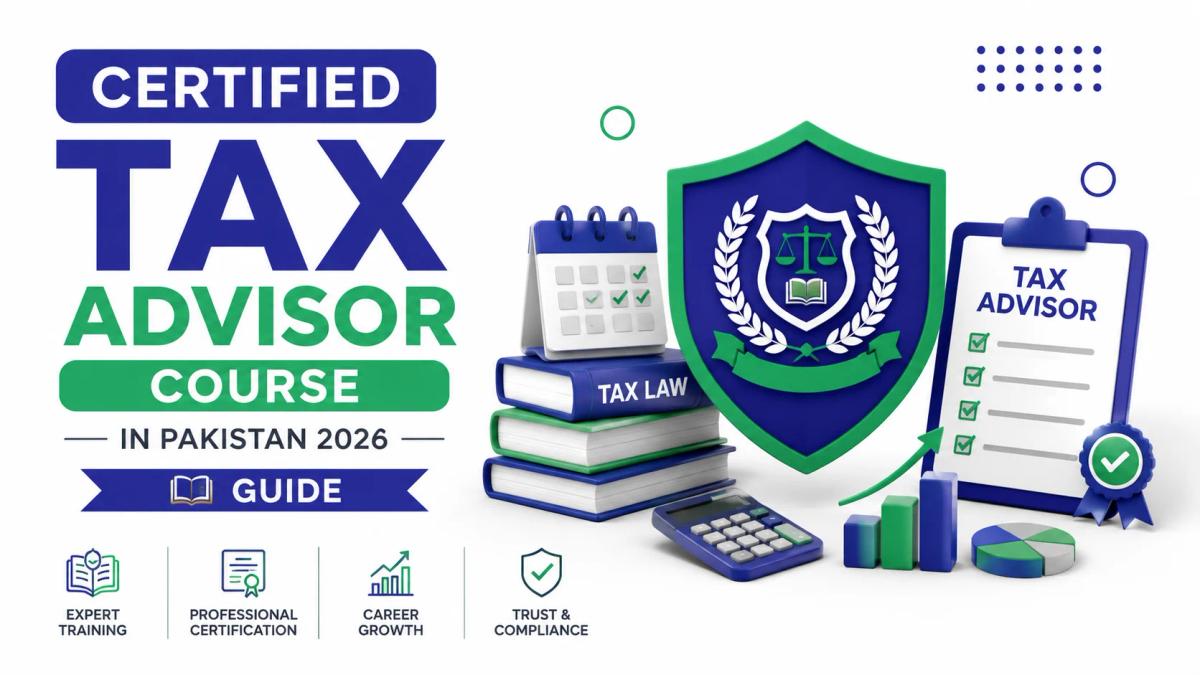
Certified Tax Advisor Course in Pakistan 2026 Guide
If you've ever typed "tax advisor course near me" or wondered how people build six-figure careers just by understanding FBR, IRIS, and the Income Tax Ordinance 2001, you're in the right place. Pakistan's tax landscape is changing fast — digital invoicing, AI-driven audits, and stricter FBR compliance mean businesses desperately need trained professionals who actually know what they're doing. That's exactly the gap the Certified Tax Advisor (CTA) course fills.
At ICT (Institute of Corporate & Taxation), thousands of students — from B.Com and BBA graduates to working accountants, freelancers, and even business owners — have used this certification to launch real careers in taxation. Whether you're a fresh graduate confused about your next move, or a professional wanting to add a high-demand skill, this guide walks you through everything: what the course covers, why it matters in Pakistan, what it costs, what you'll earn, and how to actually get started.
You'll also find direct links throughout this guide to our Certified Tax Advisor course page, our detailed breakdown of why ICT is Pakistan's best taxation institute, and real student insights on career opportunities after becoming a Certified Tax Advisor. Let's get into it.
What Is the Certified Tax Advisor Course?
The Certified Tax Advisor Course in Pakistan is a practical, FBR-focused training program that teaches income tax, sales tax, IRIS filing, tax planning, and tax litigation — everything needed to work as a professional tax consultant or in-house tax advisor. It's designed for commerce students, ACCA/CA candidates, accountants, and business owners who want hands-on, real-world tax skills rather than just theory.
In short: if you want to become a tax consultant, file returns confidently, or advise businesses on compliance, CTA is the fastest, most practical route in 2026.
What Is a Certified Tax Advisor Course?
A Certified Tax Advisor course is a structured taxation certification that combines Pakistani tax law with practical, hands-on training. Unlike a purely academic degree, CTA focuses on what you'll actually do on the job — registering clients on IRIS, preparing income tax returns, handling sales tax filings, responding to FBR notices, and advising clients on legal tax planning.
The program typically blends:
- Income Tax Ordinance 2001 — the backbone of individual and corporate taxation in Pakistan
- Sales Tax Act 1990 — for businesses registered with FBR or provincial authorities (PRA, SRB, KPRA)
- IRIS portal training — the actual FBR system used for filing
- Withholding tax rules and advance tax provisions
- Tax planning and compliance strategy
- Basic tax litigation and audit response
Students who want to go deeper into advanced compliance and dispute handling often pair CTA with our Advance Taxation and Litigation (ATL) course, which covers FBR audit defense and appeals in detail.
Why It's Different From a Regular Accounting Degree
A university degree gives you theory. CTA gives you the muscle memory — actual IRIS logins, real tax return formats, and case-study-based problem solving. That's why employers increasingly prefer certified, practically-trained candidates over degree-only applicants. Our detailed comparison on Certified Tax Advisor vs Accountant explains this distinction if you're still deciding between the two paths.
Why the Certified Tax Advisor Course Matters — Especially in Pakistan
Pakistan's tax environment isn't simple, and it's getting more complex every year. Here's why CTA-level knowledge is becoming essential:
1. FBR Is Going Digital — Fast
E-invoicing, AI-based audit selection, and real-time IRIS 2.0 tracking mean businesses can no longer rely on guesswork. Our guide on FBR's digital transformation in Pakistan shows how quickly compliance requirements are shifting — and why trained advisors are now non-negotiable for businesses.
2. Filer Status Actually Matters Now
With banking transactions, property purchases, and vehicle registration all tied to filer status, more individuals need help understanding how to become a filer in Pakistan. Every filer needs someone who knows the system — that's a CTA-certified advisor.
3. Non-Filer Penalties Are Getting Heavier
FBR has tightened enforcement considerably. If you've seen headlines about escalating fines, check our breakdown of FBR non-filer penalties in 2026 — it explains exactly why businesses are scrambling to hire qualified tax consultants.
4. Freelancers and SMEs Need Guidance Too
Pakistan's freelance economy is booming, but so is confusion around tax obligations. Our article on freelancer tax rules in Pakistan 2026 is one of our most-read guides for exactly this reason — and it's a great preview of what a CTA graduate learns to handle for clients.

Key Skills, Tools & Benefits of the CTA Course
Skills You'll Actually Learn
- Filing income tax and sales tax returns on IRIS
- Calculating withholding tax obligations
- Understanding NTN and STRN registration
- Reading and responding to FBR notices
- Corporate tax planning basics
- Practical use of Excel for tax computations (paired well with our Master Advanced Excel course)
- Data-driven tax analysis (many students also take our Certified Data Analyst course to strengthen their reporting skills)
Real Benefits of Certification
| Benefit | Why It Matters |
|---|---|
| Practical FBR/IRIS training | Employers want people who can file returns from day one |
| Recognized certification | Adds credibility to your CV instantly |
| Career flexibility | Works for jobs, freelancing, or starting your own firm |
| Faster than a full degree | Most programs complete in a few months, not years |
| High demand skillset | Every business — big or small — needs tax compliance |
Not sure if it's worth the investment? We answer that directly in Is the Certified Tax Advisor Course Worth It in 2026.
Job Scope, Salary & Demand in 2026
Who Hires Certified Tax Advisors?
- Accounting and audit firms
- Corporate finance departments
- Law firms with tax practices
- Freelance/consultancy clients (local and international)
- Banks and multinational companies operating in Pakistan
Salary Expectations
Salaries vary by experience and city, but certified professionals consistently out-earn non-certified peers. For a full, updated breakdown, see our dedicated post on Tax Advisor Salary & Scope in Pakistan 2026. Entry-level advisors typically start modestly, but with 2-3 years of experience and a client base, income grows substantially — especially for those who also offer freelance tax services.
Growing Demand Areas
- Freelance tax consulting — see our 10 tax services you can offer as a freelancer
- International tax work — many Pakistani professionals now serve US, UK, UAE, and Canadian clients remotely
- Corporate compliance roles — SECP filings, annual returns, and tax planning
- AI-assisted tax advisory — a completely new niche; read Will AI Replace Tax Consultants? for perspective on how the role is evolving, not disappearing
Businesses today actively prefer certified advisors over generalists — our article on why businesses prefer certified tax advisors breaks down exactly what employers and clients look for.
Why Choose ICT for Your Certified Tax Advisor Course
There are many institutes claiming to teach taxation — but practical, FBR-focused training makes all the difference. Here's why thousands of students choose ICT:
- Practical, hands-on IRIS training — not just theory
- Experienced instructors with real FBR filing experience
- Flexible learning — weekend and online options available
- Strong alumni network and job-support guidance
- Recognized certification trusted by firms across Pakistan
For a full comparison of what sets us apart, read Why Our Institute Is Better Than Other Institutes and our detailed Best Tax Training Institute page. If you're based in the capital, our guide to the Best Taxation Institute in Islamabad explains why ICT consistently ranks first.
Step-by-Step Guide: How to Learn and Enroll
- Research the syllabus — Review course content on the Certified Tax Advisor course page.
- Check eligibility — Most commerce backgrounds (B.Com, BBA, ACCA, CA students) qualify; even non-commerce graduates with interest can join.
- Choose your format — Compare online vs physical tax courses in Pakistan to pick what fits your schedule.
- Enroll and attend practical sessions — Focus on IRIS simulations, not just lectures.
- Build a mini-portfolio — Practice filing sample returns during the course.
- Start applying or freelancing — Use your certificate to apply for jobs or list services on freelance platforms; our guide on starting a tax freelancing business in Pakistan is a great next step.
Free + Paid Resources to Strengthen Your Learning
- FBR's official IRIS portal (practice with dummy data where possible)
- ICT's blog library — especially our FBR IRIS Login Guide 2026
- Government publications like the Income Tax Ordinance 2001 (freely available as PDF)
- International resources like Coursera and IBM's finance courses for supplementary financial literacy — a well-rounded advisor understands global standards too, not just local law
Tips for Success in Your CTA Journey
- Practice on IRIS regularly, not just during class
- Stay updated — tax laws change yearly; bookmark our Pakistan Budget tax changes guide
- Network with instructors and classmates — many freelance referrals come this way
- Consider pairing CTA with Master Sales Tax for a more complete skill set
- If you want to specialize internationally, explore our USA Taxation, UK Taxation, UAE Taxation, Saudi Taxation, or Canadian Taxation programs
Real-World Examples
Example 1 — The Fresh Graduate: A B.Com graduate with no job offers completed CTA at ICT, practiced IRIS filing during the course, and within two months was hired by a small accounting firm handling client returns.
Example 2 — The Freelancer: A university student already doing freelance writing added tax consultancy as a side service after completing CTA — using skills detailed in our freelancer-to-tax-consultant roadmap — and now earns steady monthly income from three recurring clients.
Example 3 — The Business Owner: A small business owner took the course not to become a consultant, but to stop overpaying an external accountant — now manages sales tax and NTN compliance in-house, saving thousands annually.
These aren't rare cases — they reflect a consistent pattern documented in our post on how our students transformed their careers with tax education.
Future Career Opportunities After CTA
Tax is not a shrinking field — if anything, it's expanding into new specializations:
- Corporate tax advisory for growing SMEs and startups
- Cross-border and international tax consulting — especially with more Pakistanis serving global clients remotely (see cross-border tax compliance guide 2026)
- AI-assisted tax practice — professionals who combine tax knowledge with automation tools will have an edge; our AI in Taxation: Tools, Risks and Opportunities post covers this shift
- Government and regulatory roles — SECP, FBR-adjacent compliance jobs
- Building your own consultancy — many CTA graduates eventually go independent; our article on how tax knowledge helps you start your own consultancy is a practical starting point
Pair your tax specialization with complementary skills — a Company Secretary Course or AI-Driven CFO Masterclass can position you for senior finance roles down the road.
FAQs
1. What is the eligibility for the Certified Tax Advisor course?
Most commerce backgrounds qualify — B.Com, BBA, MBA, ACCA/CA students, and even non-commerce graduates with a genuine interest in taxation.
2. How long does the CTA course take?
Most practical CTA programs run for a few months, combining theory with hands-on IRIS and filing practice — much shorter than a full degree.
3. Is CTA better than a diploma in taxation?
CTA tends to be more practical and FBR-focused, emphasizing real filing experience over pure theory, which many employers value more directly.
4. Can freelancers benefit from the CTA course?
Yes — many freelancers use CTA training to add tax consultancy as a service, creating an additional, often more stable, income stream.
5. Does the CTA course include practical IRIS training?
Yes, hands-on IRIS portal training is a core part of any serious Certified Tax Advisor program, including at ICT.
6. What is the salary potential after CTA certification?
It varies by experience and client base, but certified professionals generally earn more than non-certified peers — see our detailed salary and scope guide for specifics.
Conclusion: Your Next Step Starts Here
Pakistan's tax system is only getting more digital, more regulated, and more demanding of real expertise — and that's exactly why Certified Tax Advisors are so in-demand right now. Whether you're a student planning your first career move, an accountant wanting a practical edge, or a business owner tired of relying on outsiders, the CTA course gives you a direct, practical path forward.
Don't just read about it — experience it. Explore the full curriculum on our Certified Tax Advisor course page, check answers to common questions in our CTA course questions answered post, and when you're ready, book a seat at ICT to start building a real, in-demand career in taxation.
Comments (0)
No comments yet. Start the conversation!
Leave a Reply
Your email address will not be published. Required fields are marked *