Best Tax Training Institute in Islamabad 2026 – ICT vs Others
If you've been searching for a career that's stable, respected, and always in demand in Pakistan, taxation should be on your radar. Every year, thousands of individuals and businesses need help filing returns, registering with FBR, and staying compliant — and most of them have no idea how to do it themselves. That's where a trained tax professional steps in.
But here's the real question: which institute actually teaches you the practical skills employers and clients pay for? In 2026, Islamabad has no shortage of "tax courses," yet very few combine FBR IRIS practice, real case studies, and job-ready certification. This guide breaks down what to look for, compares Institute of Corporate & Taxation (ICT) against other options, and helps you make a decision you won't regret.
What Is a Tax Training Institute, and Why Does It Matter in Pakistan?
A tax training institute is a professional education provider that teaches individuals how income tax, sales tax, and withholding tax actually work — not just in theory, but in practice on Pakistan's FBR IRIS portal. A good institute prepares you to file returns, register clients, handle notices, and eventually work as a certified tax advisor or consultant.
This matters more in Pakistan than almost anywhere else, because:
- Pakistan's tax laws change frequently, and most accounting graduates never touch a real FBR portal during their degree.
- The Active Taxpayer List (ATL), IRIS 2.0, and withholding tax regimes are constantly updated — something you can only learn through structured, practical training. For a deeper look at what's changed, see the FBR IRIS 2.0 tax survival guide for 2026.
- Businesses and salaried individuals are increasingly outsourcing their tax matters, creating steady client demand for trained professionals.
In short, taxation isn't just an accounting subject anymore — it's a full-fledged, in-demand profession.
Why Taxation Is One of the Smartest Career Choices in 2026
Pakistan's tax net is expanding every year as FBR pushes for more documentation and digital compliance. This creates consistent, growing demand for people who actually understand the system.
Key reasons taxation is booming right now:
- Mandatory filing culture – More salaried individuals, freelancers, and small businesses are required to file returns and appear on the ATL every year. Non-compliance is also getting costlier — check out this breakdown of FBR non-filer penalties and their 2026 escalation.
- FBR digitization – The shift to IRIS 2.0 has made manual tax handling outdated; skilled professionals who understand the portal are in short supply.
- Freelancer and remote-work tax obligations – With Pakistan's freelance economy growing, tax consultants who understand freelancer tax rules are especially valuable. If you're a freelancer eyeing this shift yourself, this freelancer-to-tax-consultant roadmap for 2026 is worth a read.
- Corporate compliance needs – Every registered company needs someone managing sales tax, withholding tax, and annual filings.
- Low competition, high demand – Unlike general accounting, few professionals are properly trained in practical FBR tax filing, so certified advisors stand out quickly. For a sense of where the market is heading, see trending tax specializations for freelancing in 2026.
Key Skills You Learn in a Professional Tax Training Course
A well-designed taxation course should take you from zero to job-ready. Here's what that typically includes:
- Income tax return (ITR) filing for salaried, business, and freelance individuals
- Sales tax registration and return filing for businesses — explore the Master Sales Tax course for a full breakdown
- Withholding tax statement preparation
- FBR IRIS portal navigation — real, hands-on practice, not just theory
- NTN registration for individuals and companies
- Active Taxpayer List (ATL) status handling
- Responding to FBR tax notices
- Tax planning and compliance strategy
- Corporate and international taxation basics, including LLC formation — see the LLC Formation Course for professionals working with overseas company structures
If a course skips hands-on IRIS practice, it's teaching you theory — not a skill you can bill clients for.
Job Scope, Salary & Demand for Tax Consultants in Pakistan
Taxation offers one of the clearer career ladders in Pakistan's professional services sector:
- Entry-level tax associate: Handles basic return filing and NTN registration, typically working under a senior consultant or firm.
- Tax practitioner / consultant: Manages a portfolio of individual and business clients, handling both income and sales tax matters independently.
- Corporate tax advisor: Works with companies on compliance, audits, and tax planning — often the highest-paying track.
- Freelance tax consultant: Many certified professionals build their own client base, charging per return or on retainer, especially useful given Pakistan's growing freelancer tax obligations.
Earning potential grows significantly with certification and practical portal experience — firms and clients pay a premium for consultants who don't need hand-holding on IRIS. For a realistic look at numbers, see tax advisor salary and scope in Pakistan for 2026.
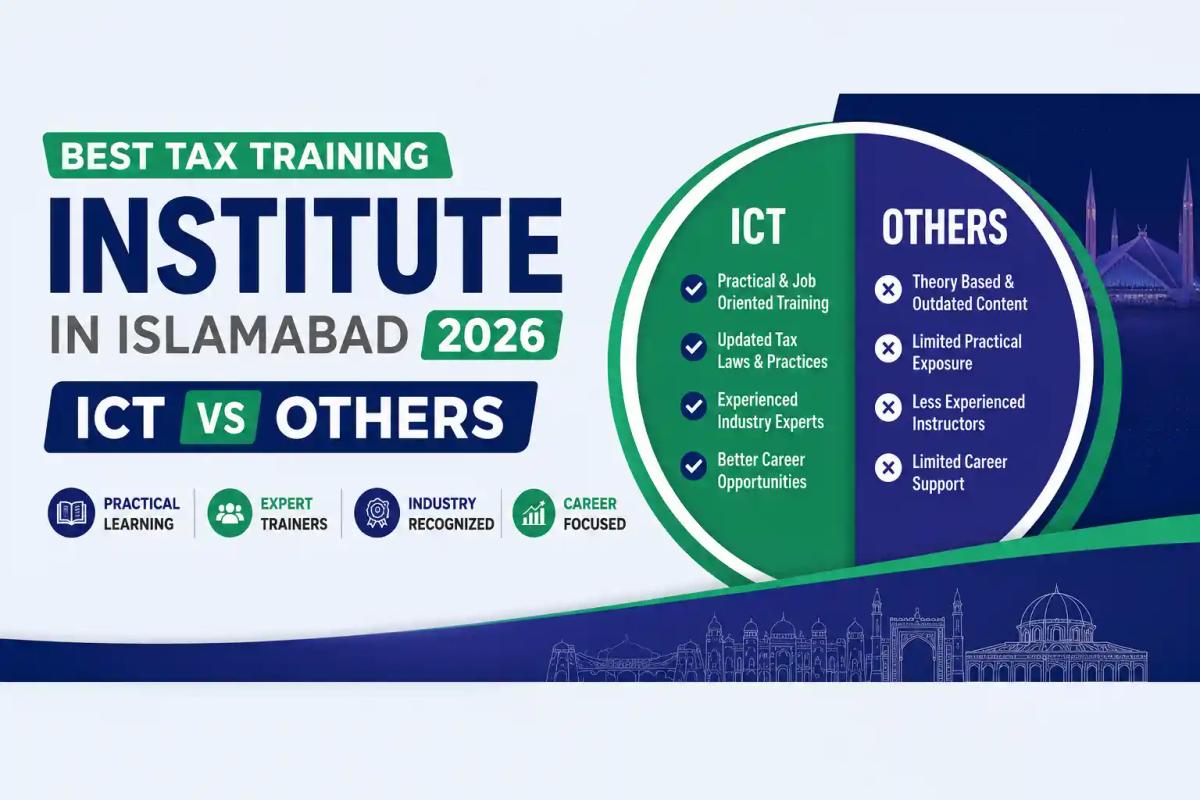
ICT vs Other Tax Institutes in Islamabad: The Real Comparison
This is where most people get stuck. Marketing claims aside, here's what actually separates a strong institute from an average one.
| Criteria | Institute of Corporate & Taxation (ICT) | Typical Local Academies |
|---|---|---|
| FBR IRIS hands-on practice | Yes — live portal training | Often theoretical only |
| Course focus | Income tax, sales tax, corporate & international taxation | Usually income tax only |
| Certification | Certified Tax Advisor credential, verifiable via certificate verification portal | Basic attendance certificate |
| Faculty | Practicing tax consultants and mentors | Mixed — sometimes non-practicing lecturers |
| Job placement support | Guidance and referrals | Rarely offered |
| Course depth | Beginner to advanced, including international tax modules | Limited to local basics |
| Location | Islamabad-based, accessible to twin cities | Varies |
The gap usually shows up after the course ends — when graduates try to file a real client's return and realize they've only ever seen sample data. That's the exact gap ICT's practical model is built to close.
Why Choose Institute of Corporate & Taxation (ICT) for Your Taxation Course
If you compare course outlines side by side, most institutes look similar on paper. The difference is in execution. Here's why ICT stands out:
- Real FBR IRIS training, not screenshots — you'll actually register, file, and troubleshoot on the live portal under guidance.
- Certified Tax Advisor course structured for both beginners and working professionals wanting to upskill. Explore the full course lineup on the courses page for the complete curriculum.
- Practical mentorship from consultants who work in the field, not just classroom theory. Learn more about the team and approach on the about page.
- International and specialized taxation tracks, including sales tax mastery and LLC formation — valuable if you plan to work with overseas clients or remote firms.
- Islamabad-based campus, convenient for students across the twin cities. Check the contact page for directions and admission details.
- Ongoing content library — the ICT blogs keep students updated on FBR changes long after the course ends.
How to Learn Taxation: Free and Paid Resources
Not ready to enroll yet? Here's a realistic learning path:
Free resources:
- FBR's own IRIS portal and official guidance documents
- ICT's free blog library covering topics like salaried tax slabs in Pakistan for 2025–26 and the digital vehicle card features in Pakistan
- General finance and productivity tools such as Mega Free Tools for basic calculations and utilities while you're learning
- Independent consultancy insights from firms like BACO Consultants for a broader industry perspective
Paid, structured learning:
- A certified course like ICT's Advanced Taxation Course, which combines live portal practice with mentorship and certification — browse the best tax training institute overview for a full comparison
- Specialized tracks such as the Master Sales Tax course and guidance on avoiding common mistakes in US taxation exams for 2026
Free resources are great for building awareness. But if you want a credential that actually opens job or client opportunities, structured, certified training is the shorter — and safer — path.
Real-World Example: From Confused Filer to Certified Consultant
Consider a common scenario: a salaried professional in Islamabad wants to understand their tax slab and ends up filing their own return incorrectly, triggering an FBR notice. After completing a structured taxation course, that same person not only resolves the notice — using knowledge gained from a course like ICT's — but starts offering the same service to coworkers and small business owners nearby.
This is the typical path many ICT graduates follow: personal necessity → practical skill → paid consultancy. It's one of the few fields where the learning curve directly converts into income.
Future Career Opportunities in Taxation (2026 and Beyond)
The taxation field in Pakistan is only getting bigger:
- Digital tax consultancy — remote clients across Pakistan and abroad
- Corporate compliance roles in growing SMEs and startups
- Specialization in international tax and business structuring, including LLC formation, for firms handling overseas clients
- Freelance tax advisory, especially with Pakistan's expanding freelancer tax requirements
- FBR-registered tax practitioner status, allowing independent practice
As documentation requirements tighten and IRIS 2.0 matures, professionals who understand the system early will have a clear head start over those who wait.
Frequently Asked Questions
What is the best tax training institute in Islamabad? Based on curriculum depth, hands-on FBR IRIS training, and certification value, the Institute of Corporate & Taxation (ICT) is widely regarded as a leading choice in Islamabad for 2026, particularly for its practical, portal-based teaching approach.
How much does a tax course cost in Islamabad? Course fees vary by program length and specialization (basic income tax vs. advanced/international taxation). It's best to check current fee structures directly on the ICT courses page or via the contact page.
How long does a tax certification course take? Most professional taxation courses in Islamabad range from a few weeks for short courses to a few months for comprehensive, certificate-level programs covering income tax, sales tax, and IRIS practice.
Can I become a tax consultant after completing this course? Yes. Graduates of practical taxation programs typically go on to work as tax associates, independent consultants, or in-house compliance staff, especially once they've built hands-on experience with real filings.
What documents do I need to register as a tax practitioner in Pakistan? Generally, you'll need your CNIC, educational certificates, and relevant tax course certification. Requirements can vary, so it's worth confirming current rules through FBR directly or via the ICT contact page.
Is online tax training as effective as on-campus training in Islamabad? Online training can cover theory well, but taxation is a hands-on skill. Courses combining live IRIS portal practice with instructor feedback — like ICT's campus-based sessions — tend to produce more job-ready graduates than purely online options.
Final Thoughts: Making the Right Choice for 2026
Taxation isn't going anywhere — if anything, Pakistan's push toward digital compliance and documentation means demand for trained professionals will keep climbing. The institute you choose determines whether you walk away with theoretical knowledge or a genuinely marketable skill.
If you're serious about building a career as a certified tax advisor, don't just compare brochures — compare outcomes. Look at whether a course gets you onto the real IRIS portal, teaches you to handle actual notices and filings, and connects you with mentors who work in the field every day.
Ready to take the next step? Book a seat in the Advanced Taxation Course at the Institute of Corporate & Taxation (ICT) — Islamabad's practical, FBR-focused training institute — and start building a skill that pays for itself. Explore the full courses page to see what's included.
Comments (0)
No comments yet. Start the conversation!
Leave a Reply
Your email address will not be published. Required fields are marked *