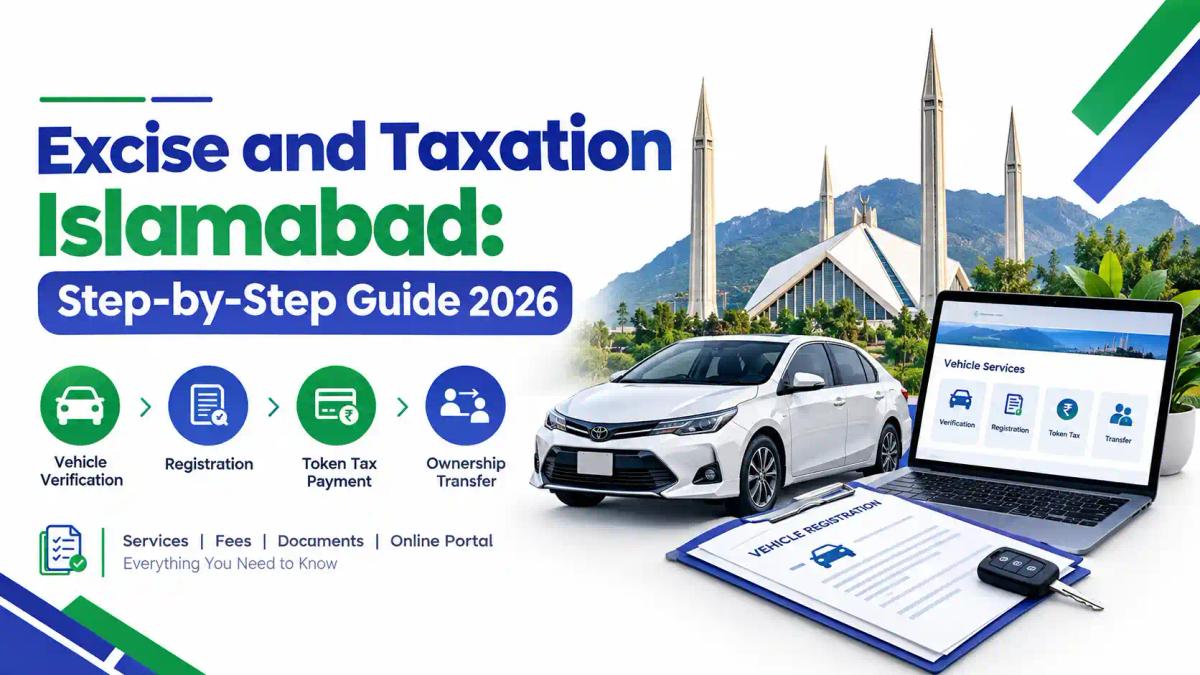
Excise and Taxation Islamabad: Step-by-Step Guide 2026
Quick Answer
The Excise and Taxation Department Islamabad registers and transfers all ICT vehicles and collects token tax. You can verify a vehicle and pay token tax online through the official website and the City Islamabad app. New registration and ownership transfer still need document checks, biometric verification and a physical inspection.
Vehicle counters operate Monday to Friday, 8:00 AM to 1:30 PM, at the H-9 office next to the HEC Building. From 1 July 2026, cars above 1,000cc pay token tax as a percentage of invoice value.
For rates in detail, see our Islamabad vehicle tax rates 2026 guide.
Introduction
Most people deal with the Islamabad Excise Department only a few times: when they buy a new car, buy or sell a used one, or pay token tax. Because these visits are rare, the rules have usually changed since the last one.
That is exactly what happened in 2025 and 2026. Islamabad moved to owner-based number plates. It raised transfer fees, made M-Tags compulsory, allowed biometric verification through NADRA's Pak ID app, and replaced flat token tax with an invoice-value system.
This guide gives you a step-by-step method for each Excise task, in the order you are likely to need them. At the Institute of Corporate & Taxation (ICT), we teach Pakistani tax law daily, and vehicle taxes come up constantly because they sit where excise law and federal income tax meet. For office timings, contact numbers and directions, read our separate Islamabad Excise Office timings and address guide. For the bigger national picture, see our complete guide to excise and taxation in Pakistan.
What Is the Excise and Taxation Department Islamabad?
The Excise and Taxation Department, usually called Islamabad Excise or ETO Islamabad, is part of the Islamabad Capital Territory Administration. It acts as the Motor Registration Authority for every vehicle registered in Islamabad.
According to the official Islamabad Excise website, the Deputy Commissioner Islamabad is also designated Director General Excise and Taxation. The powers of Secretary Excise are exercised by the Chief Commissioner.
What the department handles
Vehicle services:
- New vehicle registration (local, imported and auctioned vehicles)
- Transfer of ownership
- Token tax (motor vehicle tax) collection
- Duplicate documents and other post-registration changes
Non-vehicle taxes and duties:
- Professional Tax
- Education Cess
- Bed Tax
- Motor Vehicle and Real Estate Dealer Tax
- Tobacco Vend Fee
- Entertainment Duty
- Liquor permits
Book a Seat at the Institute of Corporate & Taxation and study Pakistan's tax system with practising professionals.
Only use official channels
The department's website warns that only its official resources should be used for Excise information. The two to rely on are islamabadexcise.gov.pk and the City Islamabad app. Copycat "MTMIS Islamabad" websites and agents often quote outdated fees, so always confirm amounts on the official fee calculator.
Key Terms You Should Know First
The Excise office, its forms and its apps use terms that can confuse first-time visitors. Here is what each one means in plain English.
Offices and officials
- MRA (Motor Registration Authority): the legal role the Excise and Taxation Department performs for registering and transferring vehicles in Islamabad. Transfer applications are addressed to the "MRA / ETO, Islamabad".
- ETO (Excise and Taxation Officer): the officer in charge of an Excise office. Registration applications are addressed to the ETO.
- Excise Inspector: the official who physically inspects your vehicle and checks your documents during registration or transfer.
- DEO (Data Entry Operator): the counter official who enters your file into the system, issues the computerised Form 'F', takes the fee and gives you the receipt.
Forms and documents
- Form 'F': the form recording your vehicle's particulars. The inspector fills a manual Form 'F', and the DEO later issues a computerised Form 'F' for you to sign.
- Computerised transfer letter: the official letter, signed by the seller, that transfers the vehicle to the buyer. It is one of the core transfer documents.
- Transfer of Ownership form: the ICT Administration form for transfers, printed on legal-size paper.
- Registration book / smart card: proof that a vehicle is registered and who owns it. Islamabad now issues smart cards, and digital cards are available through NADRA's Pak ID app.
- NOC (No Objection Certificate): written permission from a bank, leasing company or another Excise department. It is needed to transfer a leased vehicle, or to bring a vehicle registered elsewhere to Islamabad.
- Class-I officer attestation: when the seller cannot appear in person, the seller's documents must be attested by a Class-I government officer. The officer's CNIC copy and official phone number are attached.
- Open letter: a signed transfer letter used to sell a car without completing the transfer. The car stays legally in the seller's name, so buyers should avoid it.
Taxes and fees
- Token tax (motor vehicle tax): the tax that keeps an Islamabad registration valid. It is charged under the West Pakistan Motor Vehicles Taxation Act, 1958, as it applies in ICT. See our Islamabad vehicle tax rates 2026 guide.
- Invoice value: the vehicle's original purchase value on record. Since 1 July 2026, token tax for cars above 1,000cc is a percentage of this value, not of the car's current market price.
- Section 231B advance tax: federal income tax that the Excise office collects for the FBR at registration and on transfer. It is not collected on transfers more than five years after first registration.
- Section 234 tax: federal income tax collected along with token tax on private vehicles.
- Professional Tax: an ICT tax that is added at registration for commercial vehicles.
- Capital Value Tax (CVT): an additional charge on higher-value vehicles at registration, where it applies.
- Late registration fee: a fine charged when a new vehicle is registered more than 60 days after the invoice date.
- Special number fee: an extra fee for choosing a particular registration number.
Tax status
- ATL (Active Taxpayers List): the FBR's list of people who file income tax returns. Being on it means you pay "filer" rates, which are much lower than non-filer rates on vehicle taxes. Check yours with our ATL filer status guide.
- Filer / non-filer: a filer is on the ATL; a non-filer is not. Our filer vs non-filer guide explains the difference.
Digital services
- City Islamabad app: ICT Administration's official mobile app. You use it to pay token tax and access other ICT services.
- PSID (Payment Slip ID): the unique payment code the app generates for your token tax. You pay it through internet banking, mobile banking or another channel that accepts PSID payments.
- Pak ID app: NADRA's mobile app, used for biometric verification of buyers and sellers and for digital vehicle cards.
- Biometric verification: identity confirmation by fingerprint or face, required for registration and ownership transfer. You can complete it through Pak ID or at a NADRA e-Sahulat centre.
- NADRA e-Sahulat centre: an authorised NADRA outlet that issues biometric verification slips for people who do not use the app.
Book a Seat at the Institute of Corporate & Taxation and study Pakistan's tax system with practising professionals.
Number plates and tags
- Owner-based number plate: since July 2025, an Islamabad registration number belongs to the owner, not the vehicle. On sale, the buyer receives a new number. The seller can keep the old number for up to one year; if it is not used on another vehicle in that time, it is cancelled.
- M-Tag: a prepaid RFID sticker on the vehicle, read at toll plazas and checkpoints. It has been compulsory for cars entering Islamabad since 1 January 2026, and for motorcycles since 20 February 2026.
Processes
- Physical inspection: the Excise Inspector's check of the actual vehicle, including its chassis and engine numbers. It is required for registration and transfer.
- Post-registration processes: changes made to a vehicle's record after registration, such as a change of address, colour or engine.
Why Online Excise Services Matter in Pakistan
For decades, dealing with an Excise office meant long queues, several visits and heavy reliance on agents. Online services are changing that, in Islamabad and across Pakistan. Here is why they matter for vehicle owners, buyers and the tax system itself.
1. They save time and repeated visits
Tasks that once needed a trip to the Excise office can now be done from a phone:
- checking a vehicle's record
- paying token tax through the City Islamabad app
- checking smart card status
- completing biometric verification through NADRA's Pak ID app
Even where a visit is still needed, Islamabad's doorstep service lets you book an Excise team to come to you through 051-111-383-383.
2. They protect buyers from fraud
A used-car buyer can check the official record before paying. They can compare the owner's name, engine number, chassis number and tax status against the car and the seller's documents. This is one of the simplest ways to avoid stolen, disputed or tax-defaulting vehicles.
Biometric verification adds another layer. The seller and buyer confirm their identities, so a vehicle cannot easily be transferred without the real owner's consent.
3. They reduce dependence on agents
In September 2024, the Islamabad Excise department introduced new procedures to curb the "agent mafia". These included doorstep services, online applications and biometric verification for anyone collecting a registration card on someone else's behalf.
When citizens can check fees and records themselves on official channels, there is far less room for inflated "processing" charges. This is also why the department warns people to rely only on its official website and the City Islamabad app.
4. They help end the "open letter" problem
Many vehicles in Pakistan run on open transfer letters, with the car still legally in the seller's name. Slow and inconvenient biometric verification was one reason buyers left transfers incomplete.
Mobile biometrics make completing a transfer much easier. That protects:
- sellers, from liability for a car they no longer own
- buyers, who get clear legal title to the car
Book a Seat at the Institute of Corporate & Taxation and study Pakistan's tax system with practising professionals.
5. They make life easier for overseas Pakistanis
Previously, an overseas seller often needed an authority letter attested at a Pakistani embassy. Biometric verification through the Pak ID app removes much of that burden. NADRA's app now supports vehicle biometrics for Islamabad-registered vehicles, and Punjab and Sindh have introduced similar systems.
6. They improve tax compliance and records
When the City Islamabad app calculates token tax, it applies filer or non-filer rates automatically. Payment is linked directly to the vehicle's record through the PSID. This reduces errors and disputes about whether tax was paid.
Owner-based number plates, introduced in July 2025, also make it easier to trace who owns which vehicle.
7. Digital adoption still has room to grow
Online services are not yet the norm. During the 2026-27 budget discussions, officials told the National Assembly Standing Committee on Finance that Islamabad collected about Rs 3.9 billion in vehicle token tax that year. Only 19% of those payments came through digital channels.
Most owners still pay in person, often in long queues near deadlines, even though they could pay from home in minutes.
A nationwide shift, with local differences
Every province is moving online, but each runs its own system. A vehicle is always handled by the department where it is registered, not where the owner lives. If your vehicle is registered outside Islamabad, see:
- our Punjab Excise vehicle verification and token tax guide
- our Sindh vehicle verification guide for Karachi
- our complete guide to excise and taxation in Pakistan, which compares the systems
For the wider picture of government tax digitisation, read about FBR's digital transformation in Pakistan.
What online services cannot do yet
New registration, ownership transfer and inter-province transfers still need a physical inspection of the vehicle and original documents. The practical approach is to do everything you can online, then visit the office, or book the doorstep service, only for the steps that need it.
Islamabad Excise Services at a Glance
| Task | Online? | In person? | Official processing time |
|---|---|---|---|
| Check vehicle details | Yes, official website | No | Instant |
| Pay token tax | Yes, City Islamabad app (PSID) | Optional | Instant |
| Biometric verification | Yes, NADRA Pak ID app, or NADRA e-Sahulat | Optional | Same day |
| New vehicle registration | Partly | Yes, inspection and file | 90 days |
| Transfer of ownership | Partly | Yes, inspection and verification | 4 weeks |
| Bring an out-of-province vehicle to ICT | No | Yes, NOC and original file | Varies |
| Duplicate registration document | No | Yes | Varies |
| M-Tag installation | No | Yes, issuance points | Same day |
Processing times are those listed on the ICT Administration service pages.
Documents Required for Online Verification and Payment
Most online Excise services in Islamabad need very little paperwork, but having the right details ready saves time and avoids failed attempts. Here is what you need for each online task.
Quick checklist
| Online task | What you need |
|---|---|
| Vehicle verification (online record check) | Vehicle registration number |
| Token tax payment | Smartphone with the City Islamabad app, a registered app account, vehicle registration number, and an online banking or payment channel that accepts PSID payments |
| Smart card status check | Vehicle registration number, and your registration or transfer receipt for reference |
| Biometric verification (Pak ID app) | Your original CNIC, a smartphone with NADRA's Pak ID app, and the vehicle's details (registration number, and the chassis number if asked) |
| Fee estimate | Engine capacity, invoice value, and your filer status |
For online vehicle verification
To check a vehicle's record on the official Islamabad Excise website, you only need the vehicle registration number, entered exactly as it appears on the number plate or registration document.
If you are buying a used vehicle, keep these ready to compare against the online result:
- The registration book or smart card shown by the seller
- The chassis and engine numbers physically stamped on the vehicle
- The seller's original CNIC, to confirm the name matches the registered owner
The online check itself needs no documents. These items are what you match the result against. For the full method, see our guide to verifying vehicle registration and paying token tax online in Islamabad.
For online token tax payment
To pay through the City Islamabad app, you need:
- A smartphone with the City Islamabad app installed from the Play Store or App Store.
- A registered account on the app, created with the details the app asks for at sign-up.
- Your vehicle registration number. The app uses it to calculate the payable amount and generate the PSID.
- Your filer status. The app applies filer or non-filer rates to the income tax portion, so check your status first with our ATL filer status guide if you are unsure.
- A payment channel. You can pay the PSID through internet banking, a mobile banking app, or another channel that accepts PSID payments.
After payment, save the receipt as a screenshot or PDF. You may need it when selling the vehicle or if your record does not update.
Paid at a Post Office in the past? Keep that old receipt too. Ask the Excise office to confirm the payment appears on your record before you transfer the vehicle.
For biometric verification through the Pak ID app
Biometric verification is needed for registration and ownership transfer. To complete it through NADRA's Pak ID app, you need:
- Your original CNIC
- A smartphone with the Pak ID app installed, and a registered Pak ID account
- The vehicle's details, such as the registration number and, where asked, the chassis number
Follow the procedure linked on the official Islamabad Excise website. If you cannot use the app, a NADRA e-Sahulat centre can issue the biometric slip instead; take your original CNIC.
NADRA has also said that digital registration cards for Islamabad vehicles are available through Pak ID. See our article on digital vehicle card features in Pakistan.
What online services cannot replace
Online services cover checking, paying and biometrics. You will still need original documents and a physical inspection for:
- new vehicle registration
- ownership transfer
- bringing a vehicle registered elsewhere to Islamabad
Those document lists are given in the registration and transfer sections below.
Step-by-Step: How to Verify an Islamabad Vehicle Before You Buy
Verification is the most important step in any used-car purchase, and it costs nothing. Do it before you pay any money.
Step 1: Check the online record.
Open the official Islamabad Excise website and use the vehicle detail check with the registration number. Note the owner name, make, model, engine number, chassis number and token tax status.
Step 2: Match the record against the car.
Compare the online record with:
- the engine and chassis numbers physically stamped on the vehicle
- the registration book or smart card the seller shows you
- the seller's original CNIC
Step 3: Check the tax position.
If token tax is unpaid, agree in writing who will clear it before transfer. Under the 2026 invoice-value system, arrears on a larger car can be significant.
Step 4: Check finance and legal status.
Ask whether the car is leased or financed. A leased vehicle cannot be transferred without the bank's or leasing company's NOC or transfer letter.
Islamabad Police also run a vehicle verification service at the Public Facilitation Centre, F-6/1, for owners who need police-side verification.
Red flags that should stop the deal:
- Chassis or engine numbers that do not match the record
- A seller who is not the registered owner and cannot produce proper authority
- Refusal to complete biometric verification
- Pressure to buy on an "open letter" without transfer
For a detailed screen-by-screen walkthrough, see our guide to verifying vehicle registration and paying token tax online in Islamabad.
Can you check an Islamabad vehicle by SMS?
Many websites publish SMS codes for Islamabad vehicle checks, but the department names only its official website and the City Islamabad app as its official channels. Use those for verification rather than unofficial SMS services, which may give outdated or wrong records.
Does Islamabad vehicle registration need renewal?
Islamabad registration does not have a separate yearly renewal. Your registration stays valid as long as you pay token tax when due. If token tax is left unpaid during an enforcement drive, the registration can be cancelled and must then be restored with a penalty. For recurring tax obligations across Pakistan, see our vehicle token tax guide.
Step-by-Step: How to Pay Islamabad Token Tax Online
Token tax is the recurring motor vehicle tax that keeps your registration valid. The ICT tax year runs from 1 July to 30 June.
How to pay through the City Islamabad app
In a 2025 interview with APP, the Director Excise explained that the City Islamabad app calculates the fee from your vehicle number and generates a PSID. You can pay the PSID through any linked online banking channel.
- Download the City Islamabad app from the Play Store or App Store and register.
- Select the token tax service and enter your vehicle registration number.
- Check the calculated amount. It applies filer or non-filer rates for the income tax portion.
- Generate the PSID.
- Pay the PSID through your bank's app, internet banking or another channel linked to the PSID.
- Save the payment receipt. You may need it at transfer.
Tip: If you once paid token tax at a Post Office, ask the Excise office to confirm the payment appears on your record before you sell the vehicle.
Book a Seat at the Institute of Corporate & Taxation and study Pakistan's tax system with practising professionals.
Islamabad token tax rates 2026-27
The Finance Act 2026 substituted new token tax tables in the West Pakistan Motor Vehicles Taxation Act, 1958, as it applies in ICT. The News reported the enacted rates as follows.
| Private vehicle engine capacity | Token tax from 1 July 2026 |
|---|---|
| Up to 1,000cc | Rs 20,000 |
| 1,001cc to 1,300cc | 0.25% of invoice value |
| 1,301cc to 1,500cc | 0.25% of invoice value |
| 1,501cc to 2,000cc | 0.25% of invoice value |
| 2,001cc to 2,500cc | 0.35% of invoice value |
| 2,501cc and above | 0.35% of invoice value |
Motor cabs have separate, lower rates. For example, Rs 600 up to 1,000cc and Rs 1,000 for 1,001cc to 1,300cc.
Worked examples (our arithmetic from the published rates):
- A 1,300cc car with an invoice value of Rs 5,000,000: 0.25% × 5,000,000 = Rs 12,500
- A 2,400cc SUV with an invoice value of Rs 15,000,000: 0.35% × 15,000,000 = Rs 52,500
Points to watch
- It is invoice value, not market value. The rate applies to the vehicle's recorded invoice value, not what the car is worth today. A higher trim of the same model pays more.
- Is the Rs 20,000 band one-time or yearly? Reports differ on whether the Rs 20,000 for cars up to 1,000cc is a one-time (lifetime) payment or an annual one. Check your exact liability on the official calculator before you pay.
- Income tax is collected with token tax. Withholding tax under section 234 of the Income Tax Ordinance, 2001 is collected alongside token tax on private vehicles. Non-filers pay more. The rates are in the FBR Withholding Tax Rate Card; use the latest card for the current tax year.
- New registrations pay pro rata. Token tax and income tax apply for the remaining months of the fiscal year from the registration date.
For historic rates and more examples, see our Islamabad vehicle tax rates 2026 and the national vehicle token tax guide.
Is there a last date for Islamabad token tax?
The ICT token tax year runs from 1 July to 30 June, so tax for 2026-27 falls due for the year starting 1 July 2026. Islamabad does not work to one fixed "last date" every year. Instead, the department announces payment drives with deadlines and then enforces them.
What happened in the last drive:
- In December 2024, the department gave owners 15 days to pay.
- The deadline was then extended to 31 January 2025.
- The department warned that defaulters' registrations would be cancelled, with a 200% penalty to restore them.
Practical advice:
- Pay early in the tax year through the City Islamabad app rather than waiting for a drive.
- Deadlines and penalties change from drive to drive, so follow the department's official announcements.
- If your registration has already been cancelled for non-payment, visit the Excise office to restore it. Restoration can cost far more than the original tax.

Step-by-Step: How to Register a New Vehicle in Islamabad
Documents required
The official ICT Administration registration page lists the following.
- Photocopy of the applicant's CNIC
- Application to the Excise and Taxation Officer for registration of a new vehicle
- Proof of purchase:
- Locally manufactured vehicle: sale invoice, sale certificate and related documents
- Imported vehicle: Bill of Entry, Bill of Lading, old registration book and related documents
- Auctioned vehicle: auction voucher and related documents
- Proof of Islamabad residence, any one of: a utility bill, CNIC, lease agreement, registry, allotment letter, or an office card or appointment letter for government servants
You will also need biometric verification of the person named on the invoice. You can complete it at a NADRA e-Sahulat centre or through the Pak ID app, using the procedure linked on the official website.
The registration process
- Prepare the documents listed above.
- Take the vehicle and documents to the designated Excise Inspector for physical inspection. The inspector records the report on the manual Form 'F' and signs the application.
- Go to the Data Entry Operator (DEO). If anything is incomplete, the DEO tells you what is missing.
- Sign the computerised Form 'F' to confirm your particulars.
- Pay the fee at the same window.
- Collect the vehicle registration receipt once the DEO takes your file.
- Pay the number plate fee in cash to the DEO.
Book a Seat at the Institute of Corporate & Taxation and study Pakistan's tax system with practising professionals.
Islamabad Vehicle Registration Fees and Charges 2026-27
A new registration bill is not one fee. ICT Administration calculates it as:
Registration fee + Advance tax + Token tax + Income tax (+ Professional Tax for commercial vehicles)
On top of this you pay the smart card fee, the number plate fee and, where it applies, Capital Value Tax.
Registration fee and other Excise charges
| Charge | How it is calculated |
|---|---|
| Registration fee | 1% of value up to 1,000cc; 2% from 1,001cc to 2,000cc; 4% above 2,000cc |
| Capital Value Tax | 1% of value on cars above 1,300cc, for the first five financial years |
| Smart card fee | Rs 2,400 |
| Number plate fee | Not published; ask at the information counter |
| Special (choice) number | Extra fee under the department's special number schedule |
| Token tax | Pro rata for the remaining months of the tax year (see the Islamabad vehicle tax rates 2026 guide) |
Advance income tax at registration (Section 231B)
This is usually the largest single item. The Excise office collects it on behalf of the FBR, and it depends heavily on whether you are on the Active Taxpayers List (ATL).
| Engine capacity | Filer (on ATL) | Non-filer |
|---|---|---|
| Up to 850cc | 0.5% of value | 1.5% |
| 851cc to 1,000cc | 1% | 3% |
| 1,001cc to 1,300cc | 1.5% | 4.5% |
| 1,301cc to 1,600cc | 2% | 6% |
| 1,601cc to 1,800cc | 3% | 9% |
| 1,801cc to 2,000cc | 5% | 15% |
| 2,001cc to 2,500cc | 7% | 21% |
| 2,501cc to 3,000cc | 9% | 27% |
| Above 3,000cc | 12% | 36% |
Not sure where you stand? Check with our ATL filer status guide before you buy. Our filer vs non-filer guide explains why the difference is so large.
Worked example: new 1,300cc car invoiced at Rs 5,000,000
| Item | Filer | Non-filer |
|---|---|---|
| Registration fee (2%) | Rs 100,000 | Rs 100,000 |
| Advance tax u/s 231B | Rs 75,000 (1.5%) | Rs 225,000 (4.5%) |
| Token tax (0.25% a year, pro rata) | Up to Rs 12,500 | Up to Rs 12,500 |
| Smart card fee | Rs 2,400 | Rs 2,400 |
| Estimated total (before plate fee and section 234 income tax) | About Rs 189,900 | About Rs 339,900 |
This is our arithmetic from the published rates. Being on the ATL saves Rs 150,000 on this single transaction. A filer can generally adjust the section 231B amount against their annual income tax liability, so keep the Excise receipt for your return.
Late registration fines
Register within 60 days of the invoice date (or the Bill of Entry or auction date). After that, fines rise with both the delay and the engine size.
| Engine capacity | 61–120 days late | 121–180 days late | More than 180 days |
|---|---|---|---|
| Up to 1,000cc | Rs 60,000 | Rs 90,000 | Rs 182,500 |
| 1,001cc to 2,000cc | Rs 120,000 | Rs 180,000 | Rs 365,000 |
| 2,001cc to 3,000cc | Rs 360,000 | Rs 540,000 | Rs 1,095,000 |
| 3,001cc and above | Rs 600,000 | Rs 900,000 | Rs 1,825,000 |
The lesson is simple: a few weeks' delay on a larger car can cost more than the registration fee itself.
Can you register without visiting?
Partly. ICT Administration offers a mobile registration service through the City Islamabad app and its helpline. In June and July 2026, the department also promoted a doorstep service: book on 051-111-383-383 and an Excise team visits you for registration, transfer and related procedures.
Motorcycle Registration and Token Tax in Islamabad
Motorcycles go through the same registration steps as cars: documents, biometric verification, physical inspection, Form 'F' and fee payment. The main differences are the tax treatment and the costs.
Motorcycle token tax (lifetime)
| Engine capacity | Token tax |
|---|---|
| Up to 200cc | Rs 1,000, once for life |
| 201cc to 400cc | Rs 2,000, once for life |
| 401cc and above | Rs 5,000, once for life |
Motorcycle transfer fees
| Engine capacity | Transfer fee |
|---|---|
| Up to 200cc | Rs 550 |
| 200cc to 400cc | Rs 1,000 |
| Above 400cc | Rs 1,500 |
Don't forget the M-Tag
M-Tags became compulsory for motorcycles in Islamabad from 20 February 2026. Bring your original CNIC and the motorcycle's registration documents to an issuance point.
Before buying a used bike, verify its record exactly as you would for a car. See our guide to verifying vehicle registration online in Islamabad.
Registering an Electric Vehicle (EV) in Islamabad
EVs follow the same registration procedure as other vehicles. The differences are in the fees.
Transfer fee: EVs have paid a transfer fee since April 2025, based on motor power:
| Motor power | Transfer fee |
|---|---|
| Up to 50 kW | Rs 2,500 |
| 50 kW to 100 kW | Rs 5,500 |
| Above 100 kW | Rs 10,000 |
Token tax and registration fee: the department's fee schedule lists EVs as exempt from both registration fee and token tax, and the draft New Energy Vehicle (NEV) policy of May 2026 also proposes these exemptions for Islamabad. Income tax still applies. Because the NEV policy was still a draft when announced, confirm the exemption at the Excise counter before you register.
Advance tax (Section 231B): an EV has no engine capacity, so the value-based rules in the FBR rate card apply. Check the current FBR Withholding Tax Rate Card for your vehicle's value.
Step-by-Step: How to Transfer Vehicle Ownership in Islamabad
Documents required
The official ICT Administration transfer page lists the following.
- Application for transfer of ownership addressed to the Motor Registration Authority (MRA) / Excise and Taxation Officer (ETO), Islamabad
- Photocopy of the buyer's CNIC
- Filled and signed Form 'F'
- Photocopy of the seller's CNIC
- Computerised transfer letter
- Transfer of Ownership form, printed on legal-size paper
- For a leased vehicle: NOC or transfer letter from the bank or leasing company
- Affidavit that the vehicle is not stolen or wanted in any case, and that the applicant accepts responsibility for any later discrepancy
If the seller does not appear in person: the seller's CNIC copy, the computerised transfer letter and the transfer form must be attested by a Class-I officer. You must also provide that officer's CNIC copy and official phone number.
The transfer process
- Complete the documents listed above. Print the transfer form on legal paper.
- Complete biometric verification for both seller and buyer. You can use NADRA's Pak ID app, following the procedure the Islamabad Excise website publishes, or a NADRA e-Sahulat centre.
- Deposit the transfer fee at the designated window.
- Present the vehicle and documents for verification by the designated Excise Inspector.
- Collect your receipt from the Data Entry Operator and keep it until the new registration document is issued.
Islamabad vehicle transfer fees
These fees were set by a Chief Commissioner ICT notification dated 11 April 2025, in force from 14 April 2025, as reported by The Express Tribune.
| Vehicle | Size or power | Transfer fee |
|---|---|---|
| Car (private or commercial) | Up to 1,000cc | Rs 2,750 |
| Car (private or commercial) | 1,001cc to 1,800cc | Rs 5,500 |
| Car (private or commercial) | Above 1,800cc | Rs 11,000 |
| Electric vehicle | Up to 50 kW | Rs 2,500 |
| Electric vehicle | 50 kW to 100 kW | Rs 5,500 |
| Electric vehicle | Above 100 kW | Rs 10,000 |
| Motorcycle | Up to 200cc | Rs 550 |
| Motorcycle | 200cc to 400cc | Rs 1,000 |
| Motorcycle | Above 400cc | Rs 1,500 |
The ICT Administration transfer page still shows an older "Rs 1,200 to 3,000" range. Treat the notification figures as current, and confirm on the official calculator.
Advance tax on transfer
Advance tax under section 231B applies only if the vehicle is less than five years from its first registration in Pakistan. The amount reduces by 10% for each year since first registration. For older vehicles, no advance tax is collected on transfer.
Book a Seat at the Institute of Corporate & Taxation and study Pakistan's tax system with practising professionals.
Owner-based number plates: what changes when you buy
Since July 2025, Islamabad registration numbers belong to the owner, not the vehicle. The Associated Press of Pakistan reported the notification:
- The seller returns the number to the department on sale.
- The seller can keep that number for up to one year without a vehicle. If it is not used within a year, it is cancelled.
- The buyer receives a new registration number linked to their own identity.
What this means for you: a buyer should budget for new plates and expect a new number. A seller who likes their number should plan to use it on their next vehicle within the year.
When the seller has died
A transfer from a deceased owner needs succession documentation and the involvement of the legal heirs. Ask the Excise information counter for the current checklist before you start.
Step-by-Step: Moving a Vehicle Registered Elsewhere to Islamabad
If your car is registered in Punjab, Sindh, Khyber Pakhtunkhwa or elsewhere and you now live in Islamabad, you can bring it onto the ICT record. In addition to the normal transfer documents, the official page asks for:
- Proof of residence in Islamabad, for example an electricity, gas or telephone bill, CNIC, lease, driving licence, registered deed, allotment letter, or office card or appointment letter.
- An affidavit from your host, who must appear in person, if you live with someone else and have no residence proof of your own.
- A photocopy of the registration book.
- A photocopy of the complete registration file.
- The original file, if the other Excise department has returned it.
- An NOC for transfer of ownership from the Excise department where the car is currently registered.
Get the NOC first. Nothing moves in Islamabad until the other department releases the vehicle.
Live in Rawalpindi? A Punjab-registered car is handled by Punjab Excise, not Islamabad Excise. See our guides to Punjab Excise vehicle verification and token tax and Sindh vehicle verification in Karachi.
Commercial Vehicles, Taxis and Motor Cabs in Islamabad
Commercial vehicles follow the same registration and transfer steps, with three extra points.
1. Professional Tax is added at registration.
ICT Administration's fee formula adds Professional Tax for commercial vehicles on top of the registration fee, advance tax, token tax and income tax.
2. Motor cabs pay separate token tax rates.
Under the Finance Act 2026 schedule, motor cabs have their own rates. For example:
| Motor cab engine capacity | Token tax |
|---|---|
| Up to 1,000cc | Rs 600 |
| 1,001cc to 1,300cc | Rs 1,000 |
Higher engine bands for cabs have their own rates, so check the official calculator for yours.
3. Transport vehicles need a fitness certificate.
Under the motor vehicles law, a transport vehicle needs a valid fitness certificate issued after examination by a Motor Vehicle Examiner. Ask the department which office handles your vehicle category before you apply.
Businesses running several vehicles should also check which local taxes apply to them. Our complete guide to excise and taxation in Pakistan covers these.
How to Check Your Islamabad Vehicle Smart Card Status
After registration or transfer, you receive a receipt while your smart card is produced. You do not need to visit the office to ask whether it is ready.
- Open the official Islamabad Excise website (islamabadexcise.gov.pk).
- Go to the Check Vehicle Smart Card Status service.
- Enter your vehicle registration number, or the details requested on the page.
- Check the status shown: in process, ready, or dispatched.
If your card is taking too long:
- Compare the time elapsed with the official processing time: 90 days for new registration and four weeks for transfer.
- If the official period has passed, contact the department with your receipt number.
- Keep the receipt safe. It is your proof that the application is in process.
Digital card option: NADRA has said digital registration cards for Islamabad-registered vehicles are available through the Pak ID app. Our article on digital vehicle card features in Pakistan explains what the digital card shows.
Step-by-Step: Lost or Damaged Registration Document
If your registration book or smart card is lost, stolen or unreadable:
- Report the loss to the police and obtain a copy of the report (FIR). This is needed for a duplicate.
- Prepare an application to the Excise and Taxation Officer with:
- a copy of your CNIC
- the police report (for a lost document), or the original damaged document (for a replacement)
- Pay the prescribed fee through the bank challan issued by the department.
- Submit at the Excise office and keep the receipt until the duplicate is issued.
Requirements for post-registration changes vary by case, so confirm the checklist with the department before you visit.
Digital card option: NADRA has said digital registration cards for Islamabad-registered vehicles are available through the Pak ID app. See our article on digital vehicle card features in Pakistan.
Post-Registration Changes: Address, Colour and Engine
The Islamabad Excise website lists Post Registration Processes as a separate service category. These cover changes to your vehicle's record after it is registered. The general approach is:
Change of address:
- Apply to the Excise and Taxation Officer.
- Attach proof of your new Islamabad address (a utility bill, lease or allotment letter).
- Attach a copy of your CNIC and the registration document.
Change of colour:
- Apply with the registration document and your CNIC.
- The vehicle will usually need a physical inspection so the new colour can be recorded.
Change of engine:
- Keep proof of purchase of the replacement engine.
- The new engine number must be verified in a physical inspection before it is entered on your record.
- Never buy or drive a vehicle whose engine number does not match its registration record.
Requirements and fees differ case by case, so confirm the checklist with the department before you visit. For office timings and contact numbers, see our Islamabad Excise Office timings and address guide.
M-Tag: Mandatory for Vehicles in Islamabad
The Islamabad Excise website asks owners to install an M-Tag and warns of strict action against vehicles without one. It links to a list of issuance points.
- Cars: Dawn reported that, from 1 January 2026, vehicles without M-Tags would not be allowed to enter Islamabad. Tag readers were installed at entry points and checkpoints, and the issuance fee was Rs 250 per vehicle.
- Motorcycles: M-Tag issuance for motorcycles began on 20 February 2026 in a second phase.
- What to bring: your original CNIC and the vehicle's registration documents.
Buying a used car? Because the buyer now receives a new registration number, ask at an issuance point whether the existing tag needs re-linking to your record.
Real-Life Journeys: What the Full Process Looks Like
Journey 1: Buying a seven-year-old 1,300cc car from an Islamabad seller
- Verify the vehicle online and match the engine and chassis numbers physically.
- Confirm token tax is clear, or agree in writing who pays any arrears.
- Both parties complete biometric verification (Pak ID app or e-Sahulat).
- Prepare the transfer documents and pay the Rs 5,500 transfer fee.
- Present the vehicle and documents for inspection and verification.
- Receive a new registration number under the owner-based system and get new plates.
- Confirm the M-Tag is valid for the vehicle.
Cost note: no section 231B advance tax applies, because the car is more than five years from first registration. From then on, you pay annual token tax at 0.25% of the car's invoice value.
Journey 2: Buying a new 1,000cc car from a dealer
- Collect the sale invoice and sale certificate from the dealer.
- Complete biometric verification for the person named on the invoice.
- Register within 60 days of the invoice date to avoid the late fee.
- Pay the registration fee, section 231B advance tax, token tax (Rs 20,000 band) and income tax. Your filer status decides the income tax portion.
- Pay the number plate fee and install an M-Tag.
Book a Seat at the Institute of Corporate & Taxation and study Pakistan's tax system with practising professionals.
Journey 3: Selling your car in Islamabad
- Clear any token tax arrears.
- Complete your seller biometric verification.
- Sign the transfer letter and transfer form. If you cannot attend, use Class-I officer attestation.
- Make sure the buyer actually completes the transfer. An untransferred "open letter" leaves the car legally in your name.
- Use your retained number on your next vehicle within one year, or it will be cancelled.
Common Mistakes to Avoid
- Paying before verifying. Always check the official record and the physical numbers first.
- Buying on an open letter. Until the transfer is complete, the car remains legally the seller's.
- Missing the 60-day window for new registration.
- Ignoring filer status. Non-filers pay substantially more advance and withholding tax.
- Using unofficial websites or agents for fees and procedures.
- Forgetting the bank NOC on a leased or financed car.
- Assuming the old number plate stays with the car. Under the owner-based system, it does not.
- Driving without an M-Tag, which risks being stopped at Islamabad checkpoints.
- Visiting after 1:30 PM. Vehicle counters work to the official service window.
- Taking a Punjab-registered car to the Islamabad office. It cannot be processed there.
Expert Tips From a Tax Practitioner
- Plan the tax before the purchase. Whether you are on the ATL at the time of registration can change your advance tax bill by a large amount. Become a filer first: our how to become a filer in Pakistan guide explains the steps.
- Keep every Excise receipt. Section 231B and section 234 collections are income tax. A filer should reconcile them in the annual return, and our filer vs non-filer guide explains why this matters.
- Mind the invoice value. For cars above 1,000cc, a higher-trim variant means higher token tax every year it is payable.
- Check whether the car is under five years old. Transfer-stage advance tax falls 10% a year and stops after five years, which affects the real cost of a used car.
- Use the doorstep service for elderly owners. Booking through 051-111-383-383 avoids travel and repeated visits.
Why Choose ICT to Understand Vehicle and Withholding Taxes
The Excise office processes your vehicle, but most of the money you pay there is governed by tax law. That includes advance tax under section 231B, withholding under section 234, filer versus non-filer rates and invoice-based token tax.
At ICT, these provisions are taught as practical skills, so accountants, tax consultants and business owners can:
- calculate the real cost of a vehicle transaction
- advise clients correctly
- claim collections properly in income tax returns
ICT's Certified Tax Advisor course covers income tax, withholding tax, sales tax and practical FBR compliance, including IRIS return filing. Explore the Course
Frequently Asked Questions
What is Excise and Taxation Islamabad?
It is the ICT Administration department that registers and transfers Islamabad vehicles and collects token tax. It also collects local taxes such as Professional Tax, Education Cess and Bed Tax.
How can I check vehicle registration in Islamabad online?
Use the vehicle detail check on islamabadexcise.gov.pk with the registration number. Then match the result with the car's chassis and engine numbers and the seller's CNIC.
How do I pay Islamabad token tax online?
Register on the City Islamabad app and enter your vehicle number. Generate the PSID and pay it through any linked online banking channel.
What is the token tax for a 1,300cc car in Islamabad in 2026-27?
It is 0.25% of the car's invoice value each year. For a car invoiced at Rs 5,000,000, that is Rs 12,500.
How much is the vehicle transfer fee in Islamabad?
Rs 2,750 up to 1,000cc, Rs 5,500 for 1,001cc to 1,800cc, and Rs 11,000 above 1,800cc. These rates have applied since 14 April 2025.
What documents are required for vehicle transfer in Islamabad?
- Transfer application
- CNIC copies of the buyer and seller
- Form 'F'
- Computerised transfer letter
- Transfer of Ownership form
- Affidavit that the vehicle is not stolen or wanted
- Bank NOC, if the vehicle is leased
Biometric verification of both parties is also required.
Can I do biometric verification for vehicle transfer from home?
Yes. The Islamabad Excise website publishes a procedure for biometric verification through NADRA's Pak ID app. The remaining transfer steps are then completed with the department.
Will I get a new number plate when buying a used car in Islamabad?
Yes. Under the owner-based system, the buyer receives a new registration number. The seller can keep the old number for up to one year.
Book a Seat at the Institute of Corporate & Taxation and study Pakistan's tax system with practising professionals.
What are the Islamabad Excise office timings?
ICT Administration lists vehicle registration and transfer counters as Monday to Friday, 8:00 AM to 1:30 PM, at Service Road, Sector H-9, next to the HEC Building.
Is M-Tag mandatory in Islamabad?
Yes. Vehicles without M-Tags have been barred from entering Islamabad since 1 January 2026. Motorcycle tagging began on 20 February 2026.
Is advance tax charged when transferring an old car?
No. Advance tax on transfer applies only within five years of the vehicle's first registration in Pakistan, and it reduces by 10% each year.
What is the registration fee for a new car in Islamabad?
The department's fee schedule lists the registration fee as 1% of value up to 1,000cc, 2% for 1,001cc to 2,000cc, and 4% above 2,000cc. Advance tax, token tax, income tax and the smart card fee are added on top.
What is the fine for late vehicle registration in Islamabad?
A late fee applies after 60 days from the invoice date. It rises with the delay and the engine size, starting at Rs 60,000 for a car up to 1,000cc registered 61 to 120 days late.
What is the token tax for a motorcycle in Islamabad?
Motorcycles pay a one-time lifetime token tax: Rs 1,000 up to 200cc, Rs 2,000 for 201cc to 400cc, and Rs 5,000 above 400cc.
What happens if I don't pay Islamabad token tax?
During enforcement drives, the department has warned that defaulters' registrations will be cancelled, with a 200% penalty to restore them.
Do electric vehicles pay token tax in Islamabad?
The department's fee schedule lists EVs as exempt from token tax and registration fee, but income tax still applies. Confirm the exemption at the Excise counter.
How can I check my Islamabad smart card status?
Use the "Check Vehicle Smart Card Status" service on islamabadexcise.gov.pk with your vehicle details.
Do I need to renew my vehicle registration in Islamabad every year?
No. There is no separate annual renewal. Paying token tax on time keeps your registration valid.
What documents do I need to verify a vehicle online in Islamabad?
Only the vehicle registration number is needed for the online check. When buying a used car, also compare the result with the registration document, the chassis and engine numbers on the vehicle, and the seller's original CNIC.
What do I need to pay Islamabad token tax online?
You need the City Islamabad app with a registered account, your vehicle registration number, and an online banking or payment channel to pay the PSID the app generates.
Conclusion
Excise and Taxation Islamabad is far easier to deal with when you follow the right sequence:
- Verify online first.
- Complete biometrics.
- Prepare the full document set.
- Pay only through official channels.
- Keep every receipt.
The 2026 changes (invoice-based token tax, owner-based number plates, mandatory M-Tags and higher transfer fees) make it more important than ever to check current rules before you buy, sell or register.
If you want to understand the tax law behind these charges, or advise clients on them professionally, learn it properly. Book a Seat at the Institute of Corporate & Taxation and study Pakistan's tax system with practising professionals.
Comments (0)
No comments yet. Start the conversation!
Leave a Reply
Your email address will not be published. Required fields are marked *