Punjab Excise Vehicle Verification & Token Tax Online 2026
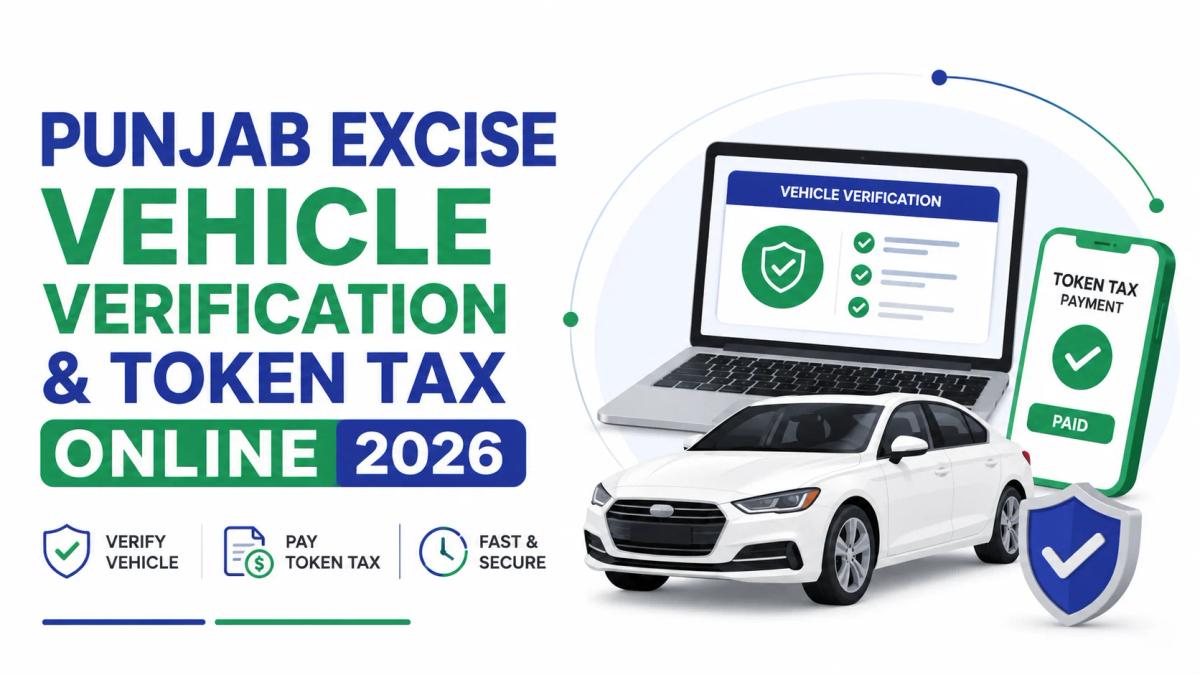
Buying a used car in Lahore without checking its background is a bit like signing a contract without reading it. You might get lucky. Or you might end up with a stolen bike, an unpaid tax bill, or a registration book that doesn't match the person standing in front of you. That's exactly the problem Punjab vehicle verification and online token tax payment were built to solve.
If you own a vehicle in Punjab, or you're about to buy one in Lahore, this guide walks you through everything: how Punjab excise vehicle verification actually works, how to pay your token tax online, what documents you need, what happens if you don't pay, and how to avoid the fraud that catches out thousands of buyers every year. No jargon, no runaround — just a clear, practical 2026 guide.
Quick Answer: What Is Punjab Vehicle Verification and Token Tax?
Punjab vehicle verification is the process of confirming a vehicle's registration, ownership, and tax status through the Punjab Excise, Taxation & Narcotics Control Department's digital records, commonly accessed through the Motor Transport Management Information System (MTMIS). Token tax is the annual (or lifetime) tax every registered vehicle owner in Punjab must pay to keep their vehicle legally on the road. Together, these two systems let you confirm a vehicle is genuine, legally owned, and tax-compliant — all online, without a trip to the excise office.
For a Lahore-based buyer or owner, both processes can usually be completed from a phone or laptop in a few minutes, provided you have the vehicle's registration number, chassis number, or CNIC on hand.
Why Vehicle Verification Matters in Pakistan
Vehicle fraud isn't rare in Pakistan — it's common enough that experienced dealers verify every car before touching cash. Stolen vehicles get resold with forged papers. Registration books are duplicated. Owners "forget" to mention years of unpaid token tax until the new buyer discovers it at a police checkpoint.
Here's why online verification has become essential rather than optional:
- It prevents you from buying a stolen vehicle. The excise database flags vehicles reported stolen or under investigation.
- It confirms the real owner. The name on the registration book should match the seller — verification proves it does (or doesn't).
- It reveals unpaid token tax and penalties. These often transfer with the vehicle if not settled beforehand.
- It protects you legally. Driving an unverified or unregistered vehicle can result in fines, impoundment, or worse during routine checks.
- It supports Pakistan's shift toward digital governance. Punjab's e-government push, backed by the Punjab Information Technology Board (PITB), means fewer trips to government offices and faster resolution of disputes.
Independent research on digital government adoption — including work referenced by the World Bank's Digital Government reports — consistently shows that online verification systems reduce fraud and improve public trust in record-keeping. Punjab's excise digitization fits squarely into that global trend.
Key Entities Behind the System
Before diving into the steps, it helps to know who's actually running the show:
| Entity | Role |
|---|---|
| Punjab Excise, Taxation & Narcotics Control Department | Owns and maintains vehicle registration and tax records |
| MTMIS (Motor Transport Management Information System) | The digital database used to verify vehicle and ownership details |
| Punjab Information Technology Board (PITB) | Developed and maintains the technical infrastructure |
| ePay Punjab | Government-approved gateway for paying token tax and fees online |
| Banks, JazzCash, Easypaisa, 1LINK | Payment channels connected to ePay Punjab |
Verification and payment are technically two separate systems: MTMIS handles the lookup and record-checking, while ePay Punjab (and connected banking channels) handles the actual token tax payment. Understanding this split makes the whole process much less confusing.
Step-by-Step Guide: How to Verify a Vehicle in Punjab Online
Here's the general process for verifying a vehicle registered in Punjab, including Lahore, Rawalpindi, Gujranwala, Multan, Faisalabad, and Sialkot.
Step 1: Gather Your Vehicle Details
You'll typically need one of the following:
- Vehicle registration number (number plate)
- Chassis number
- Engine number
- CNIC of the registered owner (for some lookup types)
Step 2: Access the Official Verification Channel
Visit the Punjab Excise and Taxation Department's official portal or the MTMIS Punjab system. If you're unsure which channel is current, search "MTMIS Punjab" through a trusted search engine and confirm you're on the Excise and Taxation Department's official domain before entering any personal information — fraudulent look-alike sites do exist.
Step 3: Enter the Registration or Chassis Number
Type the details exactly as they appear on the registration book. Small errors (a mixed-up letter or digit) are the most common reason verification fails on the first try.
Step 4: Complete the Captcha
This step confirms you're a real user, not an automated script, and protects the database from scraping.
Step 5: Review the Results
A successful search typically returns:
- Owner's name and city
- Registration date and vehicle category
- Engine and chassis number
- Token tax payment status
- Registration validity
Step 6: Cross-Check With the Physical Documents
Compare what the system shows against the registration book, CNIC copy, and any sale agreement the seller provides. If names, chassis numbers, or engine numbers don't match exactly, stop the transaction and ask questions before proceeding.
Step 7: Verify via SMS (Optional Backup)
For areas with limited internet access, Punjab Excise also supports SMS-based vehicle verification. This is slower but useful as a secondary check.
Step-by-Step Guide: How to Pay Punjab Token Tax Online
Paying token tax used to mean standing in line at an excise office. Now it's largely a digital process.
Step 1: Confirm Your Token Tax Status
Before paying, check whether tax is already due, partially paid, or overdue using the vehicle verification portal — this avoids double payment.
Step 2: Choose Your Payment Channel
Common options include:
- ePay Punjab (the primary government gateway)
- Mobile banking apps
- Internet banking through partner banks
- JazzCash or Easypaisa (where integrated)
- 1LINK-enabled ATMs and bank branches
Step 3: Enter Vehicle and Owner Details
You'll usually need the registration number, engine/chassis number, and the CNIC of the registered owner.
Step 4: Confirm the Tax Amount
Token tax amounts vary based on engine capacity (cc), vehicle type (car, bike, commercial vehicle), and whether it's a filer or non-filer payment. Lifetime token tax options also exist for certain categories.
Step 5: Complete Payment
Choose your preferred method, confirm the transaction, and wait for the payment gateway to process it.
Step 6: Download or Save the Digital Receipt
This challan or receipt is your proof of payment. Keep both a digital and printed copy — you may need it for future verification, vehicle transfer, or in case of a dispute.
Step 7: Verify the Update Reflects in the System
Token tax payments sometimes take a short while to reflect in the online database. If it doesn't update within a reasonable window, keep your receipt and follow up with the excise office.

Required Documents Checklist
| Document | Needed For |
|---|---|
| CNIC (original and copy) | Verification and payment |
| Vehicle registration book | Verification, cross-checking |
| Smart registration card (if issued) | Ownership confirmation |
| Sale/purchase agreement | Ownership transfer |
| Previous tax payment receipts | Confirming tax history |
| Chassis/engine number proof | Verification lookup |
Table: Vehicle Verification Methods Compared
| Method | Speed | Best For | Requires Internet |
|---|---|---|---|
| Online portal (MTMIS) | Fast (seconds) | Buyers, sellers, general owners | Yes |
| SMS verification | Moderate | Remote areas, low-connectivity zones | No |
| In-person excise office visit | Slow | Disputes, document mismatches | No |
| Third-party verification apps | Fast | Convenience, but verify legitimacy first | Yes |
Table: Payment Options for Token Tax
| Payment Method | Convenience | Availability |
|---|---|---|
| ePay Punjab portal | High | 24/7 online |
| Mobile banking | High | 24/7 via bank apps |
| Internet banking | High | 24/7 |
| JazzCash / Easypaisa | High | 24/7 mobile wallets |
| Bank branch / ATM | Moderate | Business hours or ATM availability |
Lahore-Specific Notes
Lahore, being Punjab's provincial capital, has the highest volume of vehicle registrations and transfers in the province. A few practical points specific to Lahore residents:
- Multiple excise offices operate across the city, so if online verification shows a discrepancy, you can visit the office linked to the vehicle's original registration district rather than any random branch.
- Used car markets in areas with high transaction volume (where buyers and sellers meet informally) are also where verification scams are most common — always verify online before handing over any advance payment.
- Smart card delivery and tracking for Lahore-registered vehicles can be checked through the same MTMIS-linked system, separate from the token tax payment process.
- Motorcycle verification follows the same steps as car verification — don't skip it just because a bike feels like a "smaller" purchase; bike theft and fraud are extremely common in urban Punjab.
Common Mistakes to Avoid
- Skipping verification because the seller "seems trustworthy." Verification takes minutes; regret over a fraudulent purchase can last years.
- Entering registration numbers incorrectly. Double-check formatting — extra spaces or wrong characters cause failed searches.
- Paying token tax through unofficial third-party agents who charge inflated "service fees" for something you can do yourself for free or at official rates.
- Ignoring outstanding token tax before a purchase. Unpaid dues can follow the vehicle, not just the previous owner.
- Not saving payment receipts. Digital systems occasionally have sync delays — a saved receipt is your proof if a dispute arises.
- Confusing MTMIS (verification) with ePay Punjab (payment). They serve different functions and sometimes different login requirements.
Why This Matters for Businesses and Tax Professionals Too
Vehicle verification and token tax compliance aren't just personal concerns — they intersect with broader tax, corporate, and import/export compliance work. Professionals handling customs clearance, import and export, or corporate vehicle fleets deal with these systems regularly, since commercial vehicles carry their own token tax categories and compliance requirements.
If you're building a career in taxation, accounting, or corporate compliance in Pakistan, understanding how provincial systems like Punjab's excise and token tax framework work is a practical, real-world skill — one that complements formal qualifications in taxation and corporate law.
This is exactly the kind of applied, real-world knowledge covered in professional training. If you want to build deeper expertise in how Pakistan's tax systems function — provincial and federal — it's worth exploring Master Sales Tax or the Certified Tax Advisor (CTA) program, both of which go beyond theory into practical compliance work that professionals actually use day to day.
For those managing vehicle fleets, import documentation, or logistics for a business, the Customs Clearance Course and Master Import & Export programs cover the compliance side of moving and registering vehicles and goods across borders and provinces — a natural extension of understanding excise and token tax systems.
Real-World Example
Consider a common Lahore scenario: a buyer finds a used Honda Civic listed online at an attractive price. Before transferring any advance, the buyer runs the registration number through the Punjab vehicle verification portal. The system shows the vehicle's last token tax payment was three years ago — meaning multiple years of dues, plus penalties, are outstanding. Armed with that information, the buyer either negotiates a lower price to cover the dues or walks away entirely.
Without that five-minute check, the buyer would have inherited a tax liability worth tens of thousands of rupees — a mistake that happens to hundreds of car buyers in Punjab every month.
Future of Digital Vehicle Verification in Punjab
Punjab's e-government roadmap continues to expand. Expect ongoing improvements including:
- Deeper integration between MTMIS and NADRA's identity records for faster CNIC-based lookups
- Expanded biometric verification for remote and overseas Pakistanis transferring vehicle ownership
- Broader token tax exemptions and adjusted rates for electric and hybrid vehicles as EV adoption grows
- Continued rollout of unified e-government portals reducing the need to jump between multiple systems for registration, verification, and payment
These shifts mirror global trends in digital governance — the same direction reflected in international benchmarks like the UN E-Government Development Index, which tracks how countries modernize citizen-facing government services.
FAQs: Punjab Vehicle Verification & Token Tax
1. What is Punjab vehicle verification? It's the process of confirming a vehicle's registration, ownership, and tax status using the Punjab Excise Department's online database, primarily accessed through MTMIS.
2. What is Punjab token tax? Token tax is the mandatory annual (or lifetime, for some categories) tax paid to keep a vehicle legally registered and road-legal in Punjab.
3. Is Punjab vehicle verification free? Yes, checking a vehicle's registration and ownership details through the official portal is free. You should never need to pay a "verification fee" to a third party for this basic check.
4. Can I verify a motorcycle the same way as a car? Yes. The same verification process applies to cars, motorcycles, and commercial vehicles registered in Punjab.
5. What happens if token tax is unpaid? Unpaid token tax accumulates penalties over time and can affect vehicle transfer, registration renewal, and result in fines during traffic enforcement checks.
6. Can I pay token tax using mobile banking or JazzCash/Easypaisa? In most cases, yes — mobile banking apps and digital wallets connected to ePay Punjab are commonly used for online token tax payment.
7. How long does online vehicle verification take? Typically just a few seconds to a couple of minutes, assuming the portal is functioning normally and you've entered the correct registration or chassis number.
8. Is Lahore included in Punjab's online verification and token tax system? Yes. Lahore, along with all other Punjab districts, is fully covered under the province-wide MTMIS and ePay Punjab systems.
9. Can I verify a vehicle by CNIC instead of registration number? Some verification tools support CNIC-based lookups, though registration number and chassis number remain the most reliable and widely supported methods.
10. What documents should I bring if online verification shows a mismatch? Bring the original registration book, your CNIC, and any transfer documents to the relevant excise office for manual reconciliation.
Conclusion: Verify First, Pay Smart, Drive Confident
Whether you're buying your first car in Lahore, checking your bike's tax status, or managing a small fleet for your business, Punjab's online vehicle verification and token tax systems exist to protect you from fraud, unnecessary penalties, and legal headaches. The process is free, fast, and available around the clock — there's no good reason to skip it.
If this guide sparked a deeper interest in how Pakistan's taxation and compliance systems actually work — whether for personal knowledge or a career shift into accounting, taxation, or corporate compliance — it's worth taking the next step. Explore Advance Taxation and Litigation (ATL) at ICT for hands-on training in real Pakistani tax law and procedure, or browse our full range of Taxation Courses covering UK, USA, UAE, Saudi, and Canadian systems for those eyeing international opportunities.
Ready to build real, in-demand skills instead of just reading about them? Book a seat at ICT today and take the next step toward a serious career in taxation, accounting, or corporate compliance.
This guide is for general informational purposes. Vehicle verification and token tax procedures, portals, and fee structures are subject to change by the Punjab Excise, Taxation & Narcotics Control Department. Always confirm current procedures through official government channels before making payments or relying on verification results for a financial transaction.
Comments (0)
No comments yet. Start the conversation!
Leave a Reply
Your email address will not be published. Required fields are marked *