
Income Tax Slabs Pakistan 2026: Complete FBR Tax Guide
If you've ever stared at your salary slip and wondered why a chunk of it disappears before it even reaches your bank account, you're not alone. Every year, thousands of salaried people, freelancers, and business owners across Pakistan search for one thing: clear, simple answers about income tax slabs Pakistan 2026. Not legal jargon. Not confusing FBR circulars. Just plain facts about how much tax you owe and why.
That's exactly what this guide is for. Whether you're a fresh graduate starting your first job in Rawalpindi, a small business owner in Lahore, or a freelancer billing clients from Karachi, understanding the pakistan tax slabs 2026 structure is the first step toward staying compliant and keeping more of your hard-earned money. At the Institute of Corporate and Taxation (ICT), we've trained thousands of students to master exactly this kind of practical, real-world tax knowledge — the kind that turns confusion into confidence.
In this guide, we'll break down the income tax rates 2026 pakistan, walk through real salary examples, explain who's exempt, and show you how to calculate your own liability step by step. We'll also point you toward professional courses if you want to turn this knowledge into a full-blown career — because tax literacy in Pakistan isn't just useful, it's becoming a genuine career path. If you're serious about going beyond just filing your own return, our Certified Tax Advisor (CTA) programme and UK Taxation Course are two great starting points once you understand the local basics laid out below. Let's get into it.
What Are the Income Tax Slabs Pakistan 2026?
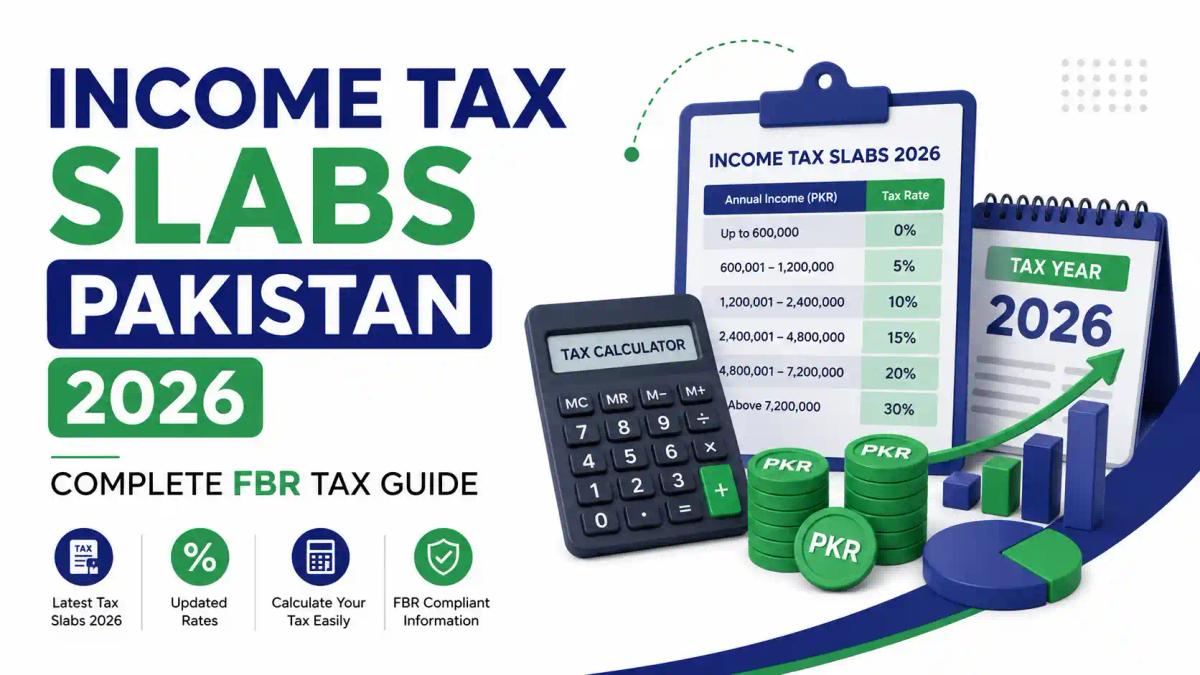
For tax year 2026 (July 1, 2025 – June 30, 2026), the FBR applies a progressive tax system for salaried individuals, meaning your income is taxed in slices, not as one lump sum. Here's the current slab table:
| Annual Taxable Income | Tax Rate |
|---|---|
| Up to Rs. 600,000 | 0% (tax-free) |
| Rs. 600,001 – Rs. 1,200,000 | 1% of the amount exceeding Rs. 600,000 |
| Rs. 1,200,001 – Rs. 2,200,000 | Rs. 6,000 + 11% of the amount exceeding Rs. 1,200,000 |
| Rs. 2,200,001 – Rs. 3,200,000 | Rs. 116,000 + 23% of the amount exceeding Rs. 2,200,000 |
| Rs. 3,200,001 – Rs. 4,100,000 | Rs. 346,000 + 30% of the amount exceeding Rs. 3,200,000 |
| Above Rs. 4,100,000 | Rs. 616,000 + 35% of the amount exceeding Rs. 4,100,000 |
For non-salaried individuals and business persons, the rates are noticeably higher at every bracket above the exemption limit:
| Annual Taxable Income | Tax Rate |
|---|---|
| Up to Rs. 600,000 | 0% |
| Rs. 600,001 – Rs. 1,200,000 | 2% of the excess |
| Rs. 1,200,001 – Rs. 2,200,000 | Rs. 12,000 + 22% of the excess |
| Rs. 2,200,001 – Rs. 3,200,000 | Rs. 232,000 + 46% of the excess |
| Rs. 3,200,001 – Rs. 4,100,000 | Rs. 692,000 + 60% of the excess |
| Above Rs. 4,100,000 | Rs. 1,232,000 + 70% of the excess |
A 9% surcharge also applies where annual taxable income exceeds Rs. 10 million, though this is under review in ongoing budget discussions. Rates are set under the Finance Act and published through the Federal Board of Revenue (FBR), so always cross-check the current figures on the official FBR portal before filing.
What Is an Income Tax Slab, Really?
An income tax slab is simply an income bracket assigned a specific tax rate. Pakistan, like most countries, uses a progressive tax system — the more you earn, the higher the rate on the portion of income above each threshold. This is the part most people misunderstand.
Your entire salary is not taxed at your highest bracket's rate. Only the amount that falls within each slab is taxed at that slab's rate. So if you earn Rs. 1,500,000 annually, you don't pay 11% on the whole amount — you pay 0% on the first 600,000, 1% on the next 600,000, and 11% only on the remaining 300,000. This is why two people close to the same salary can end up paying very different effective tax rates depending on exactly where they fall.
Why Income Tax Slabs Matter So Much in Pakistan
Pakistan's tax-to-GDP ratio remains one of the lowest in the region, which is part of why the government revises tax slab 2025-26 rates almost every budget cycle. For ordinary taxpayers, understanding these changes isn't optional — it directly affects:
- How much lands in your bank account every month
- Whether you qualify for the Active Taxpayer List (ATL)
- Your eligibility for reduced withholding tax rates on banking, property, and vehicle transactions
- Your ability to legally claim refunds if excess tax was deducted
Being an active filer versus a non-filer in Pakistan isn't a small distinction — non-filers pay significantly higher withholding tax on property purchases, vehicle registration, and even banking transactions. If you're unsure where you stand, our detailed breakdown on filer vs non-filer status in Pakistan explains the practical financial difference clearly.
Step-by-Step Guide: How to Calculate Your Income Tax
Here's the exact method FBR uses (and the one we teach hands-on in our Master Advanced Excel and Certified Data Analyst courses for building your own tax models):
Step 1 — Calculate your annual gross salary. Multiply your monthly salary by 12.
Step 2 — Subtract allowed deductions and exemptions. This includes Zakat, provident fund contributions, and any approved allowances.
Step 3 — Determine your annual taxable income. This is your gross salary minus Step 2 deductions.
Step 4 — Apply the correct slab rate. Match your taxable income to the salaried or non-salaried table above.
Step 5 — Calculate total annual tax liability. Add the fixed amount plus the percentage of the excess.
Step 6 — Divide by 12. This gives you the monthly withholding tax your employer should deduct.
Example 1: Annual income = Rs. 600,000 → Tax = Rs. 0. A person earning Rs. 50,000/month pays zero income tax — this is the tax-free threshold for 2026.
Example 2: Annual income = Rs. 1,200,000 → Taxable excess = Rs. 600,000 → Tax = 1% × 600,000 = Rs. 6,000 per year, or Rs. 500/month.
Example 3: Annual income = Rs. 3,000,000 → Falls in the third slab → Tax = Rs. 116,000 + 23% of (3,000,000 − 2,200,000) = Rs. 116,000 + Rs. 184,000 = Rs. 300,000 annually, roughly Rs. 25,000/month.
If manual math feels tedious, an online income tax calculator pakistan or salary tax calculator tool can do this instantly — but understanding the formula yourself is what actually protects you from employer errors and FBR notices down the line.
Tips for Getting Your Tax Calculation Right
- Always calculate based on annual income, not just monthly figures, since some allowances and one-time bonuses shift your bracket.
- Keep your salary certificate and wealth statement updated every year — these matter during income tax audit checks.
- If you're a freelancer or business individual, remember you fall under the non-salaried table, which is considerably steeper.
- Register on the IRIS portal early. Late registration often causes filing delays right before the deadline.
- Cross-check withholding tax already deducted by your bank or employer against your final annual liability to claim any refund you're owed.

Who Is Exempt From Income Tax in Pakistan?
Anyone earning Rs. 600,000 or less annually is fully exempt from income tax under the current slabs. Certain categories also enjoy specific exemptions or reduced rates, including some agricultural income (taxed provincially, not federally), specific pension categories, and income covered under bilateral tax treaties for non-resident individuals. If you're unsure whether your income category qualifies, this is exactly the kind of practical detail covered in depth in our Income Tax Ordinance 2001 compliance guide.
Key Skills, Tools & Benefits of Understanding Tax Slabs
Learning how income tax slabs work isn't just about compliance — it opens doors. Here's what solid tax knowledge gives you:
Skills you build:
- Reading and applying FBR notifications and Finance Act changes
- Using IRIS for return filing, NTN registration, and wealth statements
- Calculating withholding tax, advance tax, and tax credits accurately
- Advising others on filer status, refunds, and legal tax-saving strategies
Tools professionals use:
- FBR's IRIS 2.0 portal for e-filing
- Excel-based tax calculators and payroll models
- Tax Asaan app for basic filing on mobile
- Professional tax software used in accounting firms
Benefits:
- Avoiding penalties for late or incorrect filing
- Qualifying for lower withholding rates as an active filer
- Building a service you can freelance or consult on
- Career mobility into accounting, HR, or corporate advisory roles
Our Master Sales Tax and Advance Taxation and Litigation (ATL) courses go well beyond income tax slabs into the broader compliance ecosystem businesses actually need — sales tax registration, litigation defense, and audit response.
Job Scope, Salary & Demand for Tax Professionals in Pakistan
Here's something most people don't realize: understanding tax slabs is often the entry point into a genuinely well-paying career. Demand for tax consultants, certified tax advisors, and corporate tax advisors has grown steadily as FBR pushes digital invoicing, e-filing, and stricter documentation requirements across Pakistan.
Entry-level tax and accounting roles in Pakistan typically start around Rs. 40,000–70,000 per month, while certified tax advisors and consultants with a few years of practical experience regularly earn Rs. 100,000–250,000+ monthly, especially those handling international clients from the US, UK, UAE, or Canada. Freelance tax consultants serving overseas clients on platforms like Upwork and Fiverr often out-earn traditional office roles once they build a reputation — something we cover practically in our guide on starting a tax preparation business in 2026.
The scope isn't limited to Pakistan either. With businesses expanding cross-border, professionals trained in USA Taxation, UAE Taxation, Canadian Taxation, and Saudi Taxation are increasingly sought after by firms serving international clients directly from Pakistan.
Why Choose ICT — and How to Learn Taxation (Free + Paid)
If this guide has made income tax slabs finally click for you, imagine what a structured course could do. At ICT, our approach isn't theory-heavy textbook learning — it's practical, IRIS-based, real-filing training designed for the Pakistani tax environment specifically.
Free resources to start with:
- FBR's own IRIS user manuals and Tax Asaan app
- Our free blog library covering everything from how to file an income tax return in Pakistan to FBR IRIS login guides
- Government-published Finance Act summaries each budget cycle
Paid, structured learning:
- Certified Tax Advisor (CTA) — our flagship, most comprehensive taxation certification
- UK Taxation Course, USA Taxation, UAE Taxation, Saudi Taxation, and Canadian Taxation for those targeting international clients
- Customs Clearance Course for import/export-focused careers
Why choose ICT over generic online tutorials? Because our trainers work with live FBR filings, real case studies, and constantly update content as slabs and rules shift — something a static YouTube video simply can't do. You can read more about our teaching philosophy in why our institute is better than other institutes and see verified outcomes on our best tax training institute page.
For broader career flexibility, pairing tax knowledge with complementary skills matters too. Consider our AI-Driven CFO Course, Certified Business Advisor, or Company Secretary Course if you want to expand into corporate advisory alongside taxation.
Real-World Examples: How Slabs Play Out in Everyday Life
The salaried employee: Ayesha, a marketing executive in Islamabad, earns Rs. 100,000/month (Rs. 1,200,000 annually). Her employer deducts roughly Rs. 500/month based on the 1% slab — small, but she still files annually to maintain her active filer status and avoid higher withholding on her upcoming car purchase.
The freelancer: Bilal, a freelance web developer in Peshawar billing international clients, falls under the non-salaried table since freelance income isn't treated as salary. At Rs. 2,500,000 annual income, his liability is significantly higher than a salaried person at the same income level — a detail many freelancers miss until they get a notice. Our guide on freelancer tax rules in Pakistan 2026 walks through this exact scenario.
The small business owner: A shop owner in Faisalabad registered as an Association of Persons (AOP) faces even steeper non-salaried rates, plus sales tax obligations depending on turnover — which is why many business owners eventually enroll in courses like our Master Sales Tax programme to handle both income tax and sales tax compliance in-house.
Future Career Opportunities in Taxation
As Pakistan pushes toward mandatory digital invoicing and AI-assisted tax audits, the demand for professionals who understand both traditional tax law and modern compliance technology is only growing. Emerging opportunities include:
- Digital tax compliance officers for e-commerce and retail
- Freelance international tax consultants serving US/UK/UAE clients remotely
- Corporate advisory roles blending tax, AI automation, and business strategy
- Government and audit-support roles as FBR expands documentation requirements
According to global research from institutions like the OECD, digital tax transformation is a worldwide trend, not just a Pakistani one — meaning professionals who build this skill now are positioning themselves ahead of a global shift, not just a local one. Related reads worth exploring: AI in taxation: tools, risks and opportunities and future of tax advisory Pakistan 2026-2030.
Frequently Asked Questions
What are the income tax slabs in Pakistan for 2026?
For salaried individuals, income up to Rs. 600,000 is tax-free, with rates rising progressively to 35% above Rs. 4,100,000. Non-salaried individuals face higher rates at every bracket above the same exemption limit.
Is the Rs. 600,000 income tax-free limit the same for everyone?
Yes, both salaried and non-salaried individuals get the same Rs. 600,000 annual tax-free threshold, but the rates above that threshold differ significantly between the two categories.
How do I calculate my monthly salary tax deduction?
Calculate your annual tax liability using the slab table, then divide by 12. Your employer should already be doing this correctly, but it's worth verifying yourself each year.
What happens if I don't file my income tax return?
Non-filers face significantly higher withholding tax on banking transactions, vehicle registration, and property purchases, plus potential FBR notices and penalties for non-compliance.
Can freelancers and business owners use the salaried tax slab?
No. Freelance and business income falls under the non-salaried table unless salary makes up more than 75% of total annual income, in which case salaried rates may apply.
Do these slabs change every year?
Yes, slabs are typically revised with each Finance Act, usually announced during the federal budget in June. Always verify the latest rates on the FBR website before filing.
Conclusion
Understanding the income tax slabs Pakistan 2026 structure isn't just about avoiding penalties — it's about taking control of your finances and, if you choose, building a genuinely rewarding career out of it. Tax knowledge in Pakistan is becoming more valuable every year as compliance requirements tighten and businesses look for people who actually understand FBR's evolving system.
If this guide gave you clarity, imagine what a structured, practical course could do for your career or your business. Whether you're aiming to become a Certified Tax Advisor, specialize in international taxation, or simply want to file your own returns with total confidence, ICT has a course built for exactly that goal.
Book a seat at ICT today and turn tax confusion into a skill that pays you back for years to come.
Comments (0)
No comments yet. Start the conversation!
Leave a Reply
Your email address will not be published. Required fields are marked *