
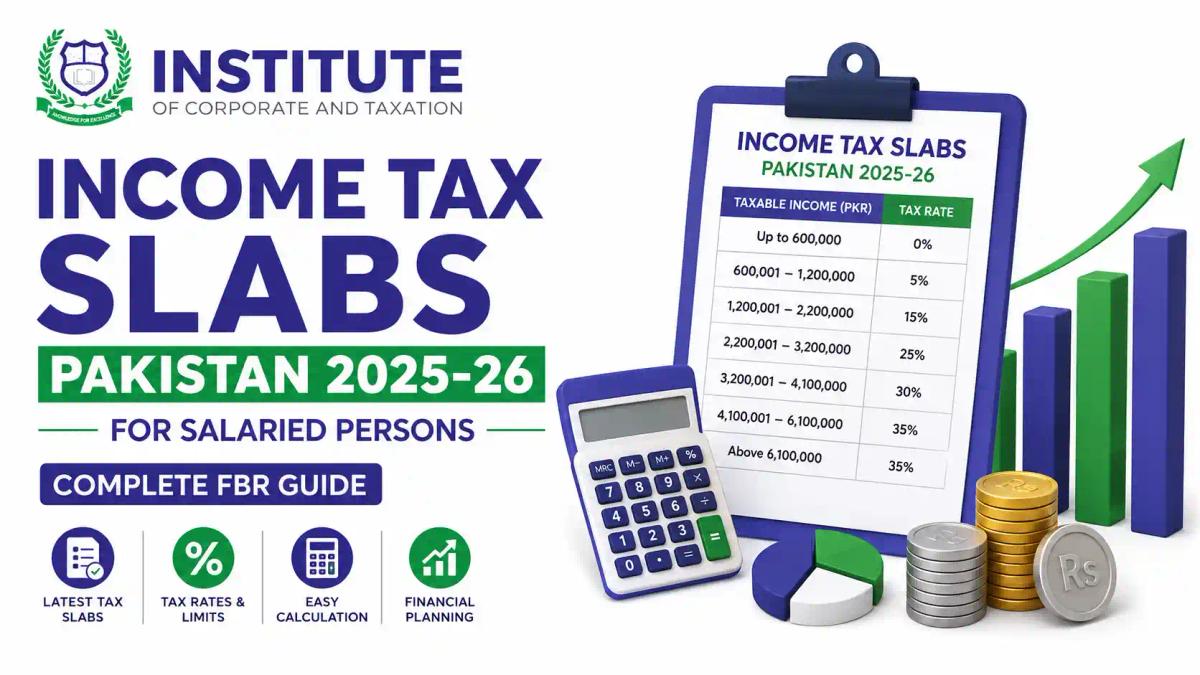
Income Tax Slabs Pakistan 2025-26 for Salaried Persons – Complete FBR Guide
Update
The 2025–26 tax year has ended. For the current 2026–27 income tax slabs and latest FBR tax rates, see our updated Income Tax Slabs in Pakistan 2026–27 guide.
Introduction
Understanding income tax slabs is essential for every salaried individual in Pakistan, especially as the Federal Board of Revenue (FBR) updates its tax structure each fiscal year. This comprehensive guide breaks down the Income Tax Slabs for Tax Year 2026 (Financial Year 2025–26), covering everything salaried persons need to know about their tax liabilities. These rates were effective from July 1, 2025 to June 30, 2026, and apply specifically to individuals earning income under the "Salary" head as defined by the Income Tax Ordinance, 2001. Whether you're a fresh graduate starting your first job or an experienced professional planning your finances, knowing where you stand in the tax bracket helps you calculate deductions accurately and avoid surprises at filing time. This guide has been compiled with reference to standards followed by the Institute of Corporate and Taxation, ensuring the information aligns with recognized professional and regulatory practices. We'll walk you through each slab, the applicable rates, and practical examples to make tax calculation simple and stress-free. Please note: if you're looking for the current 2026–27 tax rates, kindly refer to our updated guide, as slab rates and thresholds are subject to annual revision by the FBR.
What Are Income Tax Slabs? (Simple Definition)
Income tax slabs are income brackets set by the government, each carrying a specific tax rate. Pakistan follows a progressive tax system, meaning the more you earn, the higher the rate applied — but only on the portion of income that falls within each bracket, not on your entire salary.
For salaried persons, the Federal Board of Revenue (FBR) defines a salaried individual as someone whose income from salary constitutes more than 75% of their total taxable income. This classification matters because salaried individuals enjoy lower, preferential tax rates compared to non-salaried or business income earners under the Income Tax Ordinance 2001.
FBR Income Tax Slabs 2025-26 for Salaried Persons – Historical Rates
Understanding income tax slabs is essential for every salaried individual in Pakistan, especially as the Federal Board of Revenue (FBR) updates its tax structure each fiscal year. This comprehensive guide breaks down the Income Tax Slabs for Tax Year 2026 (Financial Year 2025–26), covering everything salaried persons need to know about their tax liabilities. These rates were effective from July 1, 2025 to June 30, 2026, and apply specifically to individuals earning income under the "Salary" head as defined by the Income Tax Ordinance, 2001. Whether you're a fresh graduate starting your first job or an experienced professional planning your finances, knowing where you stand in the tax bracket helps you calculate deductions accurately and avoid surprises at filing time. This guide has been compiled with reference to standards followed by the Institute of Corporate and Taxation, ensuring the information aligns with recognized professional and regulatory practices. We'll walk you through each slab, the applicable rates, and practical examples to make tax calculation simple and stress-free. Please note: if you're looking for the current 2026–27 tax rates, kindly refer to our updated guide, as slab rates and thresholds are subject to annual revision by the FBR.
| Annual Taxable Income | Fixed Tax | Tax Rate on Excess |
|---|---|---|
| Up to Rs. 600,000 | Rs. 0 | 0% |
| Rs. 600,001 – Rs. 1,200,000 | Rs. 0 | 1% |
| Rs. 1,200,001 – Rs. 2,200,000 | Rs. 6,000 | 11% |
| Rs. 2,200,001 – Rs. 3,200,000 | Rs. 116,000 | 23% |
| Rs. 3,200,001 – Rs. 4,100,000 | Rs. 346,000 | 30% |
| Above Rs. 4,100,000 | Rs. 616,000 | 35% |
Note
These income tax slabs were applicable from July 1, 2025 to June 30, 2026. For the current 2026–27 income tax slabs, see our latest guide.
How to Calculate Salary Income Tax in Pakistan: 2025-26 Example
The following examples use the 2025–26 tax rates and are provided for historical/reference purposes. For current 2026–27 calculations, use the latest tax slab guide.
Calculating your tax is simpler than it looks. The rate applies only on the portion of income that falls within a specific bracket — not on your full salary. Follow these steps:
Step 1 — Calculate your annual gross salary (include basic pay, all allowances, and bonuses)
Step 2 — Subtract allowable exemptions (Zakat, medical allowance, pension contributions, etc.)
Step 3 — Identify your net taxable income and find your applicable FBR slab
Step 4 — Apply the fixed tax plus the percentage on the excess amount above the slab threshold
Step 5 — Divide the annual tax by 12 to get your monthly withholding deduction
Salary Tax Calculation Examples for 2025-26
These examples are based on the 2025–26 salary tax slabs and should not be used as current 2026–27 tax calculations.
Here is what salaried individuals at different income levels will actually pay this year:
Monthly Salary: Rs. 50,000 | Annual Income: Rs. 600,000 Tax: Rs. 0 Monthly Deduction: Rs. 0 — Fully tax free
Monthly Salary: Rs. 100,000 | Annual Income: Rs. 1,200,000 Calculation: 1% × (1,200,000 − 600,000) = 1% × 600,000 Annual Tax: Rs. 6,000 Monthly Deduction: Rs. 500
Monthly Salary: Rs. 150,000 | Annual Income: Rs. 1,800,000 Calculation: Rs. 6,000 + 11% × (1,800,000 − 1,200,000) = Rs. 6,000 + Rs. 66,000 Annual Tax: Rs. 72,000 Monthly Deduction: Rs. 6,000
Monthly Salary: Rs. 200,000 | Annual Income: Rs. 2,400,000 Calculation: Rs. 116,000 + 23% × (2,400,000 − 2,200,000) = Rs. 116,000 + Rs. 46,000 Annual Tax: Rs. 162,000 Monthly Deduction: Rs. 13,500
Monthly Salary: Rs. 300,000 | Annual Income: Rs. 3,600,000 Calculation: Rs. 346,000 + 30% × (3,600,000 − 3,200,000) = Rs. 346,000 + Rs. 120,000 Annual Tax: Rs. 466,000 Monthly Deduction: Rs. 38,833
Monthly Salary: Rs. 500,000 | Annual Income: Rs. 6,000,000 Calculation: Rs. 616,000 + 35% × (6,000,000 − 4,100,000) = Rs. 616,000 + Rs. 665,000 Annual Tax: Rs. 1,281,000 Monthly Deduction: Rs. 106,750
Want to calculate your exact tax instantly? Use the free Pakistan Income Tax Calculator
Income Tax Slabs Comparison: 2024-25 vs 2025-26 Pakistan
One of the most searched questions right now is: what actually changed in the income tax slabs from 2024-25 to 2025-26? Here is a clear side-by-side breakdown:
Slab: Up to Rs. 600,000 Rate in 2024-25: 0% Rate in 2025-26: 0% Change: No change
Slab: Rs. 600,001 to Rs. 1,200,000 Rate in 2024-25: 2.5% Rate in 2025-26: 1% Change: Significant relief — rate dropped by more than half
Slab: Rs. 1,200,001 to Rs. 2,200,000 Rate in 2024-25: 15% plus Rs. 30,000 fixed tax Rate in 2025-26: 11% plus Rs. 6,000 fixed tax Change: Major relief — fixed tax reduced by Rs. 24,000, marginal rate down by 4%
Slab: Rs. 2,200,001 to Rs. 3,200,000 Rate in 2024-25: 25% plus Rs. 180,000 fixed tax Rate in 2025-26: 23% plus Rs. 116,000 fixed tax Change: Moderate relief
Slab: Rs. 3,200,001 to Rs. 4,100,000 Rate in 2024-25: 30% plus Rs. 430,000 fixed tax Rate in 2025-26: 30% plus Rs. 346,000 fixed tax Change: Marginal relief on fixed component
Slab: Above Rs. 4,100,000 Rate in 2024-25: 35% Rate in 2025-26: 35% Change: No change
The Finance Act 2025-26 delivered the most significant reduction in the second slab — dropping from 2.5% to just 1% — following strong advocacy for the salaried class by the government and recommendations from the National Assembly Standing Committee on Finance.
Note
This comparison shows the changes introduced for the 2025–26 tax year. For changes introduced in 2026–27, see our latest 2026–27 income tax slabs guide.
2025-26 vs 2026-27 Income Tax Slabs: Key Changes
| Change | 2025–26 | 2026–27 |
|---|---|---|
| Tax-Free Threshold | Rs. 600,000 | Rs. 600,000 |
| Rs. 2.2m–3.2m Bracket | 23% | 20% |
| Rs. 3.2m–4.1m Bracket | 30% | 25% |
| Top 35% Tax Threshold | Above Rs. 4.1 million | Above Rs. 7 million |
| High-Income Salaried Surcharge | 9% | Abolished |
Looking for the Current Income Tax Rates?
The 2025–26 tax year has ended. For the latest 2026–27 salary tax slabs, rates, calculations and FBR updates, read our updated guide.
Income Tax Slabs in Pakistan 2026–27: Latest FBR Tax Rates
Who Qualifies as a Salaried Person Under FBR Pakistan?
According to the Income Tax Ordinance 2001, you are treated as a salaried individual if:
— Your income from salary exceeds 75% of your total taxable income
— You receive a regular payslip, pay cheque, or remuneration from an employer
— You are a government servant, public sector employee, private sector employee, or contractual employee on payroll
— You are a teacher or researcher at a recognized educational institution (and you also qualify for an additional 25% tax reduction on your liability)
If your income comes from a combination of salary and business activity, your dominant income source determines your tax category. For hybrid income situations, it is best to consult a certified tax advisor.

Deductions That Can Reduce Your Taxable Income in 2025
Many salaried individuals overpay their tax simply because they are unaware of the legal deductions and exemptions available under Pakistani tax law. Here is what FBR allows:
Allowances and Exemptions:
Medical Allowance — Exempt up to 10% of basic salary, provided it is not separately reimbursed by the employer
House Rent Allowance (HRA) — Exempt up to 45% of basic salary
Conveyance Allowance — Up to Rs. 50,000 per year is exempt
Leave Encashment — Exempt within certain prescribed limits
Deductible Payments:
Zakat — Compulsory Zakat deducted under the Zakat and Ushr Ordinance is fully deductible from your taxable salary income
Charitable Donations — Donations to FBR-approved charitable organizations are deductible, subject to specified limits
Pension Fund Contributions — Contributions to approved pension funds are eligible for tax credits
Life Insurance Premiums — Eligible for tax credits under Section 62 of the Income Tax Ordinance 2001
Teacher Special Rebate — A 25% reduction on the calculated tax liability for educators at recognized institutions
Subtracting these from your gross salary gives you your net taxable income, on which the FBR slab rates are then applied. Smart tax planning can save you thousands of rupees every single year.
For business owners, use the Pakistan Business Tax Calculator
For freelancers, use the Pakistan Freelance Tax Calculator
Filer vs Non-Filer: Why Filing Your Tax Return Matters
Being a filer or non-filer does not change the salary income tax slab itself. However, ATL status can affect withholding tax on other transactions.
Registering on FBR's Active Taxpayer List (ATL) as a filer is one of the smartest financial decisions a salaried person in Pakistan can make. Filers enjoy significantly lower withholding tax rates across dozens of everyday transactions compared to non-filers.
Property Purchase Tax Filers: 3% Non-Filers: 4%
Bank Cash Withdrawal Above Rs. 50,000 Filers: 0.6% Non-Filers: 1.2%
Dividend Income Filers: 15% Non-Filers: 30%
Vehicle Registration Filers: Reduced rates Non-Filers: Higher rates
Prize Bond Winnings Filers: Lower withholding tax Non-Filers: Double withholding tax
Getting on the ATL is straightforward. File your annual income tax return on the FBR Iris portal before September 30, 2026, and you will automatically appear on the next ATL update. Make sure your National Tax Number (NTN) is registered first.
Withholding Tax on Salary – How Your Employer Deducts It
As a salaried employee, you do not have to manually pay income tax every month. Your employer calculates your estimated annual tax liability based on FBR's current salary tax slab rates, divides it equally across 12 months, and deducts it from your paycheck each month. This is called withholding tax on salary or tax deduction at source.
Under the Income Tax Ordinance 2001, your employer is legally required to:
— Deduct the applicable monthly tax from your salary before payment
— Deposit the withheld tax to FBR on a monthly basis
— Provide you with an annual tax deduction certificate (Form 16) at year end
— Submit a salary statement to FBR at the end of the tax year
Even if your employer is correctly withholding tax, you are still required to file your own annual income tax return. Filing allows you to claim refunds if excess tax was deducted, maintain your filer status, and stay compliant with FBR regulations.
Income Tax Slabs Apply Uniformly Across All of Pakistan
Whether you are a salaried professional in Karachi, Lahore, Islamabad, Rawalpindi, Peshawar, Quetta, Faisalabad, Multan, Sialkot, Gujranwala, or Hyderabad — the FBR income tax slabs 2025-26 are federal regulations and apply uniformly across all provinces and cities of Pakistan. There is no city-specific or province-specific variation in income tax rates for salaried individuals.
The only location-based tax variation you may notice is Provincial Professional Tax, which is collected separately by provincial revenue authorities and is generally a small amount deducted by your employer on your behalf.
How to File Income Tax Return Online in Pakistan – 2025-26 Tax Year
Filing your income tax return online in Pakistan is done entirely through the FBR IRIS portal at iris.fbr.gov.pk, where you register or log in with your CNIC/NTN, select the correct return form, and submit your declaration along with a wealth statement. In Pakistan, returns are filed by tax year, and Tax Year 2026 covers income earned from 1 July 2025 to 30 June 2026 — this is the return you file in 2026. From the Declaration menu, you choose Income Tax Return and select Tax Year 2026 for the year ended 30 June 2026, with most individuals filing Form 114(1) as a voluntary return for a complete year. The standard filing deadline is typically September 30, though FBR often grants extensions. Once submitted, your return moves from Draft to Completed Task, after which you can download your acknowledgement as proof and confirm your inclusion on the Active Taxpayer List (ATL) for lower withholding tax rates going forward.
Learn Taxation Professionally – ICT Pakistan's Expert Courses
Understanding income tax slabs is just the beginning. If you want to build a serious career as a tax professional, financial advisor, corporate manager, or business consultant, you need deep, practical, and up-to-date knowledge of Pakistan's tax laws, FBR procedures, the Income Tax Ordinance 2001, and corporate taxation frameworks.
The Institute of Corporate and Taxation (ICT) is Pakistan's leading professional education institute, offering industry-recognized certification programs in taxation, accounting, and business advisory.
Visit ICT About the Institute: All Courses
Certified Tax Advisor (CTA) Master FBR tax laws, income tax filing, sales tax, withholding tax, tax planning, and compliance strategy — everything you need to practice as a professional tax advisor in Pakistan.
Certified Business Advisor (CBA) Combine taxation expertise with business consulting, financial planning, and corporate strategy — a powerful combination for today's competitive job market. Course Details:
Whether you are a fresh graduate, a finance professional looking to upskill, or a business owner wanting to manage your own taxes, ICT's courses are designed to give you practical, job-ready skills from day one.
Book your seat today or get in touch:
Frequently Asked Questions – Income Tax Slabs Pakistan 2025-26
Q1. What are the new income tax slabs for salaried persons in Pakistan 2025-26?
The FBR income tax slabs for salaried persons in 2025-26 are: 0% on annual income up to Rs. 600,000; 1% on Rs. 600,001 to Rs. 1,200,000; 11% plus Rs. 6,000 fixed on Rs. 1,200,001 to Rs. 2,200,000; 23% plus Rs. 116,000 fixed on Rs. 2,200,001 to Rs. 3,200,000; 30% plus Rs. 346,000 fixed on Rs. 3,200,001 to Rs. 4,100,000; and 35% plus Rs. 616,000 fixed on income above Rs. 4,100,000.
Q2. What is the tax-free salary limit in Pakistan 2025?
The tax-free income limit for salaried persons in Pakistan for 2025-26 is Rs. 600,000 per year, which equals Rs. 50,000 per month. Any annual income below this threshold is completely exempt from income tax.
Q3. How much tax do I pay on Rs. 100,000 monthly salary in Pakistan 2025?
On a monthly salary of Rs. 100,000, your annual income is Rs. 1,200,000. The total annual tax for 2025-26 is Rs. 6,000, which works out to just Rs. 500 per month. This is a major improvement over 2024-25, where the same salary attracted Rs. 15,000 annually — a saving of Rs. 9,000 per year.
Q4. What is the difference between a filer and non-filer in Pakistan?
A filer is a person registered on FBR's Active Taxpayer List (ATL) who files their annual income tax return. Filers benefit from significantly lower withholding tax rates on property transactions, vehicle registration, banking, dividends, and investments. Non-filers pay double or higher rates on most of these transactions. Filing your return is not just a legal obligation — it is a major financial advantage.
Q5. Is medical allowance taxable for salaried persons in Pakistan 2025?
No. Medical allowance up to 10% of your basic salary is exempt from income tax, provided it is not separately reimbursed by your employer. If your employer directly reimburses your medical expenses instead, the allowance itself may be treated as taxable.
Q6. Can I calculate my income tax online in Pakistan?
Yes. Use the free Pakistan Income Tax Calculator to instantly calculate your annual and monthly tax based on FBR's 2025-26 slab rates:
Q7. What is the highest income tax rate for salaried persons in Pakistan 2025?
The maximum income tax rate for salaried persons in Pakistan for 2025-26 is 35%, applicable on annual income above Rs. 4,100,000. An additional 9% surcharge is levied on total income exceeding Rs. 10 million.
Q8. Is Zakat deductible from income tax in Pakistan?
Yes. Compulsory Zakat deducted under the Zakat and Ushr Ordinance 1980 is fully deductible from your taxable salary income. This reduces your net taxable income before FBR slab rates are applied.
Q9. Are teachers exempt from income tax in Pakistan?
Teachers and researchers employed at recognized educational institutions in Pakistan are entitled to a 25% reduction on their calculated income tax liability. This is not a full exemption but it results in meaningful and significant annual savings for educators across the country.
Q10. What changed in income tax slabs from 2024-25 to 2025-26?
The Finance Act 2025-26 reduced tax rates across lower and middle income slabs. The most significant change was in the Rs. 600,001 to Rs. 1,200,000 bracket, where the rate dropped from 2.5% to 1%. In the Rs. 1,200,001 to Rs. 2,200,000 bracket, the fixed tax was cut from Rs. 30,000 to Rs. 6,000 and the marginal rate dropped from 15% to 11%. Higher income slabs remain largely unchanged.
Q11. How does progressive tax work in Pakistan?
Progressive tax means you pay a higher rate only on the portion of income that falls in a higher bracket — not on your entire salary. For example, if you earn Rs. 1,500,000 annually, you pay 0% on the first Rs. 600,000, 1% on the next Rs. 600,000, and 11% only on the remaining Rs. 300,000. Your full salary is never taxed at the highest applicable rate.
Q12. What is the surcharge on high income in Pakistan 2025?
A 9% surcharge is applied on the total income tax liability of individuals whose annual income exceeds Rs. 10 million. This surcharge is in addition to the standard slab-based tax and is calculated on the total tax payable, not on the income itself.
Q13. Is the 2025-26 salary tax rate still current?
No. The 2025–26 rates applied from July 1, 2025 to June 30, 2026. For the current 2026–27 rates, see the latest ICT guide.
Q14. What changed from 2025-26 to 2026-27?
The tax-free threshold stays the same at Rs. 600,000 a year, but the middle brackets got real rate cuts — the 20% bracket was previously 23%, and the 25% bracket was previously 30%. The threshold for the highest 35% tax rate was also raised from Rs. 4.1 million to Rs. 7 million. The 9% surcharge on salaried individuals earning above Rs. 10 million annually has also been abolished from 1 July 2026.
Q15. What is the current salary tax rate in Pakistan?
Under the Finance Act 2026-27, the maximum tax rate for salaried individuals remains 35%, but it now kicks in only above Rs. 7 million instead of Rs. 4.1 million, with lower rates of 20% and 25% applying to the middle brackets. Income up to Rs. 600,000 a year remains completely tax-free.
Q16. What was the tax-free salary limit in 2025-26?
The tax-free salary limit in Tax Year 2025-26 (income earned July 2025–June 2026) was Rs. 600,000 per year, or Rs. 50,000 per month — the same threshold that continues under the new FY 2026-27 slabs.
Related Guides
Income Tax Slabs in Pakistan 2026-27: Latest FBR Tax Rates
Income Tax Slabs Pakistan 2026: Complete FBR Tax Guide
Salaried Class Tax Slabs Pakistan 2025–26: Planning Guide
Filer vs Non-Filer Pakistan 2026: Tax Rates, Benefits & Rules
Non-Filer Tax Rates Pakistan 2026: Full FBR Guide
Tax Deductions Every Salaried Person Should Know 2025
Pakistan Budget 2025-26 – Complete Guide to Tax Changes
Pakistan Tax Calendar 2026: FBR Deadlines & Filing Guide
Steps for Filing Income Tax Return: The Complete 2025–2026 Guide
Tax Filer Status in Pakistan 2026: Complete FBR Guide
Conclusion – Know Your Tax, Plan Smart, File on Time
The income tax slabs for salaried persons in Pakistan 2025-26 represent a genuine step toward financial relief, particularly for low and middle-income earners. With rates dropping across key brackets and the progressive tax structure remaining in place, most salaried individuals will keep more money in their pockets this fiscal year than the last.
However, knowing the slabs is only half the picture. Claiming your legal deductions, maintaining your filer status on the FBR Active Taxpayer List, and filing your annual income tax return before the September 30, 2026 deadline are equally important steps. Tax compliance is not just about avoiding penalties — it unlocks financial benefits, builds personal credibility, and supports Pakistan's economic development.
If you want to go beyond calculating your own tax and build a genuine career in taxation and financial advisory, visit the Institute of Corporate and Taxation (ICT) and explore their professional certification programs
Book your seat in ICT's Advance Taxation Course today —
Comments (0)
No comments yet. Start the conversation!
Leave a Reply
Your email address will not be published. Required fields are marked *