
Non Filer Tax Rates Pakistan 2026: Complete FBR Guide
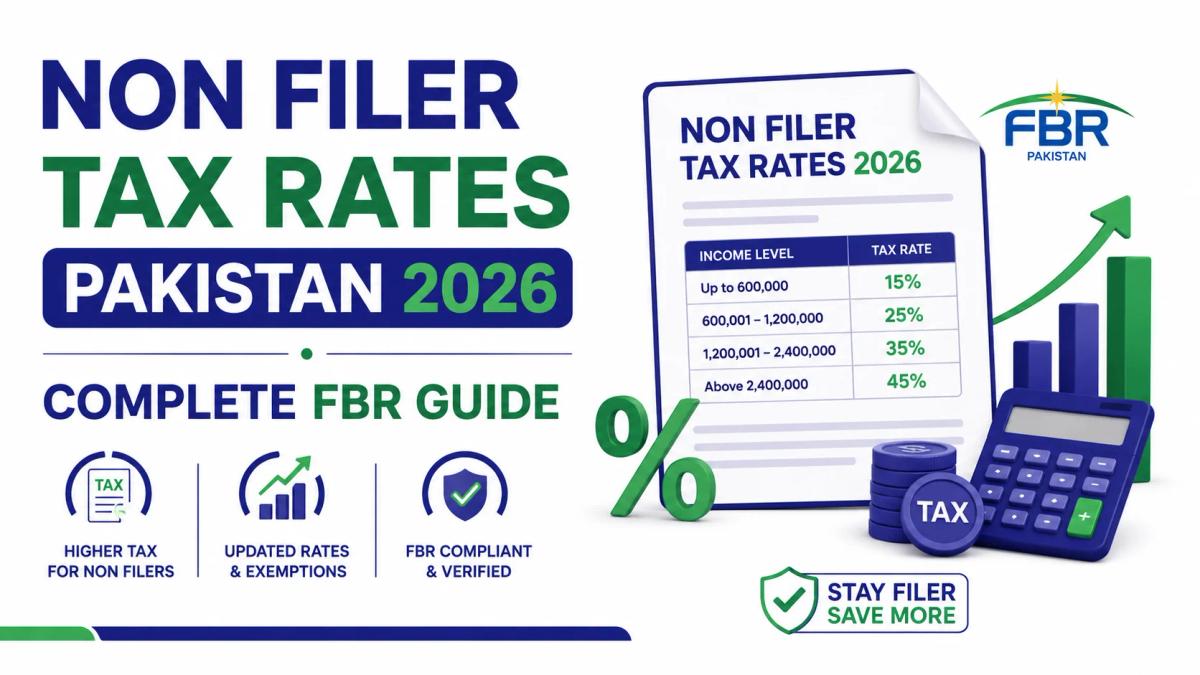
If you have ever wondered why your bank suddenly deducts extra tax on a cash withdrawal, or why your cousin paid double the token tax on his new car, the answer almost always comes back to one word: filer status. At the Institute of Corporate and Taxation (ICT), we get this question every single day from students, freelancers, salaried employees, and small business owners across Pakistan. Understanding non filer tax rates in Pakistan isn't just useful trivia — it can literally save you lakhs of rupees on property, banking, and vehicle transactions. In this guide, we break down exactly how much extra tax non-filers pay in 2026, why the gap between filers and non-filers keeps widening, and how you can fix your status before your next big transaction. If you want to go deeper into this subject professionally, our filer vs non-filer guide and our Certified Tax Advisor course are great next steps — and if tax law feels overwhelming right now, that is exactly why thousands of students choose ICT as their best tax training institute in Pakistan.
This article covers the latest non-filer withholding tax rates, a full filer vs non-filer comparison, real transaction examples, and a step-by-step guide on how to become an active filer — so you never overpay the FBR again.
What Are Non Filer Tax Rates in Pakistan?
A non-filer in Pakistan is anyone whose name does not appear on the FBR's Active Taxpayer List (ATL). Because they haven't filed an income tax return, non-filers are charged significantly higher withholding tax and advance tax rates on almost every major financial transaction — property purchases, vehicle registration, bank cash withdrawals, dividends, profit on savings, and even international card payments. Depending on the transaction, a non-filer can pay anywhere from double to more than triple the tax that an active filer pays on the same amount.
In short: staying a non-filer doesn't mean you escape tax — it just means you pay far more of it, transaction by transaction, all year long.
What Is a Non-Filer in Pakistan?
Under the Income Tax Ordinance 2001, taxpayers in Pakistan generally fall into three categories:
- Active Filer – Someone whose income tax return has been submitted and who appears on the current ATL (Active Taxpayer List).
- Late Filer – Someone who filed their return after the due date. They eventually appear on the ATL but pay a surcharge and, in some cases, slightly higher rates than an on-time filer.
- Non-Filer – Someone who has not filed a return at all, or whose NTN/CNIC does not appear on the ATL. This group faces the highest withholding tax rates across the board.
The FBR updates the Active Taxpayer List every week, so your status can genuinely change from one Sunday to the next depending on when you file. You can confirm your own tax filer status instantly by sending your 13-digit CNIC via SMS to 9966, or by checking the FBR IRIS portal.
Why Non Filer Tax Rates Matter (Especially in Pakistan)
Pakistan has one of the lowest tax-to-GDP ratios in the region, and the government has leaned heavily on withholding tax as a tool to push more people toward filing. Instead of chasing every non-filer individually, the FBR simply makes non-filing expensive — at the bank counter, at the vehicle registration office, and at the property registrar's desk.
This matters to almost everyone because:
- Non-filer withholding tax applies automatically, even to people who technically earn below the taxable threshold.
- Banks, car dealers, and property registrars are legally required to deduct the higher rate unless your name shows up on the ATL at the time of the transaction.
- The gap between filer and non-filer rates has widened with every recent Finance Act, and the Pakistan Budget 2026 tax changes pushed several non-filer penalties even higher.
- Non-filers now face restrictions, not just extra tax, on certain high-value property purchases.
If you're a freelancer, overseas Pakistani, salaried professional, or small business owner, this single piece of paperwork — your income tax return — is often the cheapest financial decision you'll make all year.
Non Filer Tax Rates on Key Transactions (2026)
Below is a practical breakdown of where non-filers typically pay the most extra tax. Exact percentages are revised almost every Finance Act, so always cross-check the current rate on the FBR portal or with a tax professional before a major transaction — but the pattern below has stayed consistent for years.
1. Property Purchase and Sale
This is where the non-filer tax rate hurts the most. Advance tax under Section 236C (seller) and 236K (buyer) is charged at a much lower rate for filers, while non-filers pay a rate that can run several percentage points higher — sometimes close to double or triple, depending on property value. On a property worth Rs. 1 crore, that difference alone can mean hundreds of thousands of rupees in extra tax, and in some cases non-filers face outright restrictions on purchasing high-value property.
2. Vehicle Registration and Transfer
Non-filers pay significantly higher motor vehicle tax under Section 231B, in some engine categories close to double the filer rate. This applies at first registration and at every subsequent transfer of the vehicle.
3. Bank Cash Withdrawals
Under Section 231AB, banks deduct advance tax at 0.6% on aggregate daily cash withdrawals above Rs. 50,000 from anyone not appearing on the ATL. Active filers pay 0% on the same withdrawal. This single rule is why so many people rush to check their filer status verification before withdrawing large amounts.
4. Profit on Savings Accounts and Dividends
Filers typically pay a flat rate (commonly around 15%) on profit on debt and dividend income, while non-filers can be taxed at normal slab rates or a materially higher flat rate — in some cases up to 35% depending on the income category.
5. Prize Bonds and Winnings
Filers pay a lower flat withholding rate, while non-filers pay roughly double on the same prize bond winning.
6. International Card Payments
Non-filers also face withholding tax on payments made via debit, credit, or prepaid cards for foreign digital services — think subscriptions, cloud tools, or education fees paid abroad.
7. Mobile Phone Registration (PTA/FBR)
Non-filers pay a noticeably higher tax when registering an imported mobile phone through PTA/FBR compared to filers.
For a full section-by-section breakdown, our detailed post on withholding tax on bank transactions walks through the exact sections of the ordinance involved.
Filer vs Non-Filer: Side-by-Side Comparison
| Transaction | Filer | Non-Filer |
|---|---|---|
| Cash withdrawal above Rs. 50,000/day | 0% | 0.6% |
| Property purchase advance tax | Lower rate (roughly 3–4%) | Higher rate, can reach double digits |
| Vehicle registration/transfer | Standard rate | Up to double the standard rate |
| Profit on debt / bank interest | Flat, lower rate | Slab-based or higher flat rate |
| Prize bond winnings | Lower flat rate | Roughly double the filer rate |
This comparison alone explains why "filer vs non filer" is one of the most searched tax topics in Pakistan every year. If you want the complete numbers with worked examples, our dedicated guide on filer vs non-filer in Pakistan covers each category in depth.
Step-by-Step Guide: How Non Filer Tax Is Applied
Step 1: Identify the Transaction Type
Every withholding section (property, vehicle, banking, dividends, etc.) has its own rate table under the Income Tax Ordinance 2001. The withholding agent — bank, registrar, or employer — checks which section applies to your transaction.
Step 2: The Agent Checks the ATL
Before deducting tax, the bank or registrar checks whether your CNIC/NTN appears on the current Active Taxpayer List. This check happens automatically through FBR's system.
Step 3: The Correct Rate Is Applied
If you're on the ATL, the filer rate applies. If not, the non-filer rate — often significantly higher — is deducted at source, before you even receive the funds or complete the transaction.
Step 4: Tax Is Deposited With FBR
The withholding agent deposits the deducted amount with FBR under your NTN/CNIC. This amount can later be adjusted against your annual tax liability when you file your income tax return — but only if you actually file. If you never file, that extra tax deduction is simply lost.
Step 5: You Can Reclaim Filer Status Anytime
Filing your return and appearing on the ATL — even after years of being a non-filer — immediately restores the lower filer rates on your next transaction.
Real-World Examples
Example 1 – Property Buyer: Ahmed, a non-filer, buys a house worth Rs. 1 crore in Lahore. Because he's not on the ATL, he pays substantially more in advance tax at the time of registration than a filer would on the exact same property — a difference that can run into hundreds of thousands of rupees.
Example 2 – Freelancer Withdrawing Payments: Sana, a freelance graphic designer, withdraws Rs. 200,000 in cash from her bank in a single day to pay a supplier. As a non-filer, she loses 0.6% (Rs. 1,200) instantly — money she would have kept entirely as an active filer.
Example 3 – Car Buyer: Bilal registers a 1300cc car. As a non-filer, his registration tax is roughly double what a filer pays for the same vehicle — a gap that easily exceeds the cost of professional tax filing services for several years.
These small percentage differences compound fast, which is why more Pakistanis are proactively learning how to become a filer in Pakistan the moment they start earning or plan any major purchase.
Tips to Avoid Overpaying as a Non-Filer
- File your return even if your income is below the taxable limit. Voluntary filing still gets you onto the ATL and unlocks filer rates.
- Check your NTN registration first. You cannot file a return without an active National Tax Number — see our guide on steps to obtain an NTN in Pakistan.
- File before, not after, a big transaction. Property, vehicle, and large withdrawal decisions should always be timed after your ATL status is confirmed.
- Watch the weekly ATL update. The FBR refreshes the Active Taxpayer List every Sunday — file early in the week so you're not caught mid-transaction as a non-filer.
- Understand the difference between ATL, NTN, and STRN. Many people confuse these — our post on ATL vs NTN vs STRN vs SECP clears this up in plain language.
- Don't ignore FBR notices. Non-filers are more likely to receive audit or compliance notices; our guide on FBR audit notices in 2026 explains how to respond correctly.
Why This Topic Is a Growing Career Opportunity
Understanding non-filer tax rates isn't only useful for individuals protecting their own money — it's also one of the fastest-growing service areas in Pakistan's tax consulting industry. As FBR digitizes enforcement through IRIS 2.0 and cross-checks bank, NADRA, and property data more aggressively, demand for professionals who can help clients manage filer status, respond to notices, and plan transactions correctly is rising sharply.
Key Skills You Need
- Reading and applying withholding tax sections of the Income Tax Ordinance 2001
- Filing income tax returns and wealth statements on IRIS
- Advising clients on ATL status, NTN registration, and compliance
- Keeping up with Finance Act changes every fiscal year
Job Scope, Salary & Demand
Certified tax consultants, filing agents, and advisory professionals are in high demand across accounting firms, law firms, real estate agencies, and banks — anywhere a client needs to understand filer vs non-filer implications before signing a deal. According to industry data, tax professional salaries in Pakistan have climbed steadily as compliance requirements grow more complex, and freelance tax consultants increasingly serve international clients too.
Why Choose ICT to Learn This
ICT (Institute of Corporate and Taxation) offers practical, FBR-focused training built around real filing scenarios rather than theory alone. Whether you want a broad foundation or a specialization, our courses are designed for working professionals, students, and career-changers:
- Certified Tax Advisor (CTA) – the flagship course covering income tax, sales tax, and FBR practical filing
- Advance Taxation and Litigation (ATL) – for those who want to handle audits, appeals, and litigation
- Master Sales Tax – a focused course on sales tax registration and returns
- UK Taxation Course, USA Taxation Course, UAE Taxation, Saudi Taxation, and Canadian Taxation — for those targeting international freelance or remote tax work
- AI-Driven CFO Masterclass and Certified Data Analyst — for finance professionals who want to combine tax knowledge with modern analytics
- Company Secretary Course and Certified Business Advisor — for corporate compliance career paths
- Master Advanced Excel — a practical skill every tax professional needs
You can also start with free resources on our blog section before deciding which paid course fits your career goals, or browse our full course catalog to compare options side by side.
Explore Advanced Taxation Courses at ICT
If you're serious about mastering FBR compliance, filer/non-filer advisory, and real client work, this is exactly what our Advance Taxation Courses at ICT are built for — practical, exam-relevant, and taught by working tax professionals.
Future Career Opportunities in Tax Advisory
Pakistan's tax system is moving toward greater digitization, real-time data sharing, and stricter enforcement of non-filer penalties. This trend, explored in our post on FBR non-filer penalties in 2026, means demand for trained tax consultants will only keep growing — both locally and for international clients who need Pakistan-based professionals familiar with cross-border compliance. Many ICT graduates go on to build independent consultancies, freelance for overseas clients, or move into corporate finance and advisory roles. Our guide on the future of tax advisory in Pakistan (2026–2030) covers where the profession is headed next.
Frequently Asked Questions
Q1: What is the non-filer tax rate on cash withdrawal in Pakistan?
Non-filers are charged 0.6% withholding tax on aggregate daily cash withdrawals above Rs. 50,000, while active filers pay 0% on the same withdrawal.
Q2: How much more tax does a non-filer pay on property?
Non-filers generally pay a substantially higher advance tax rate on property purchase or sale compared to filers — the exact gap depends on property value and is revised each Finance Act, so always confirm the current rate before finalizing a deal.
Q3: Can a non-filer buy property or a vehicle in Pakistan?
Yes, but non-filers pay higher advance and registration tax, and in some cases face additional restrictions on high-value property purchases introduced under recent Finance Acts.
Q4: How can I check if I'm a filer or non-filer?
Send your 13-digit CNIC via SMS to 9966, or check the Active Taxpayer List through the FBR IRIS portal.
Q5: How do I become a filer to avoid non-filer tax rates?
Register for an NTN, log into IRIS, file your income tax return and wealth statement, and your name typically appears on the ATL within a few days to a week. See our full walkthrough on how to become a filer in Pakistan.
Q6: Is non-filer tax refundable?
In many cases, the extra withholding tax deducted as a non-filer can only be adjusted against your annual tax liability if you actually file a return afterward. If you never file, that deducted amount is generally not recoverable.
Conclusion: Don't Let Non-Filer Status Cost You
Non filer tax rates in Pakistan are not a minor inconvenience — they are a real, recurring cost on almost every financial move you make, from withdrawing cash to buying a home. The good news is that fixing your status is straightforward, and understanding the system properly — whether for your own finances or as a career — puts you firmly in control.
If you want to stop overpaying and start understanding Pakistan's tax system properly, explore our Certified Tax Advisor course or browse all our taxation and accounting courses at ICT. Ready to take the next step in your tax career or finally sort out your filer status? Book a seat at ICT today and learn directly from FBR-focused, practical trainers who've helped thousands of students across Pakistan.
Comments (0)
No comments yet. Start the conversation!
Leave a Reply
Your email address will not be published. Required fields are marked *