
AI vs Tax Consultant: Who Wins in 2026?
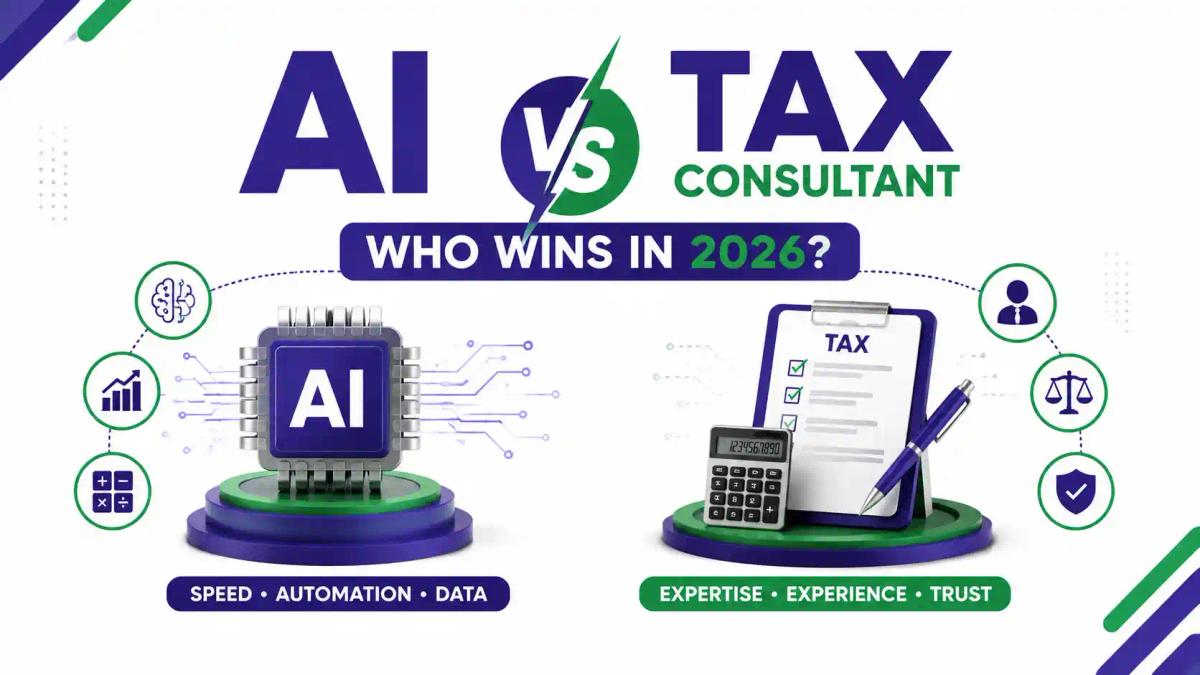
Quick Answer: AI tax software is excellent for calculations, data entry, and basic compliance checks, but it cannot interpret ambiguous law, represent you before FBR, or take legal responsibility for filings. A human tax consultant remains essential for judgment, audits, and strategy. The smartest approach in 2026 is a hybrid model — AI for speed, humans for accuracy and accountability.
Introduction
Every tax season brings the same question, and it's getting louder every year: should you trust an AI tool or hire a human tax consultant? With ChatGPT, Gemini, and specialized platforms like Intuit and Thomson Reuters now embedded into everyday accounting workflows, the line between "software" and "advisor" has blurred. At the Institute of Corporate and Taxation (ICT), we train hundreds of students and professionals every year who ask this exact question before choosing a career path or a service provider. This guide breaks down the real difference — not the marketing hype — between AI tax software and a qualified Certified Tax Advisor, and explains why the debate around whether AI will replace tax consultants misses the more useful question: how should they work together?
If you're a student deciding whether taxation is a good career in Pakistan, a freelancer trying to file correctly, or a business owner weighing software against hiring help, this article gives you a clear, practical answer.
What Is AI Tax Software?
Quick answer: AI tax software uses machine learning, OCR, and natural language processing to automate calculations, extract data from receipts and invoices, flag errors, and generate draft tax filings — reducing manual work but requiring human review for accuracy and compliance.
Tools like QuickBooks, Xero, Zoho Books, and AI-enhanced platforms from Thomson Reuters and Wolters Kluwer now handle:
- Automated tax calculation and withholding tax computation
- OCR-based invoice and receipt scanning
- Real-time bookkeeping and reconciliation
- Predictive analytics for tax liability forecasting
- Basic compliance checks against FBR rules
These tools fall under a broader trend covered in our piece on AI in taxation tools, risks, and opportunities, and they're increasingly used alongside platforms like Odoo ERP for end-to-end financial automation.
Common AI Tax Tools in 2026
| Tool | Primary Use | Best For |
|---|---|---|
| QuickBooks Online | Bookkeeping + tax prep | Small business |
| Xero Accounting | Cloud accounting | Freelancers, SMEs |
| Zoho Books | Invoicing + tax tracking | Startups |
| Thomson Reuters ONESOURCE | Corporate tax compliance | Large enterprises |
| ChatGPT / Gemini / Claude | Tax research, drafting, Q&A | Preliminary research only |
What Does a Human Tax Consultant Actually Do?
Quick answer: A human tax consultant interprets tax law, represents clients before authorities like FBR, applies professional judgment to ambiguous situations, manages audits, and takes legal and ethical responsibility for the accuracy of filings — none of which current AI systems can do independently.
A certified tax consultant, whether a CA, ACCA, CMA, or someone trained through a program like Advance Taxation and Litigation, typically manages:
- Tax planning and structuring (not just filing)
- Representation during FBR audit notices
- Interpretation of ambiguous or newly amended law, such as changes from the Pakistan Budget 2026
- Cross-border and international tax matters, e.g. UAE corporate tax registration or UK self-assessment filing
- Business advisory tied to tax outcomes (mergers, LLC formation, sales tax registration)
- Client-specific tax optimization strategies
This is why professionals with a Certified Tax Advisor credential remain in demand even as automation grows — a point explored in depth in our tax professional skills in demand 2026 analysis.
AI vs Tax Consultant: Head-to-Head Comparison
| Factor | AI Tax Software | Human Tax Consultant |
|---|---|---|
| Speed | Very fast | Slower, deliberate |
| Cost | Low (subscription-based) | Higher (fee-based) |
| Accuracy on routine tasks | High | High |
| Judgment on ambiguous law | Weak | Strong |
| Legal accountability | None | Full professional liability |
| Audit representation | Cannot represent you | Represents you before FBR |
| Handles complex/corporate tax | Limited | Strong |
| Learns your specific business | No | Yes, over time |
| Available 24/7 | Yes | No |
| Requires human oversight | Yes, always | N/A |
Where AI Wins
Quick answer: AI wins on speed, cost, and repetitive data-heavy tasks like bookkeeping, invoice scanning, and basic tax calculations — making it ideal for freelancers and small businesses with straightforward finances.
- Automation of repetitive work: data entry, reconciliation, and digital invoicing are done in seconds
- Cost savings: subscription tools cost far less than hourly consultant fees for basic tasks
- Consistency: AI doesn't get tired or make careless arithmetic errors
- 24/7 availability: useful for quick calculations or checking FBR active taxpayer list status

Where Human Consultants Win
Quick answer: Human consultants win wherever judgment, accountability, or representation is required — audits, cross-border tax planning, business structuring, and any situation where the law is unclear or the stakes are high.
- Legal accountability: a consultant signs off on filings and can be held responsible; software cannot
- Interpreting gray areas: tax law is full of exceptions AI often misses or misapplies, a risk detailed in our article on AI tax calculation and legal risk
- Audit and dispute handling: only a human can respond to a Section 114 FBR notice or negotiate on your behalf
- Strategic advisory: decisions like company structuring, LLC formation, or sales tax registration require context AI doesn't have
Can AI Replace Tax Consultants Completely?
Quick answer: No. AI can replace routine, rules-based tasks, but it cannot replace professional judgment, legal accountability, or client representation — the core reasons tax authorities and courts still require a licensed human signatory on most filings.
This question is common enough that we've dedicated a full comparison to it in Human vs AI Tax Advisory: 2026 Comparison and Will AI Replace Tax Consultants?. The short version: AI changes how consultants work, not whether they're needed.
The Hybrid Model: How Smart Firms Work in 2026
Quick answer: Leading firms now combine AI for data processing and speed with human consultants for review, judgment, and client representation — a hybrid model that improves accuracy while cutting turnaround time by 40–60%.
A typical hybrid workflow looks like this:
- AI extracts data from invoices and bank statements (OCR + automation)
- AI drafts a preliminary tax calculation
- A certified consultant reviews the draft for accuracy and compliance
- The consultant applies judgment on deductions, exemptions, and planning opportunities
- The consultant signs and files the return, taking legal responsibility
This mirrors the shift discussed in Manual vs AI-Assisted Tax Filing in 2026 and is increasingly the standard taught in our AI-Driven CFO Masterclass.
Note: Firms in Pakistan working with FBR's evolving digital invoicing system are already required to blend automated data submission with human compliance oversight.
Cost Comparison
| Service Type | AI Tool Cost (Monthly) | Human Consultant Cost (Per Filing) |
|---|---|---|
| Basic bookkeeping | PKR 2,000–8,000 | PKR 5,000–15,000 |
| Individual tax return | PKR 500–2,000 (software only) | PKR 3,000–10,000 |
| Business/corporate tax | Software insufficient alone | PKR 25,000+ |
| Audit representation | Not available | PKR 20,000–100,000+ |
Career Impact: What This Means for Students and Professionals
Quick answer: AI is not shrinking tax careers — it's changing required skills. Professionals who combine tax knowledge with AI tool fluency are seeing higher demand and salaries than those with either skill alone.
If you're a student in B.Com, BBA, ACCA, or CA, this shift actually creates opportunity rather than risk. Roles evolving right now include:
- AI-assisted tax preparers who review and validate software output
- Consultants specializing in FBR audits and dispute resolution
- International tax specialists for UK, USA, UAE, and Saudi markets
- Freelance tax consultants building international client bases, as outlined in Freelancer to Tax Consultant: 2026 Roadmap
This trend is covered in detail in Tax Careers Evolution 2026: Technology & AI and New Tax Careers 2026: Digital Compliance Roles.
Common Mistakes People Make Choosing Between AI and a Consultant
- Trusting AI output without human review — leads to compliance errors and penalties
- Assuming a consultant is always slower/costlier — many now use AI tools to speed up service, lowering fees
- Ignoring audit risk — AI cannot represent you if FBR flags your return
- Overpaying a consultant for tasks AI handles better — basic bookkeeping doesn't need a senior consultant
- Not verifying software output against actual FBR rules, especially after budget changes
Expert Tips
- Use AI tools for bookkeeping and data organization, but have a certified consultant review before filing
- For anything involving audits, cross-border income, or corporate structuring, always use a human expert
- If you're building a freelance tax practice, learn the AI tools every freelance tax consultant will use in 2026 — clients expect efficiency now
- Stay updated on regulation; AI tools lag behind real-time law changes like salaried tax slabs 2025-26
Future Trends (2026–2030)
Quick answer: Expect deeper AI integration into tax software (predictive compliance, automated audit-risk flagging) alongside growing demand for human consultants who can manage AI output, client relationships, and legal accountability — not a decline in either role.
- Wider adoption of digital tax audits powered by AI across FBR and global tax authorities
- Growth in AI-enhanced financial advisory as a standard service offering
- Increased need for professionals trained in both taxation and automation, covered in Future of Tax Advisory Pakistan 2026-2030
- More firms adopting tools like Certified AI Automation for internal efficiency
FAQs
1. Will AI replace tax consultants in Pakistan?
No. AI automates calculations and data entry, but FBR filings still require a legally accountable human signatory, especially for audits and complex cases.
2. Is AI tax software accurate?
It's accurate for routine, rules-based calculations, but it can misapply exceptions or miss recent law changes without human review.
3. Can I file my own taxes using only AI tools?
For very simple salaried returns, yes. For business, freelance, or cross-border income, a human consultant reduces error and audit risk significantly.
4. Do tax consultants use AI too?
Yes, most modern consultants use AI-powered software like QuickBooks or Thomson Reuters for efficiency, then apply professional judgment on top.
5. Is it cheaper to use AI instead of a tax consultant?
For basic bookkeeping, yes. For filings involving deductions, audits, or business structuring, a consultant often saves money by avoiding penalties.
6. What happens if AI makes an error on my tax return?
You remain legally responsible, since AI has no legal accountability — this is why human review before filing matters.
7. Should I study taxation if AI is automating the field?
Yes — AI is increasing demand for professionals who understand both tax law and AI tools, not reducing it.
8. Can AI represent me during an FBR audit?
No. Only a licensed human consultant can represent you before FBR or any tax authority.
Conclusion
AI is transforming how taxes are calculated and filed, but it hasn't replaced the need for professional judgment, legal accountability, and human representation — especially in Pakistan's evolving FBR compliance landscape. The smartest path forward, whether you're a business owner or an aspiring tax professional, is learning to work with AI rather than choosing one over the other. If you want to build real, future-proof expertise in this space, explore the Certified Tax Advisor program and see how ICT blends traditional tax training with modern AI-tool literacy.
Book a seat at ICT today and start building a career that AI can't replace.
Comments (0)
No comments yet. Start the conversation!
Leave a Reply
Your email address will not be published. Required fields are marked *