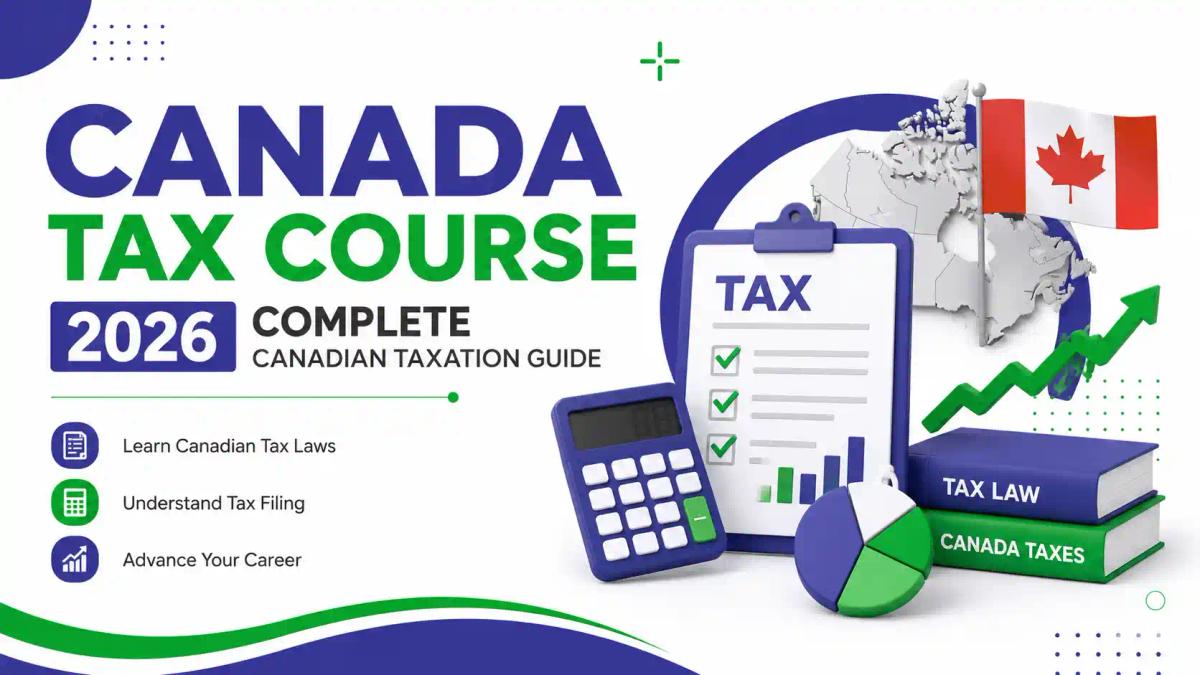
Canada Tax Course 2026: Complete Canadian Taxation Guide
If you have ever searched for a Canada Tax Course that actually teaches you how the Canada Revenue Agency (CRA) works, how GST/HST filing is done, and how to build a real career in Canadian taxation, you are exactly where you need to be. Taxation in Canada is detailed, ever-changing, and full of opportunity — and that's precisely why so many students, accountants, and freelancers from Pakistan are now enrolling in a proper Canadian Tax Course instead of trying to learn everything from random YouTube videos. At ICT (Institute of Corporate and Taxation), this exact gap is what our Canadian Taxation course was built to close. Whether you're a student, a bookkeeper, or someone dreaming of working with international clients, this guide walks you through everything about Canada Tax Training, including why it matters, what you'll learn, and how it can change your career. You can also read our detailed blog on Canadian Taxation Course: Basics to Advanced for a deeper breakdown of the syllabus, or check whether Canadian taxation is difficult for beginners before you commit.
What Is a Canada Tax Course?
A Canada Tax Course is a structured training program that teaches individuals how Canadian federal and provincial tax systems work — covering personal income tax (T1 General), corporate tax (T2 Corporation), GST/HST, payroll deductions, and CRA compliance. It's designed for students, accountants, bookkeepers, and freelancers who want to prepare Canadian tax returns professionally or work with Canadian clients remotely.
In short: if you want to become a Canadian Tax Professional, understand CRA Tax Course requirements, or simply add an in-demand skill to your resume, a proper Canada Taxation Course is the fastest and most reliable route.
What Is the Canada Tax Course All About?
A Canada Tax Course isn't just theory — it's practical training on how real Canadian tax filing works. Students learn:
- How the Canada Revenue Agency (CRA) processes personal and corporate returns
- How to prepare a T1 General Return for individuals
- How to file a T2 Corporation Return for businesses
- GST/HST and Provincial Sales Tax (PST) calculations
- Payroll deductions including CPP and EI
- Reading T4 and T5 slips
- Understanding RRSP and TFSA tax treatment
- Capital gains tax and self-employed tax filing
This is why so many people search for Canada Income Tax Course, Canada Tax Preparation Course, and Canadian Accounting and Tax Course — they want practical, job-ready skills, not just definitions. Our detailed breakdown in Canadian Taxation for Beginners – A Pakistan Guide explains each of these topics in simple language.
Why It's Important — Especially From Pakistan
Pakistan has a fast-growing freelance and remote-work economy, and Canadian companies frequently outsource bookkeeping, tax preparation, and payroll tasks to skilled professionals abroad. Learning Canadian Tax Law gives Pakistani students and accountants a genuine edge because:
- Canadian clients pay in CAD or USD — a strong advantage for freelancers
- Very few local professionals in Pakistan understand CRA processes deeply, so competition is lower
- Cross-border tax knowledge (Canada + Pakistan) is a rare, high-value combination
- Remote-first Canadian firms are actively hiring trained tax preparers
If you're weighing whether now is the right time, our post on the Right Time to Enroll in a Canadian Taxation Course breaks down current market demand in detail.
Key Skills You'll Gain From Canadian Tax Training
A well-structured Canada Tax Training program should leave you confident in:
- Tax Filing for individuals and small businesses
- Tax Planning strategies for corporate and personal clients
- Tax Compliance with CRA regulations
- Bookkeeping fundamentals alongside tax preparation
- Using tax software like QuickBooks, Sage, and Xero
- Preparing accurate Tax Returns and handling CRA Audit documentation
- Client communication for tax consulting
H3: Step-by-Step Guide to Learning Canadian Taxation
- Start with the basics — understand the Canadian tax system structure (federal vs provincial)
- Learn personal tax filing — master the T1 General and common deductions/credits
- Move to corporate tax — understand T2 filing, business expenses, and corporate tax planning
- Study GST/HST and payroll tax — this is where most real freelance work comes from
- Practice with real case studies — apply what you've learned to mock client files
- Get certified — complete your Canadian Tax Certification to prove your competency
- Start taking clients — build your portfolio through freelancing platforms or local firms
H4: Practical Tips for Faster Learning
- Practice on real CRA forms whenever possible, not just theory slides
- Join tax-focused freelancing groups to see real client requirements
- Keep a "cheat sheet" of provincial tax rate differences (Canada has 10 provinces + 3 territories)
- Revisit GST/HST rules regularly — they change most often
- Don't skip payroll tax; it's one of the most requested freelance services
For a full walkthrough on GST/HST specifically, see CRA GST/HST Filing Basics – 2026 Guide.
Tools You'll Use in a Canada Tax Course
Modern Canada Tax Preparation Course programs also train you on real software, including:
- QuickBooks for bookkeeping and small business tax prep
- Sage Accounting for payroll and corporate tax management
- Xero for cloud-based accounting and GST/HST tracking
- CRA's own e-filing systems, so you understand actual government portals
Knowing these platforms is what separates a "certificate holder" from someone who's genuinely ready to work with clients.

Job Scope, Salary & Demand for Canadian Tax Professionals
Demand for tax professionals with Canadian tax knowledge has grown steadily, both within Canada and among international freelancers serving Canadian clients. According to Statistics Canada and CPA Canada, accounting and tax-related occupations remain among the more stable professional categories in Canada's job market, with tax season consistently driving demand for seasonal and remote tax preparers.
For Pakistani professionals, this translates into opportunities such as:
- Freelance CRA tax preparation for small Canadian businesses
- Remote bookkeeping and payroll roles for Canadian accounting firms
- Corporate tax support for companies with Canadian subsidiaries
- Tax consultancy for immigrants and international students in Canada who need help filing returns
Our detailed salary breakdown is available here: Canadian Tax Professionals – Salary Trends 2026, along with Canadian Taxation Course – Job Scope for a full career outlook.
Why Choose ICT for Your Canada Tax Course
There are many institutes offering generic tax classes, but Why Choose ICT comes down to a few clear reasons:
- Practical, CRA-focused curriculum — not just theory
- Instructors with real cross-border tax experience
- Hands-on training with actual filing scenarios and software
- Recognized certification that adds credibility to your resume
- Ongoing support even after course completion
- A complete ecosystem of related courses — from UK Taxation and USA Taxation to UAE Taxation and Saudi Taxation — so you can build a truly international tax skillset
You can explore our full Advance Taxation and Litigation (ATL) course as a natural next step after mastering Canadian tax fundamentals, and read student experiences in ICT's Canadian Tax Course – CRA Guide.
How to Learn Canada Tax — Free and Paid Resources
If you're not ready to enroll immediately, here are ways to start learning on your own:
Free resources:
- CRA's official website (canada.ca) — publishes guides, forms, and filing instructions directly
- YouTube tutorials on T1 and T2 basics
- Free introductory webinars offered occasionally by accounting bodies
Paid, structured resources:
- A dedicated Canadian Tax Certification program (recommended for serious learners)
- Practical software training bundled with tax courses
- Mentorship-based programs where you can ask real questions about client scenarios
While free resources are useful for exploring the topic, most people find that a paid, structured Canada Tax Classes program gets them job-ready far faster, since it includes practice files, feedback, and certification — something scattered YouTube videos can't replicate. If you're still unsure, this comparison helps: Online vs Physical Tax Courses in Pakistan – Which Is Better.
Real-World Examples
Consider Ayesha, a bookkeeper from Lahore who completed her Canadian Tax Course and began offering GST/HST filing services to small Canadian e-commerce sellers on Upwork. Within a few months, she had built a small roster of recurring clients paying in CAD.
Or take Bilal, an accounting graduate who paired his existing skills with Canada Payroll Tax Course training and landed a remote contract with a Canadian bookkeeping firm handling T4 preparation during tax season.
These aren't unusual stories — they reflect a pattern: professionals who combine local accounting knowledge with Canadian Tax Law expertise consistently find remote opportunities that professionals without this niche skill simply don't see.
Future Career Opportunities After a Canada Tax Course
Once certified, your Canada Tax Course opens doors to:
- Freelance Tax Consultant roles serving Canadian small businesses
- Remote Payroll Specialist positions with Canadian firms
- Corporate Tax Analyst roles for multinational companies with Canadian operations
- Starting your own tax consultancy focused on Canadian clients
- Expanding into related fields like Company Secretary work or Certified Business Advisor consulting
- Combining tax skills with data tools through our Certified Data Analyst course for advanced financial analysis roles
If you eventually want to specialize further, ICT also offers a Master Sales Tax course and an AI-Driven CFO Course for those aiming at senior financial leadership roles.
Who Should Join a Canada Tax Course?
This program is ideal for:
- Accounting and commerce students wanting an international edge
- Bookkeepers looking to add Canadian clients to their portfolio
- Freelancers who want higher-paying, specialized tax work
- Working professionals studying part-time (yes, it's absolutely possible — check Is Canadian Taxation Difficult for a realistic difficulty assessment)
- Immigrants or students planning to move to Canada who want to understand the tax system in advance
FAQs — Canada Tax Course
1. What is the best Canada tax course for beginners?
A course that starts with personal tax filing (T1) before moving into corporate tax (T2) and GST/HST is best for beginners, since it builds foundational understanding before adding complexity.
2. How long does a Canadian tax course usually take?
Most structured programs run for a few weeks to a few months, depending on whether you're studying part-time or full-time, and whether the course includes hands-on software practice.
3. Is a Canada tax course available online?
Yes. Most reputable institutes, including ICT, offer a fully Online Canada Tax Course, so students anywhere in Pakistan can enroll without relocating.
4. Can international students or Pakistani freelancers really work with Canadian clients?
Yes. Many Canadian small businesses and accounting firms outsource bookkeeping, payroll, and basic tax prep to remote professionals, especially during peak tax season.
5. Does completing a Canada tax course guarantee a job?
No course can guarantee employment, but a recognized Canadian Tax Certification, combined with practical skills and a strong portfolio, significantly improves your chances of freelance or remote work.
6. What's the difference between a Canada tax course and a general accounting course?
A general accounting course covers broad bookkeeping and financial principles, while a Canada Taxation Course focuses specifically on CRA rules, Canadian tax forms, and country-specific compliance — skills a general course typically won't cover in depth.
Conclusion — Start Your Canadian Tax Career Today
Learning Canadian taxation isn't just about ticking a box on your resume — it's about opening doors to remote work, freelance income in strong currencies, and a genuinely rare skillset in Pakistan's job market. Whether you're a student exploring options, a bookkeeper wanting to diversify, or a freelancer chasing better-paying clients, a proper Canada Tax Course can be the turning point.
At ICT, our Canadian Taxation course is built exactly for this — practical, CRA-focused, and designed to get you job-ready, not just certificate-ready. Explore our full range of Advanced Taxation Courses at ICT, including UK, USA, UAE, and Saudi taxation programs, and take the next step in building a truly international tax career.
Book a seat at ICT today and start your journey toward becoming a certified Canadian tax professional.
Comments (0)
No comments yet. Start the conversation!
Leave a Reply
Your email address will not be published. Required fields are marked *