
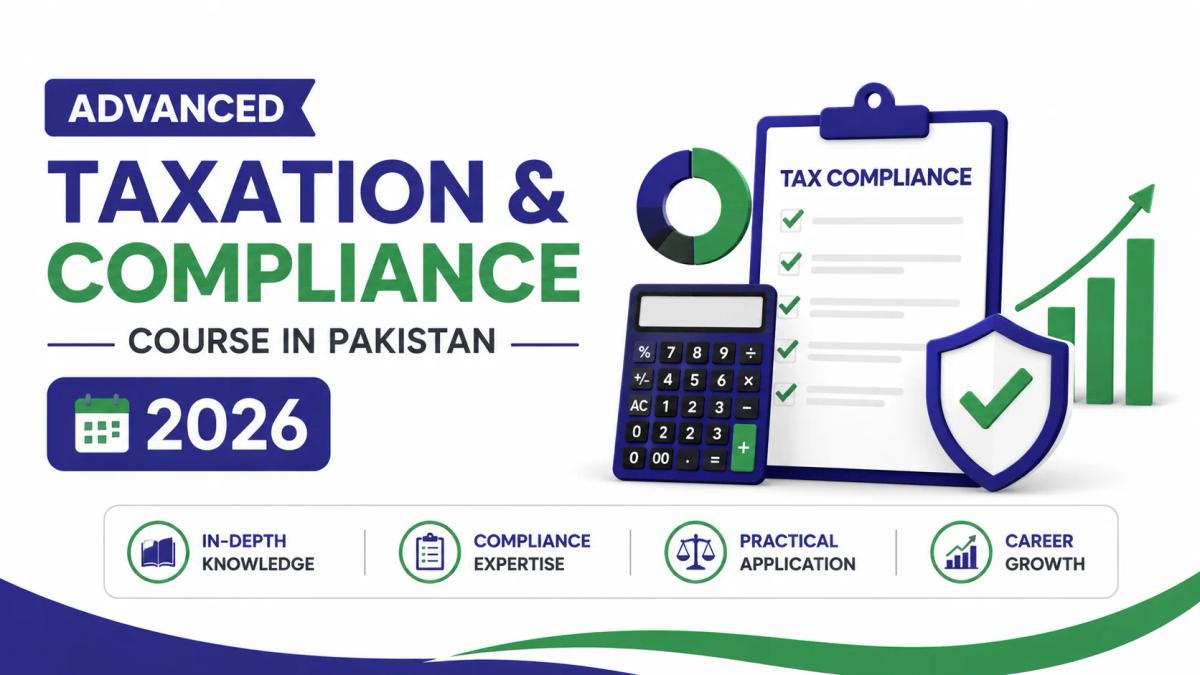
Advanced Taxation & Compliance Course in Pakistan 2026
Introduction
Pakistan's tax system is changing faster than ever, and businesses, freelancers, and individuals are all feeling the pressure to stay compliant with FBR regulations, sales tax rules, and constantly shifting withholding tax requirements. If you've ever searched for an advanced taxation course in Pakistan or wondered how professionals actually keep up with this complexity, you're not alone. This is exactly the gap that ICT (Institute of Corporate and Taxation) was built to fill. As one of the leading names offering a taxation and compliance course in the country, ICT trains students, accountants, and business owners to handle real-world tax matters with confidence rather than guesswork.
This article breaks down everything you need to know about an advanced taxation training program in Pakistan — what it covers, why it matters, the career and salary potential, and how to actually get started. Whether you're a fresh graduate exploring a tax consultant course in Pakistan, an accountant wanting a taxation certification course, or a business owner trying to understand tax compliance management, this guide is written for you.
Along the way, we'll point you toward specific programs like the Certified Tax Advisor (CTA) course and the Advance Taxation and Litigation (ATL) program, both offered directly through ICT, so you can see exactly where to go next. Let's get into it.
What Is an Advanced Taxation & Compliance Course?
An advanced taxation course in Pakistan is a structured training program that teaches income tax, sales tax, corporate taxation, withholding tax, tax filing (via FBR's IRIS portal), tax audits, and compliance management — combining legal knowledge with hands-on practical filing skills. Unlike a basic taxation class, an advanced program goes further into corporate tax planning, tax litigation, and international taxation concepts, preparing students for real client work, not just theory.
In short: it's the difference between knowing what income tax is and actually being able to file, calculate, and defend a tax return for a real business or client.
What Is Advanced Taxation & Compliance, Really?
Advanced taxation and compliance covers two connected ideas:
- Taxation — understanding direct and indirect taxes such as income tax, sales tax, withholding tax, and corporate tax under laws like the Income Tax Ordinance 2001 and the Sales Tax Act 1990.
- Compliance — making sure individuals and businesses meet their legal tax obligations on time, correctly, and without penalties — including NTN registration, STRN registration, ATL status, and accurate return filing through FBR's IRIS system.
A well-designed taxation and compliance course combines both. Students don't just memorize tax law; they practice actual filing, learn how to respond to an FBR notice, and understand how audits work. If you want a deeper look at how audit notices function, ICT's blog on how FBR audit notices work in Pakistan is a useful starting point.
Why It's Important — Especially in Pakistan
Pakistan's tax environment is uniquely demanding compared to many other countries, for a few reasons:
- Frequent regulatory changes. Tax slabs, exemptions, and filing deadlines change almost every fiscal year. ICT's guide on the income tax slabs for 2025-26 shows just how often these numbers shift.
- Digital transformation. FBR is pushing hard toward e-invoicing and digital tax systems — see ICT's coverage of FBR's digital transformation in Pakistan.
- Rising non-filer penalties. Being a non-filer is becoming more costly every year, as explained in ICT's article on FBR non-filer penalties in 2026.
- Growing freelance economy. Pakistan has one of the fastest-growing freelance workforces in the region, and freelancers now need real tax knowledge — covered in freelancer tax rules in Pakistan for 2026.
Because of all this, businesses and individuals genuinely need trained professionals who understand both the law and the practical filing process — not just theory learned from a textbook.
Key Skills, Tools & Benefits You'll Gain
Step-by-Step: What a Strong Taxation Course Should Teach You
- Income tax fundamentals — tax slabs, deductions, exemptions, and filing procedures.
- Sales tax mechanics — registration, invoicing, monthly returns, and refunds. ICT covers this in depth through its Master Sales Tax course.
- Withholding tax obligations — for employers, contractors, and service providers.
- Corporate taxation — how companies calculate and plan their tax liabilities.
- FBR IRIS portal training — hands-on practice registering, filing, and troubleshooting on the actual government portal.
- Tax audits and litigation — how to prepare documentation and represent a client during a dispute, taught in detail in the Advance Taxation and Litigation (ATL) course.
- Compliance management — keeping a business audit-ready year-round, not just at filing deadlines.

Core Tools You Should Be Comfortable With
- FBR's IRIS portal for e-filing
- Microsoft Excel for tax calculations and reconciliations
- Accounting software like QuickBooks, Xero, or Odoo (ICT even offers an Odoo ERP course for those who want to combine tax knowledge with ERP systems)
- Basic understanding of IFRS/IAS reporting standards for corporate clients
Benefits of Getting Certified
- A recognized taxation certification course adds real credibility to your CV, especially when working with employers or clients who expect proof of practical skill.
- It opens the door to freelance tax consulting, which is booming — see ICT's roadmap for going from freelancer to tax consultant in 2026.
- It builds confidence to handle real client cases instead of relying on guesswork or outdated information from forums.
Job Scope, Salary & Demand in Pakistan
Tax consultants, compliance officers, and tax advisors are in demand across almost every sector — banks, multinational corporations, accounting firms, and even small businesses that can't afford a full in-house finance team.
Typical Roles After Completing an Advanced Taxation Course
- Tax Consultant / Tax Advisor
- Compliance Officer
- Corporate Tax Analyst
- Freelance Tax Filing Specialist
- Tax Auditor
- Accounts & Tax Executive
Salary Expectations
Salaries vary depending on experience, city, and whether you work independently or for a firm. Entry-level tax executives in Pakistan often start modestly, while experienced certified tax advisors working with corporate clients or international freelance clients can earn significantly more — especially once they build a steady client base. ICT's detailed breakdown on tax advisor salary and scope in Pakistan for 2026 is worth reading if you want real numbers and comparisons.
Why Demand Keeps Growing
- Businesses are legally required to file taxes regardless of economic conditions — this makes tax expertise a genuinely recession-resistant skill.
- More companies now prefer certified tax professionals over general accountants, as discussed in ICT's article on why banks and MNCs prefer certified tax professionals.
- International clients on platforms like Upwork and Fiverr are actively hiring Pakistani tax professionals — see how Pakistanis are building global tax careers.
Why Choose ICT — And How to Learn (Free + Paid Resources)
Why Choose ICT for Taxation Training
Not every institute offers hands-on, practical training. Many programs stay purely theoretical, which leaves students unprepared for real client work. Why choose ICT comes down to a few clear reasons:
- Practical FBR filing training, not just classroom theory
- Courses designed around real Pakistani tax law and procedures
- A recognized taxation certification course upon completion
- Experienced trainers who work directly in the tax and compliance field
- A genuine focus on job-readiness, not just passing an exam
If you're comparing institutes, ICT's own comparison guide on the best taxation institute in Islamabad and its broader piece on the best taxation institute in Pakistan are genuinely useful before making a decision.
Free Resources to Start Learning
- FBR's official website for tax rates, forms, and notices
- YouTube channels covering basic IRIS filing walkthroughs
- ICT's own blog library, including guides like what is the FBR IRIS portal and how to use it for tax filing
- General finance courses on platforms like Coursera, which offer introductory tax and accounting fundamentals
Paid, Structured Learning
For anyone serious about turning this into a career rather than a hobby, a structured program makes a real difference. Explore Advanced Taxation courses at ICT to see the full range — from the UK Taxation Course and USA Taxation Course to the UAE Taxation Course, Saudi Taxation Course, and Canadian Taxation Course — depending on whether you want to work locally or serve international clients.
For those who want to specialize further, related programs like the Company Secretary Course, Certified Business Advisor, and Master Import & Export pair well with a taxation background, especially if you plan to advise businesses more broadly rather than only handling tax filings.
Real-World Examples
Example 1: The Accountant Who Added Tax Specialization
Consider an accountant already handling bookkeeping for small businesses. Without tax specialization, they're limited to recording transactions. After completing an advanced taxation and compliance course, that same accountant can now file sales tax returns, handle FBR notices, and offer corporate tax advisory — effectively tripling their service offering to existing clients.
Example 2: The Freelancer Who Became a Tax Consultant
Freelancers earning through platforms like Upwork often struggle to understand their own tax obligations, let alone help others. ICT's article on the 90-day plan from student to tax consultant shows a realistic path: learn the fundamentals, get hands-on IRIS practice, then start offering tax filing services to other freelancers — a real, growing niche in Pakistan.
Example 3: The Business Owner Avoiding Costly Mistakes
Small business owners frequently make avoidable errors — missing sales tax deadlines, misclassifying withholding tax, or ignoring an ATL notice. ICT's guide on common tax mistakes Pakistani businesses make in 2026 shows how a basic compliance course can literally save a business from unnecessary penalties.
Future Career Opportunities in Taxation
The taxation field in Pakistan isn't standing still — it's evolving alongside technology and global demand.
Where the Field Is Heading
- AI-assisted compliance — tax filing tools are getting smarter, but human oversight is still essential, as ICT explores in AI in taxation: tools, risks, and opportunities.
- Cross-border tax work — more Pakistani professionals are serving UK, US, UAE, and Canadian clients remotely.
- Digital invoicing compliance — as covered in ICT's guide on e-invoicing in Pakistan for 2026, businesses will increasingly need consultants who understand digital tax systems.
- Specialized niches — corporate tax planning, customs and litigation (see the Customs Clearance Course), and international taxation are all growing specializations with less competition than general accounting.
If you're weighing whether this career path is worth pursuing long-term, ICT's honest breakdown on whether AI will replace tax consultants is worth a read — spoiler: the human judgment side of tax work remains very much in demand.
Tips Before You Enroll
- Compare online vs. physical classes based on your schedule and learning style — ICT's comparison of online vs. physical tax courses in Pakistan can help you decide.
- Check whether the course includes practical IRIS training, not just theory — this is often the biggest gap between a good and average program.
- Ask about certification recognition before enrolling, especially if you plan to use it for job applications.
- Start with a foundational course if you're completely new, then move to specialized programs like ATL or CTA once you're comfortable with the basics.
- Don't underestimate soft skills — client communication and documentation matter just as much as tax law knowledge.
Frequently Asked Questions
1. Which taxation course is best in Pakistan?
The best course depends on your goals. For a strong all-around foundation, ICT's Certified Tax Advisor (CTA) program is a popular choice, while those wanting deeper litigation and dispute-handling skills often choose the Advance Taxation and Litigation (ATL) course.
2. Is taxation a good career in Pakistan?
Yes. Tax compliance is a legal requirement for every registered business, which makes trained tax professionals consistently in demand regardless of broader economic conditions.
3. How long does an advanced taxation course take?
Most structured programs run for a few months, combining theoretical modules with hands-on FBR filing practice, though exact duration varies by institute and course level.
4. Can I learn taxation online in Pakistan?
Yes, many institutes, including ICT, offer both online and physical class options, making it possible to learn taxation from anywhere in Pakistan.
5. Do I need an accounting background to join a taxation course?
Not necessarily. While an accounting or finance background helps, many beginner-friendly programs are designed for fresh graduates and career-changers with no prior tax experience.
6. What jobs can I get after a taxation certification?
Common roles include Tax Consultant, Compliance Officer, Corporate Tax Analyst, and Freelance Tax Filing Specialist, with opportunities in accounting firms, corporate finance departments, and independent consulting.
Conclusion
Taxation isn't just a compliance requirement anymore — it's a genuine career path with real growth potential in Pakistan, especially as digital filing systems, freelance income, and cross-border work continue expanding. Whether you're aiming to become a certified tax advisor, support your family's business, or build a freelance consulting practice, the right training makes all the difference between guessing and genuinely knowing what you're doing.
If you're ready to take the next step, explore Advanced Taxation courses at ICT and see which program fits your goals best. Book a seat at ICT today and start building a taxation career that actually keeps up with Pakistan's changing tax landscape.
Comments (0)
No comments yet. Start the conversation!
Leave a Reply
Your email address will not be published. Required fields are marked *