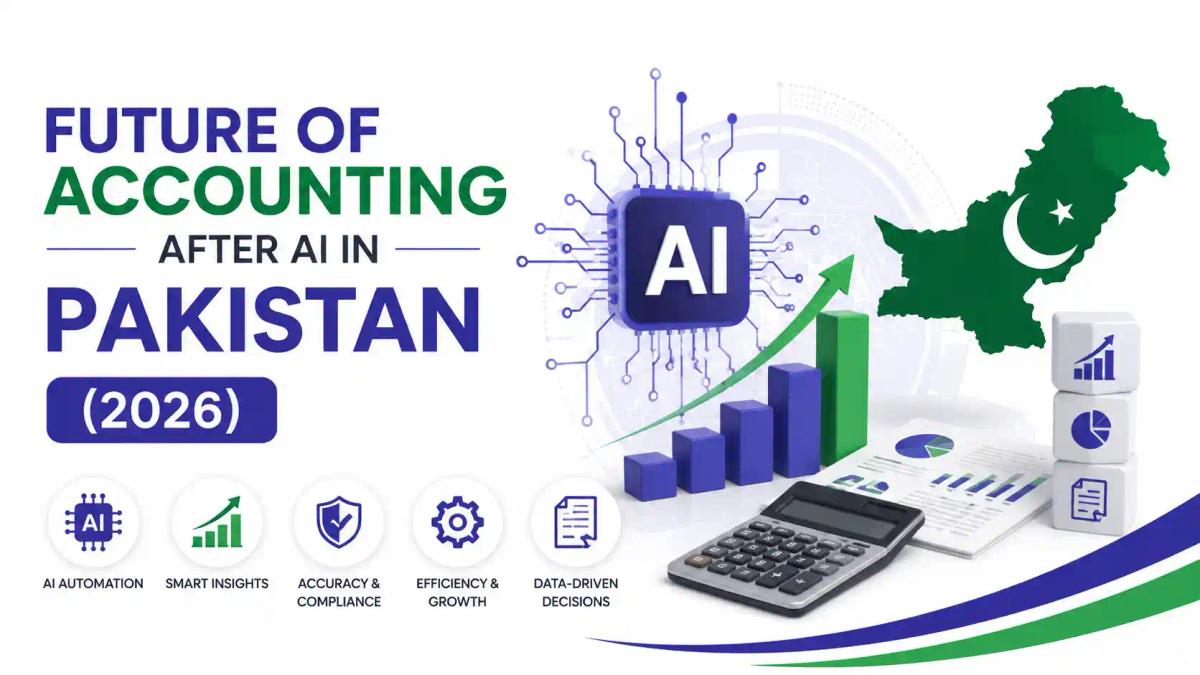
Future of Accounting After AI in Pakistan (2026)
Quick Answer
AI is not eliminating accountants — it is eliminating repetitive accounting tasks. Bookkeeping, reconciliation, invoicing, and basic tax preparation are increasingly automated by AI accounting software, while accountants shift toward advisory, financial strategy, audit judgment, and compliance oversight. The professionals who learn to work alongside AI tools — rather than compete with them — will have the strongest career prospects in Pakistan and globally.
Introduction
Every accounting student and working professional in Pakistan is asking some version of the same question right now: is AI going to take my job? The honest answer is more nuanced than the headlines suggest. At the Institute of Corporate and Taxation (ICT), we work daily with accounting students, CA and ACCA candidates, tax consultants, and business owners who are trying to figure out where the profession is heading — and how to stay relevant. This article breaks down what's actually happening to accounting because of AI, what's changing for good, and what practical steps you can take, whether you're a student choosing a specialization, a working accountant planning your next move, or a business owner deciding how to run your finance function. If you're specifically weighing a career shift, our AI-Driven CFO Masterclass and Certified AI Automation Agents Specialist course are built directly around this transition.
Accounting has always evolved with technology — from paper ledgers to spreadsheets to cloud accounting. AI is simply the next, faster wave. What's different this time is the pace of change and how deeply it touches judgment-based work, not just data entry.
Key Takeaways
- AI is automating transactional accounting work (data entry, reconciliation, invoicing) but cannot replace professional judgment, ethics, or client advisory.
- Accounting roles are shifting from "record keepers" to "financial advisors" and "AI-assisted analysts."
- Skills in AI accounting tools, data analytics, and taxation technology are becoming as important as traditional bookkeeping knowledge.
- Global bodies like IFAC, AICPA, ACCA, and IMA are actively updating guidance on AI use in the profession.
- Pakistani students and professionals who upskill now — in AI tools, Excel, data analysis, and specialized taxation — will have a competitive edge in local and international job markets.
Table of Contents
- Introduction
- What Does "AI in Accounting" Actually Mean?
- How AI Is Changing Core Accounting Functions
- Will AI Replace Accountants? The Honest Answer
- New Roles and Career Paths Emerging After AI
- Benefits of AI in Accounting
- Risks and Disadvantages of AI in Accounting
- Popular AI Accounting Software and Tools
- Skills Accountants Need for the AI Era
- AI in Accounting: A Pakistan Perspective
- Step-by-Step: How to Future-Proof Your Accounting Career
- Common Mistakes Professionals Make with AI Adoption
- Expert Tips and Best Practices
- Comparison: Traditional Accounting vs AI-Powered Accounting
- Frequently Asked Questions
- Conclusion
What Does "AI in Accounting" Actually Mean?
AI in accounting refers to software that uses machine learning, natural language processing, and predictive analytics to perform tasks that used to require manual human effort — categorizing transactions, matching invoices, flagging anomalies, drafting financial summaries, and forecasting cash flow.
It is not one single tool. It's a layer of intelligence sitting inside accounting software like QuickBooks, Xero, Sage, NetSuite, Oracle, and SAP, plus AI platforms like ChatGPT, Gemini, Claude, and Microsoft Copilot that professionals now use directly for research, drafting, and analysis. Robotic Process Automation (RPA) handles repetitive rule-based tasks, while machine learning models handle pattern recognition — like detecting unusual transactions for fraud detection or audit risk.
How AI Is Changing Core Accounting Functions
Bookkeeping and Data Entry
AI-powered bookkeeping tools now read receipts and invoices using Optical Character Recognition (OCR), automatically categorize expenses, and reconcile bank statements in a fraction of the time manual entry used to take. This is the area of accounting most heavily automated today.
Financial Reporting
AI can now draft first versions of financial statements, flag inconsistencies against prior periods, and generate management commentary. Accountants still review, interpret, and finalize these reports — but the drafting burden has dropped significantly.
Auditing
AI-driven auditing tools can scan 100% of transactions instead of a sample, flagging outliers for human auditors to investigate. This strengthens fraud detection and risk management without replacing the auditor's judgment, which remains central under standards like ISA and frameworks like COSO.
Tax Preparation and Filing
AI tax software can pre-fill returns, check for common errors, and cross-reference deductions. However, tax law interpretation — especially cross-border and jurisdiction-specific rules — still requires trained professionals. If you're curious how this plays out specifically in tax practice, our blog on AI in taxation: tools, risks, and opportunities and manual vs AI-assisted tax filing in 2026 go deeper into this.
Payroll and Accounts Payable/Receivable
AI payroll systems automatically calculate deductions, tax withholdings, and compliance requirements, while AI accounts payable and receivable tools automate invoice matching and payment reminders.
Will AI Replace Accountants? The Honest Answer
No — AI will not replace accountants, but it will replace the parts of accounting that are purely mechanical. Accountants who only perform data entry and basic compliance work face real disruption. Accountants who provide judgment, strategy, ethics, and client relationships remain in strong demand.
Professional bodies including the International Federation of Accountants (IFAC), AICPA, ACCA, IMA, and the IIA have all published guidance emphasizing that AI is a tool that augments — not replaces — professional skepticism, ethical judgment, and client advisory. A machine can calculate a number; it cannot take professional responsibility for a signed audit opinion or defend a tax position in front of a regulator.
We've explored this exact question from the tax side in Will AI Replace Tax Consultants? and Human vs AI Tax Advisory: A 2026 Comparison — the conclusions apply broadly across accounting too.
New Roles and Career Paths Emerging After AI
AI is not shrinking the accounting profession — it's reshaping it. New and growing roles include:
- AI-Assisted Financial Analyst — interpreting AI-generated reports and forecasts
- Accounting Automation Specialist — implementing and managing AI/RPA workflows in finance teams
- Advisory Accountant / Fractional CFO — focusing on strategy, cash flow planning, and business advisory
- Tax Technology Consultant — combining tax law expertise with AI compliance tools
- Data-Driven Auditor — using AI analytics to run smarter, deeper audits
- AI Compliance and Risk Officer — overseeing how AI is used responsibly in financial reporting
Many of these roles reward professionals who pair core accounting knowledge with technology skills — which is exactly why programs like Certified Data Analyst and Master Advanced Excel are increasingly seen as essential add-ons to a traditional accounting or ACCA/CA background.
Benefits of AI in Accounting
- Speed — reconciliations and reports that took days now take hours
- Accuracy — reduced human error in repetitive calculations
- Cost savings — smaller teams can handle larger transaction volumes
- Better fraud detection — pattern recognition catches anomalies humans might miss
- Real-time insights — dashboards and forecasts update continuously instead of monthly
- Scalability — growing businesses can manage more transactions without proportionally growing headcount

Risks and Disadvantages of AI in Accounting
- Over-reliance on automation without human review can let errors or fraud slip through
- Data privacy and security concerns, especially with financial data
- AI "hallucination" risk in generative tools — outputs can sound confident but be factually wrong, which is dangerous in tax and financial reporting
- Job displacement for entry-level, purely transactional roles
- Regulatory uncertainty — standards for AI use in audit and financial reporting are still evolving under bodies like the IASB and national regulators
- Upfront implementation cost for smaller firms adopting AI accounting platforms
Popular AI Accounting Software and Tools
| Category | Examples | Best For |
|---|---|---|
| AI Bookkeeping | QuickBooks, Wave Accounting, FreshBooks | Small businesses, freelancers |
| Cloud Accounting with AI | Xero, Sage, Zoho Books | SMEs, growing businesses |
| Enterprise ERP with AI | Oracle, SAP, NetSuite, Odoo | Large corporations, complex operations |
| General-purpose AI for finance work | ChatGPT, Gemini, Claude, Microsoft Copilot | Drafting, analysis, research support |
Businesses exploring ERP-level automation often start with our Odoo ERP Automation Course, which covers how AI and automation integrate into real accounting and business workflows.
Skills Accountants Need for the AI Era
- AI literacy — knowing how to prompt, verify, and responsibly use AI tools
- Data analytics — interpreting dashboards and predictive models, not just producing reports
- Advanced Excel and Power BI — still core tools, now supercharged by AI features
- Taxation specialization — deep, jurisdiction-specific knowledge (UK, USA, UAE, Saudi, Canada) that AI cannot fully replicate
- Communication and advisory skills — translating numbers into business decisions for clients
- Ethics and professional judgment — the one area AI cannot legally or practically own
If you're comparing traditional analytics training versus AI-powered tools, our post on AI vs Traditional Data Analytics in 2026 and Excel vs Power BI for Career Success can help you decide where to invest your learning time first.
AI in Accounting: A Pakistan Perspective
Pakistan's accounting and tax landscape is digitizing quickly, with FBR's IRIS system, digital invoicing requirements, and increasing e-invoicing compliance pushing accountants and businesses toward automated tools. This creates real opportunity for Pakistani accounting and finance professionals — especially those who combine core accounting skills with AI and taxation technology knowledge, since many international firms and remote employers actively look for this combination.
For students and professionals building a career around this shift, relevant reading includes Tax Careers Evolution 2026: Technology and AI, Future of Tax Advisory in Pakistan 2026–2030, and Why Every Business Needs a Tax Advisor in the AI Era. Professionals targeting international clients often pair general accounting knowledge with specialized courses such as UK Taxation, USA Taxation, UAE Taxation, and Saudi Taxation, since cross-border tax work remains one of the hardest areas for AI to fully automate.
Step-by-Step: How to Future-Proof Your Accounting Career
- Audit your current skill set — identify which of your daily tasks are purely mechanical vs judgment-based
- Learn one AI accounting tool deeply rather than many superficially
- Build data analysis skills through structured training like Certified Data Analyst
- Specialize in a taxation niche — international taxation, sales tax, or corporate advisory tend to be harder to automate; explore Certified Tax Advisor or Advance Taxation and Litigation
- Practice AI-assisted workflows, not AI-replaced workflows — use tools to speed up work you still review
- Strengthen advisory and communication skills, since client trust remains a human function
- Stay updated on regulatory changes around AI in financial reporting and taxation
Common Mistakes Professionals Make with AI Adoption
- Treating AI output as final instead of a draft that needs professional review
- Ignoring data security when uploading sensitive financial data into AI tools
- Avoiding AI entirely out of fear, and falling behind peers who adopt it strategically
- Choosing AI tools based on hype rather than fit for their firm's actual workflow
- Failing to train staff, leading to inconsistent or risky AI use across a team
Expert Tips and Best Practices
- Always keep a human review step for anything AI drafts in financial reporting or tax filings
- Use AI for first drafts and pattern detection, not final professional opinions
- Document how AI tools are used in your firm's workflow for compliance and audit trail purposes
- Combine AI accounting tools with strong foundational knowledge — AI amplifies expertise, it doesn't substitute for it
- Continuously reskill; the tools available in 2026 will look different in 2028
Comparison: Traditional Accounting vs AI-Powered Accounting
| Aspect | Traditional Accounting | AI-Powered Accounting |
|---|---|---|
| Data entry | Manual | Automated (OCR, RPA) |
| Reconciliation | Time-consuming, manual matching | Near real-time automated matching |
| Reporting | Manually drafted | AI-drafted, human-reviewed |
| Fraud detection | Sample-based checks | Full-transaction pattern analysis |
| Speed | Slower, periodic | Faster, near real-time |
| Human role | Executor of tasks | Reviewer, strategist, advisor |
| Risk | Human error | AI error/hallucination if unchecked |
Why Choose ICT to Prepare for the Future of Accounting After AI?
The Institute of Corporate and Taxation (ICT) helps aspiring accountants, students, and finance professionals prepare for the rapidly evolving future of accounting after AI in Pakistan. With practical, industry-focused training in accounting, taxation, auditing, digital tools, and emerging technologies, ICT equips learners with the skills needed to work alongside AI rather than compete against it. As automation transforms traditional accounting roles, ICT focuses on developing analytical thinking, professional judgment, technology proficiency, and real-world accounting expertise, helping professionals stay competitive and build future-ready careers in Pakistan’s changing finance industry.
Frequently Asked Questions
Is AI going to replace accountants completely?
No. AI automates repetitive, rule-based accounting tasks but cannot replace professional judgment, ethical responsibility, or client advisory work, which remain core to the profession.
What accounting jobs are most at risk from AI?
Purely transactional roles — basic data entry, manual reconciliation, and simple invoice processing — face the highest automation risk.
Do I need to learn coding to work with AI in accounting?
No. Most AI accounting tools are designed for non-technical users. Practical AI literacy, prompting skills, and data interpretation matter more than coding.
Which AI accounting software is best for small businesses in Pakistan?
Cloud tools like QuickBooks, Xero, Wave Accounting, and Zoho Books offer AI-assisted bookkeeping features suited to small business budgets and needs.
Will AI affect CA, ACCA, or CMA career prospects?
These qualifications remain highly valuable because they build the judgment, ethics, and technical depth AI cannot replicate. Adding AI and data skills alongside them strengthens career prospects further.
How is AI changing tax consulting specifically in Pakistan?
AI is speeding up return preparation and error-checking, but jurisdiction-specific interpretation, FBR compliance nuances, and cross-border tax planning still require trained human consultants.
Should accounting students specialize in AI tools or taxation?
Ideally both. A strong taxation specialization combined with AI and data analytics skills creates the most competitive, future-proof profile.
What skills should I start learning today for an AI-driven accounting career?
Start with AI-assisted Excel and data analysis, then build toward a taxation or advisory specialization where human judgment carries the most weight.
Conclusion
AI is transforming accounting the way cloud software and spreadsheets did before it — by automating the routine and elevating the strategic. The accountants who thrive after AI won't be the ones who resist the technology, and they won't be the ones who blindly trust it either. They'll be the ones who learn to use AI as a tool while doubling down on the skills machines still can't replicate: judgment, ethics, specialization, and client trust.
If you're a student, recent graduate, or working professional trying to build a career that's resilient to these changes, the smartest move is to pair strong accounting fundamentals with practical AI, data, and taxation training. Explore our AI-Driven CFO Masterclass, Certified Tax Advisor, or Certified Data Analyst programs to see which path fits your goals — and don't wait for the profession to change around you. Book a seat at ICT and start building the AI-ready accounting career the market is already asking for.
Comments (0)
No comments yet. Start the conversation!
Leave a Reply
Your email address will not be published. Required fields are marked *