
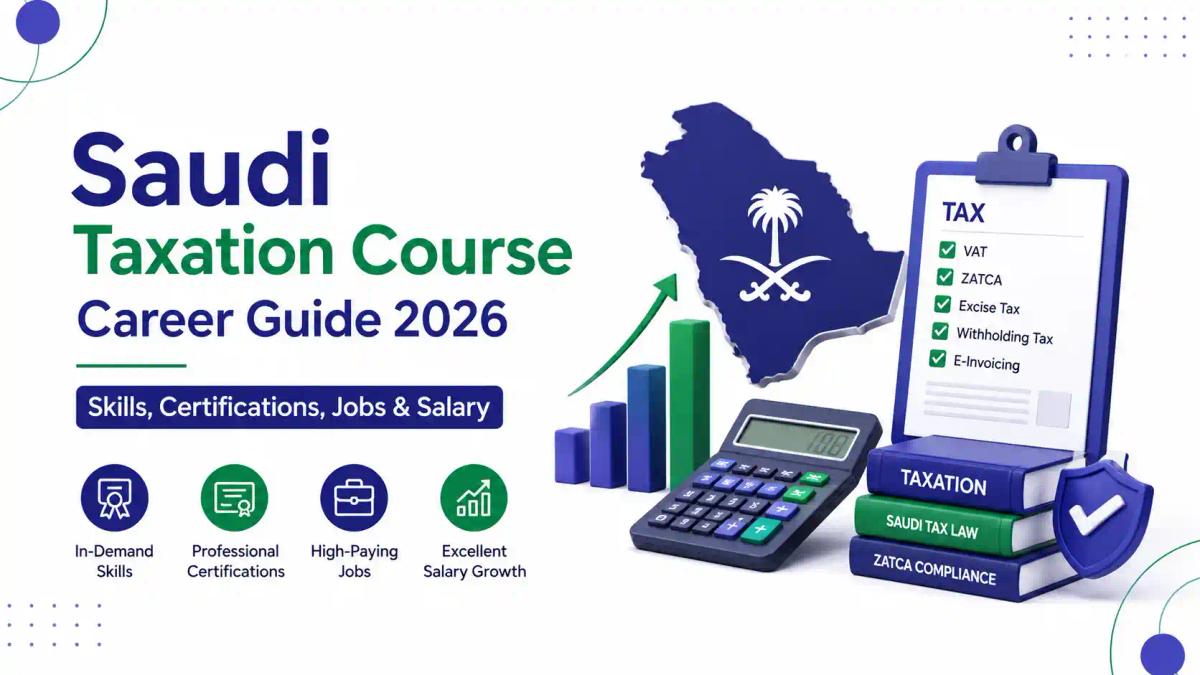
Saudi Taxation Course Career Guide 2026: Skills, Certifications, Jobs & Salary
What Is a Saudi Taxation Course?
A Saudi Taxation Course is a structured training program that teaches professionals how Saudi Arabia's tax system works — covering Value Added Tax (VAT), corporate tax, excise tax, withholding tax, and ZATCA compliance regulations. It prepares accountants, finance professionals, and job seekers to work as tax consultants or compliance specialists in the Gulf region. Completion typically takes 4 to 12 weeks.
Introduction
Saudi Arabia has gone through a complete fiscal transformation over the past decade. Before 2016, the Kingdom had virtually no direct taxation on businesses. Today, companies operating in Saudi Arabia must comply with VAT at 15%, corporate income tax, excise duties, withholding tax rules, and a rapidly evolving e-invoicing mandate from ZATCA — the Zakat, Tax and Customs Authority.
This shift has created a massive skills gap. Businesses urgently need certified tax professionals, yet qualified Saudi tax consultants remain scarce — especially those trained to handle ZATCA audits, VAT filing, and digital compliance.
That is where a Saudi Taxation Course becomes a career-defining investment.
Whether you are an accountant in Karachi looking to work in Riyadh, a fresh graduate exploring finance career paths, or a professional already working in compliance who wants to add a high-demand specialization, this guide covers everything you need to know — from what the course teaches to what salary you can realistically expect.
If you are also exploring regional tax systems, ICT's resources on UAE taxation career scope 2026 and UK taxation courses in Pakistan offer excellent comparative reading.
What Is a Saudi Taxation Course?
A Saudi Taxation Course is a professional training program designed to teach the structure, rules, and compliance requirements of the Saudi tax system.
Saudi Arabia's tax framework includes several major components:
- Value Added Tax (VAT): Introduced in 2018 at 5% and raised to 15% in 2020. Applies to most goods and services.
- Corporate Income Tax: A 20% tax on foreign-owned business profits.
- Withholding Tax: Applied to payments made to non-residents for services, royalties, and dividends.
- Excise Tax: Levied on tobacco, energy drinks, carbonated beverages, and e-cigarettes.
- Zakat: An Islamic tax on net worth, applied to Saudi and GCC nationals.
- ZATCA E-Invoicing (Fatoorah): A phased mandate requiring businesses to issue digital invoices integrated with the ZATCA platform.
A well-structured Saudi tax course covers all these areas, plus the administrative and compliance procedures required under ZATCA guidelines and the Saudi Ministry of Finance.
For those unfamiliar with how tax registration works in Pakistan before transitioning to Gulf taxation, ICT's step-by-step guide to obtaining NTN in Pakistan provides helpful context.
Why Is Saudi Taxation Training Important in 2026?
The Saudi Economy Is Growing Fast
Saudi Vision 2030 — the Kingdom's sweeping economic reform agenda — is diversifying the economy away from oil. As new sectors grow, so does the complexity of tax obligations for businesses. Companies entering Saudi Arabia need tax professionals who understand local regulations inside out.
ZATCA Is Getting Stricter
The Zakat, Tax and Customs Authority has been tightening enforcement every year. ZATCA now conducts detailed VAT audits, imposes penalties for late filing, and requires businesses to submit e-invoices in XML or PDF/A-3 format via their Fatoorah platform. Companies that are not compliant face heavy fines.
This enforcement reality means demand for ZATCA-trained tax compliance specialists is not just growing — it is urgent.
Pakistani Finance Professionals Are in High Demand
Thousands of Pakistani accountants, auditors, and finance graduates work across Saudi Arabia. However, most general accounting qualifications — even reputable ones like ACCA or CMA — do not deeply cover Saudi-specific VAT rules and ZATCA procedures. A dedicated Saudi VAT Certification Course fills that gap directly and gives Pakistani professionals a clear edge in Gulf job markets.
To understand how Pakistani income tax slabs compare with Gulf taxation structures, ICT's income tax slabs Pakistan 2025-26 guide is a useful starting point.
Businesses Need In-House Tax Expertise
Not every company can afford an external tax consultancy firm. Many SMEs operating in Saudi Arabia now hire in-house tax compliance officers. A Saudi Tax Compliance Certification makes candidates immediately employable in these roles.
What Does a Saudi Taxation Course Cover?
Core Curriculum Areas
A comprehensive Saudi taxation training program typically includes the following modules:
1. Introduction to the Saudi Tax System Overview of the Kingdom's tax structure, history of Saudi fiscal policy, and the role of ZATCA and the Saudi Ministry of Finance in tax administration.
2. Value Added Tax (VAT) — Deep Dive
- VAT registration requirements and thresholds
- Taxable supplies vs. exempt supplies
- Input and output VAT calculations
- VAT invoice requirements
- Filing VAT returns
- VAT refund claims
- Common VAT audit triggers
3. Corporate Income Tax
- Who is subject to corporate tax in Saudi Arabia
- Determining taxable income
- Deductible and non-deductible expenses
- Filing corporate tax returns
4. Withholding Tax
- Payments subject to withholding
- WHT rates for different service categories
- Filing withholding tax returns with ZATCA
- Avoiding double taxation through tax treaties
5. Excise Tax
- Products subject to Saudi excise duties
- Registration and return filing
- Excise tax compliance for importers and manufacturers
6. Zakat
- Zakat calculation methodology
- Who is subject to Zakat in Saudi Arabia
- Zakat vs. corporate income tax overlap
7. ZATCA E-Invoicing (Fatoorah)
- Phase 1 and Phase 2 requirements
- Technical specifications for e-invoices
- Integration with ERP systems like SAP and Oracle
- Compliance deadlines and penalties
8. Tax Audit Preparation
- ZATCA audit process explained
- Common audit findings
- Documentation requirements
- How to respond to ZATCA notices
9. Tax Accounting and Financial Reporting
- Accounting for VAT under IFRS
- Deferred tax calculations
- Tax provisions in financial statements
- Transfer pricing basics
10. Practical Case Studies
- Real-world VAT scenarios for Saudi businesses
- Practice VAT return filing
- Simulated ZATCA audit responses
How to Become a Tax Consultant in Saudi Arabia — Step by Step
Step 1: Build Your Educational Foundation
A bachelor's degree in accounting, finance, or business is the standard starting point. However, dedicated taxation training can supplement or accelerate any academic background.
Step 2: Enroll in a Saudi Taxation Certification Course
Choose a structured program that covers VAT, ZATCA compliance, corporate tax, and e-invoicing. Look for courses that offer practical exercises and case studies, not just theoretical content.
ICT's advance taxation programs are specifically designed to produce job-ready tax professionals with hands-on compliance skills.
Step 3: Learn Relevant Software and ERP Systems
Saudi businesses use SAP, Oracle, and Zoho to manage tax processes. Familiarity with at least one ERP system significantly improves your employability. ZATCA's own portal also requires direct interaction.
Step 4: Build Supporting Credentials
Certifications like ACCA, CMA, CPA, or IFRS credentials complement a Saudi tax certification. If you are targeting senior tax advisory roles, a combination of credentials is far stronger than a single qualification.
Step 5: Get Practical Experience
Internships at Big Four accounting firms (Deloitte, PwC, EY, KPMG) or mid-tier Saudi audit firms are ideal. Tax consultancy firms and in-house finance departments in multinational companies are also strong options.
Step 6: Stay Updated on ZATCA Regulations
Saudi tax law evolves rapidly. ZATCA regularly updates e-invoicing requirements, VAT guidelines, and audit procedures. Professionals who stay current command the highest salaries and most senior roles.
Benefits of a Saudi Taxation Certification
For Your Career
- Immediate employability: Saudi VAT and ZATCA compliance skills are in active demand right now
- Higher salary: Certified tax professionals in Saudi Arabia earn significantly more than general accountants
- International mobility: VAT expertise transfers across GCC countries — UAE, Qatar, Bahrain, and Kuwait all have similar frameworks
- Remote work opportunities: Many Saudi companies now hire remote tax consultants based in Pakistan or elsewhere
For Businesses
- Reduced compliance risk: ZATCA penalties can reach 100% of unpaid tax. Trained in-house staff dramatically reduce this risk
- Audit readiness: Businesses with certified tax staff are better prepared when ZATCA audits occur
- Cost savings: Building internal tax expertise reduces dependence on expensive external consultants
Long-Term Career Value
Tax law rarely goes out of fashion. As Saudi Arabia continues developing its non-oil economy under Vision 2030, tax compliance will only become more complex — and tax professionals more valuable. This is a career investment that appreciates over time.
Common Mistakes People Make in Saudi Tax Compliance
- Missing VAT registration deadlines: Businesses exceeding the SAR 375,000 annual threshold must register promptly or face penalties
- Incorrect VAT treatment of exempt supplies: Misclassifying exempt services as taxable (or vice versa) triggers audits
- Not retaining proper documentation: ZATCA requires VAT invoices and supporting records to be kept for a minimum of 10 years
- Ignoring e-invoicing phase timelines: Many businesses, especially SMEs, underestimate how long ZATCA e-invoicing integration takes
- Failing to file nil returns: Even if no tax is due, zero-value VAT returns must still be filed on time
- Incorrect withholding tax deductions: Applying the wrong WHT rate to cross-border payments is a common and expensive error
- Not reconciling VAT accounts: Monthly reconciliation of input and output VAT prevents accumulation of errors that become expensive to correct
- Overlooking VAT on imports: Import VAT is often missed by businesses that are unfamiliar with customs-integrated VAT procedures
Real-World Scenarios: Where Saudi Taxation Knowledge Is Applied
Scenario 1 — The Pakistani Accountant Working in Riyadh
Ahmed is a Pakistani accountant with five years of experience handling FBR filings under Pakistan's Federal Board of Revenue. When he joins a Saudi trading company, he quickly realizes that ZATCA's requirements are fundamentally different. After completing a Saudi VAT Certification Course, he handles the company's monthly VAT returns, manages ZATCA e-invoice integration, and leads the business through its first ZATCA audit successfully. Within 18 months, he is promoted to Finance Manager.
Scenario 2 — The In-House Compliance Specialist
A mid-sized Saudi manufacturing firm selling energy drinks faces a ZATCA audit covering excise tax and VAT simultaneously. Their in-house tax compliance officer, certified in both Saudi VAT and excise tax regulations, provides complete documentation, files a corrective return for a minor error discovered during the audit, and closes the case without penalties. The company estimates it saved over SAR 200,000 in potential fines.
Scenario 3 — The Remote Tax Consultant
Sana is a finance graduate from Lahore who completed her Saudi Taxation Course through ICT while living in Pakistan. She now works remotely as a VAT compliance consultant for three small Saudi businesses, handling their monthly returns, e-invoicing setup, and ZATCA correspondence. Her income exceeds what she would earn in a mid-level Pakistani accounting role, and she works entirely online.
Career Scope, Salary, and Market Demand
Saudi Arabia
Saudi-based tax professionals are among the highest-paid in the Gulf. Entry-level roles start around SAR 6,000–10,000 per month, while experienced tax managers earn SAR 18,000–35,000 or more. Specialized ZATCA compliance managers command premium salaries.
Common job titles:
- Tax Consultant
- VAT Specialist
- Tax Compliance Officer
- ZATCA E-Invoicing Specialist
- Tax Manager
- Tax Advisory Manager
- Indirect Tax Analyst
UAE
UAE introduced corporate tax in June 2023, creating a surge in demand for tax professionals. Professionals with Saudi VAT experience transfer well to UAE roles since the two systems share structural similarities. Salaries range from AED 8,000 to AED 35,000 monthly depending on experience and seniority. ICT's UAE corporate tax registration guide 2026 covers the UAE context in detail.
Pakistan — Remote and In-Country
Pakistani finance professionals with Gulf taxation certifications are increasingly hired by outsourcing firms, tax consultancies, and multinational corporations. Remote tax consultant roles paying USD 800–2,500 per month are growing rapidly through platforms like LinkedIn and Upwork.
UK
Pakistani professionals targeting the UK market can combine Saudi tax knowledge with UK-specific training. ICT's USA taxation course guide for Pakistan and UK taxation resources provide useful parallel pathways.
Industries That Hire Saudi Tax Specialists
- Retail and e-commerce
- Construction and real estate
- Healthcare
- Manufacturing
- Banking and financial services
- Hospitality and tourism
- Technology companies
- Oil and gas (services sector)
Future Trends in Saudi Taxation
AI and Tax Technology
Artificial intelligence is rapidly entering tax compliance. ZATCA itself uses AI-powered data matching to flag discrepancies between submitted returns and third-party data. Tax professionals who understand AI-assisted audit tools, automated VAT reconciliation, and ERP integration will be far more valuable than those who rely on manual processes.
Digital Tax Transformation
Saudi Arabia's e-invoicing mandate (Fatoorah) is one of the most ambitious digital tax transformations in the world. As Phase 2 rolls out to progressively smaller businesses, demand for ZATCA e-invoicing specialists will surge further. Professionals who get certified now position themselves at the front of this wave.
Expansion of Pillar Two Rules
As Saudi Arabia aligns with global OECD tax standards, including Pillar Two minimum tax rules for multinational corporations, the complexity of Saudi taxation will increase significantly. This creates strong demand for transfer pricing specialists and international tax professionals.
Growing Freelance and Consulting Market
The rise of remote work means Saudi tax expertise can be monetized from anywhere in the world. Freelance tax consultants serving Gulf businesses from Pakistan, India, or Egypt are an emerging professional category with strong growth potential.
Why Choose ICT for Your Saudi Taxation Course?
ICT (Institute of Computer & Technology) is recognized as one of the best taxation training institutes in Islamabad and across Pakistan. What sets ICT apart is its focus on practical, job-ready training rather than purely theoretical content.
What ICT Offers
- Structured Saudi Taxation curriculum covering VAT, ZATCA, corporate tax, withholding tax, and e-invoicing
- Instruction by experienced finance and taxation professionals — view ICT mentors here
- Flexible learning formats suitable for working professionals
- Career support and guidance for Gulf job placements
- A track record of placing graduates in Saudi Arabia, UAE, and other GCC markets
- Courses delivered from multiple Pakistani cities including Islamabad, Karachi, and Lahore
For professionals already familiar with Pakistani tax processes, ICT's resources on tax filer status in Pakistan 2026 and excise and taxation Islamabad verification provide solid foundational context before progressing to Gulf taxation.
You can explore all available programs on the ICT courses page or get in touch with the team directly.
Recommended Learning Resources
Free Resources
- ZATCA Official Portal (zatca.gov.sa): Publishes all VAT regulations, e-invoicing technical specifications, and filing guides in Arabic and English
- Saudi Ministry of Finance: Issues corporate tax guidelines and fiscal policy updates
- OECD Tax Policy Resources: Useful for understanding Saudi Arabia's alignment with global tax standards
- Coursera and edX: Both offer introductory taxation and accounting courses that build foundational knowledge useful before starting Saudi-specific training
- ICT Blog: The ICT blog section regularly publishes free, current tax guides relevant to Pakistani and Gulf professionals
Paid and Structured Programs
- ICT Advance Taxation Course: The most direct and structured path to Saudi VAT and ZATCA certification for Pakistani professionals — explore ICT's best tax training programs
- ACCA: Provides strong accounting fundamentals; the P6 Advanced Taxation module adds international tax context
- CMA (Certified Management Accountant): Valued across the Gulf; combines well with a dedicated Saudi tax certification
- Big Four Training Programs: Deloitte, PwC, EY, and KPMG all offer internal training; positions at these firms provide hands-on Saudi tax experience
Frequently Asked Questions
What is a Saudi Taxation Course?
A Saudi Taxation Course is a professional training program covering Saudi Arabia's tax system — including VAT, corporate income tax, withholding tax, excise tax, Zakat, and ZATCA e-invoicing compliance. It prepares finance professionals to work as tax consultants or compliance officers in Saudi Arabia and other GCC countries.
Who should take a Saudi Taxation Course?
Accountants, finance graduates, tax consultants, auditors, business owners, and anyone planning to work in Saudi Arabia or serve Saudi-based clients should consider this course. It is particularly valuable for Pakistani professionals targeting Gulf employment.
How long does Saudi taxation training take?
Most Saudi Taxation Courses take between 4 and 12 weeks, depending on the depth of curriculum and whether you study part-time or full-time. Intensive programs focused on VAT and ZATCA compliance can be completed in as little as 4 weeks.
Is a Saudi Taxation Course worth it?
Yes. Saudi Arabia's expanding economy and tightening ZATCA enforcement have created strong, ongoing demand for certified tax professionals. Salaries for qualified tax consultants in Saudi Arabia are substantially higher than equivalent accounting roles, and the investment in certification typically pays back within months.
What salary can a Saudi tax consultant earn?
Entry-level Saudi tax professionals earn SAR 6,000–10,000 per month. Mid-level VAT and compliance specialists earn SAR 12,000–20,000 monthly. Senior tax managers and ZATCA compliance heads can earn SAR 25,000–40,000 or more, depending on the company and sector.
Can I get a job after a Saudi Tax Certification from Pakistan?
Yes. Many Pakistani finance professionals find employment in Saudi Arabia or work remotely as tax consultants for Saudi businesses after completing a recognized Saudi VAT Certification Course. Gulf hiring for Pakistani accountants is well-established, and remote tax consulting is increasingly common.
What is ZATCA?
ZATCA stands for Zakat, Tax and Customs Authority — the Saudi government body responsible for administering all tax and customs regulations in the Kingdom. It manages VAT registration, corporate tax filing, e-invoicing compliance (Fatoorah), and conducts tax audits on businesses operating in Saudi Arabia.
What is included in a Saudi VAT Course?
A Saudi VAT Course covers VAT registration, taxable and exempt supplies, VAT invoice requirements, input and output tax calculations, filing VAT returns with ZATCA, managing VAT refund claims, handling VAT audits, and understanding the e-invoicing Fatoorah system.
How does Saudi VAT work?
Saudi VAT operates at a standard rate of 15% on most goods and services. Registered businesses collect VAT from customers (output VAT), deduct VAT paid on their own purchases (input VAT), and remit the net amount to ZATCA monthly or quarterly. Zero-rated supplies and exempt supplies follow specific rules that tax professionals must understand precisely.
Which is better — Saudi Taxation Course or CMA?
These credentials serve different purposes. A CMA (Certified Management Accountant) provides broad management accounting skills recognized globally. A Saudi Taxation Course provides deep, specific knowledge of Saudi tax laws and ZATCA procedures. For Gulf employment, both credentials together are ideal. If you are specifically targeting Saudi tax compliance roles, a dedicated Saudi Tax Certification adds direct, practical value that a CMA alone does not provide.
Are online Saudi taxation courses available?
Yes. Several institutions, including ICT, offer Saudi taxation training that can be completed online or in hybrid format. Online programs are particularly popular with Pakistani professionals who plan to work remotely or want flexibility while employed.
How does ZATCA e-invoicing affect businesses?
ZATCA's Fatoorah e-invoicing mandate requires Saudi businesses to generate, transmit, and store invoices in a specific digital format integrated with the ZATCA platform. Phase 1 required digital invoice generation; Phase 2 requires real-time integration with ZATCA's system. Non-compliant businesses face significant penalties, making ZATCA e-invoicing knowledge one of the most in-demand tax skills in Saudi Arabia right now.
Key Takeaways
- Saudi Arabia's tax system includes VAT at 15%, corporate income tax at 20%, withholding tax, excise tax, Zakat, and ZATCA e-invoicing — all of which require specialized professional knowledge
- ZATCA — the Zakat, Tax and Customs Authority — is the government body that regulates and enforces all Saudi tax obligations, with increasing audit activity and digital compliance requirements
- A Saudi Taxation Course typically takes 4 to 12 weeks and covers VAT, ZATCA compliance, corporate tax, withholding tax, and e-invoicing
- Pakistani finance professionals with Saudi tax certifications are in high demand for both in-country Gulf employment and remote consulting roles
- Entry-level Saudi tax professionals earn SAR 6,000–10,000 per month; senior specialists can earn SAR 25,000–40,000 or more
- The ZATCA Fatoorah e-invoicing mandate is one of the fastest-growing specialization areas, with urgent demand for technically trained compliance specialists
- Saudi Vision 2030 is expanding the Kingdom's non-oil economy, which will continue increasing the complexity and importance of tax compliance for years ahead
- Combining a Saudi Tax Certification with credentials like ACCA or CMA significantly strengthens career prospects
- ICT is among Pakistan's leading institutions offering structured, job-focused Saudi taxation training with practical case studies and career placement support
- Remote tax consulting for Saudi clients from Pakistan is a growing and viable career path for certified graduates
Conclusion
Saudi Arabia's tax landscape is no longer a niche specialty — it is a core competency for any finance professional working in or with the Gulf region. The combination of VAT enforcement, ZATCA digital mandates, corporate income tax, and Vision 2030-driven economic growth has created one of the most dynamic and rewarding environments for tax professionals in the world.
For Pakistani accountants, finance graduates, and compliance professionals, a Saudi Taxation Course is one of the highest-return career investments available today. The skills are transferable across GCC markets, the salaries are strong, and the demand is not going away.
Whether you are starting from scratch or adding Saudi tax expertise to an existing finance career, the time to act is now — before the market becomes saturated with certified professionals.
Ready to take the next step? Book a seat in the Advance Taxation Course offered by ICT and start building a career that travels as far as Saudi Arabia, UAE, and beyond.
Explore ICT courses | Meet our mentors | Contact ICT today
Comments (0)
No comments yet. Start the conversation!
Leave a Reply
Your email address will not be published. Required fields are marked *