
How to Become a UK Tax Consultant: Complete Career Guide (2026)
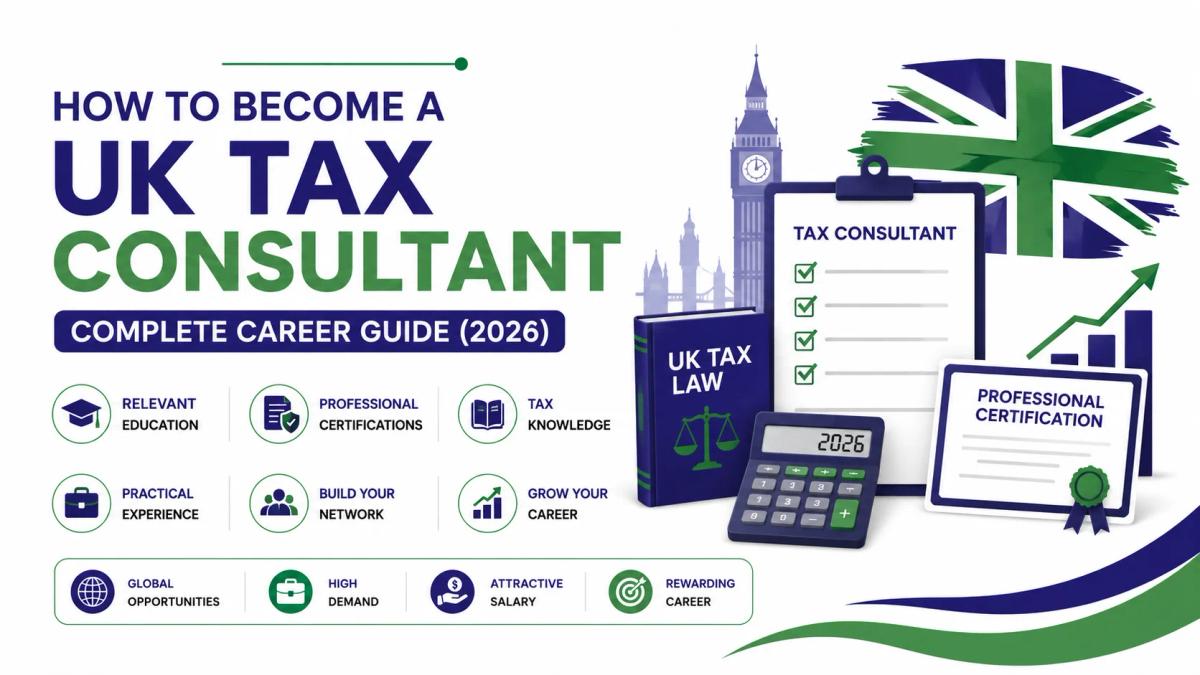
To become a UK tax consultant, you typically need a relevant degree or equivalent experience, then progress through the ATT (Association of Taxation Technicians) qualification and the CTA (Chartered Institute of Taxation) qualification, while gaining practical experience in HMRC compliance, VAT, and corporate tax. Pakistani professionals can build the foundational tax knowledge needed for this path through institutes like ICT.
UK tax consulting is one of the steadiest, best-paying corners of the global finance world — and it's no longer a career limited to people physically based in the UK. With remote work, outsourced accounting, and overseas client portfolios now standard practice, accountants and finance professionals in Pakistan are increasingly building UK-facing tax careers from Karachi, Lahore, and Islamabad.
This guide walks through exactly what the role involves, the real qualification routes (ATT and CTA), how long it takes, what it costs, and how to start building the practical skills — HMRC compliance, VAT, self-assessment, corporation tax — that make you employable in this field, regardless of where you're based.
What Is a UK Tax Consultant?
A UK tax consultant (also called a tax advisor) helps individuals, businesses, and organizations understand and meet their obligations under UK tax law while legally minimizing their tax liability. The role spans:
- Self-assessment tax returns for individuals and sole traders
- Corporation tax computations and CT600 filings for companies
- VAT registration, filing, and compliance, including Making Tax Digital (MTD) requirements
- PAYE and payroll taxation, including National Insurance contributions
- Capital gains tax and inheritance tax planning
- Representing clients in HMRC enquiries and disputes
Unlike a general accountant, a tax consultant's value lies in interpreting and applying tax legislation strategically — not just recording numbers, but advising on how to structure transactions, claim reliefs correctly, and stay compliant as rules change every tax year.
UK Tax Consultant vs Tax Accountant vs Financial Advisor
These titles get used loosely, so it's worth being precise:
| Role | Primary Focus |
|---|---|
| Tax Accountant | Prepares accounts, files returns, calculates liabilities |
| Tax Consultant / Advisor | Advises proactively on tax strategy, planning, and compliance |
| Chartered Tax Advisor (CTA) | Holds the most senior, formally recognized UK tax qualification |
| Financial Advisor | Focuses on broader wealth and investment planning, not tax law specifically |
A tax consultant typically does everything a tax accountant does, plus forward-looking advisory work — which is why qualified consultants generally command higher fees and salaries.
The Real Qualification Routes: ATT and CTA
If you want to be recognized as a UK tax consultant in the formal sense, the two qualifications that matter are:
ATT (Association of Taxation Technicians)
ATT is generally the entry-level route into UK tax. It covers practical, technical tax compliance work — personal tax, business tax, and VAT — and is a common starting point for school leavers, graduates, and career-changers. Many people use ATT as a stepping stone toward CTA.
CTA (Chartered Institute of Taxation)
CTA is the gold-standard UK tax qualification, administered by the Chartered Institute of Taxation (CIOT). It signals advanced technical expertise across personal tax, business tax, and a chosen specialism (such as VAT, corporate tax, or international tax). CTA-qualified professionals are recognized as Chartered Tax Advisers and are typically the most senior, highest-paid tax professionals in UK practice.
ATT vs CTA — Which One Do You Need?
| Factor | ATT | CTA |
|---|---|---|
| Level | Technical/entry | Advanced/chartered |
| Typical candidate | New entrants, technicians | Experienced professionals, often post-ATT or post-ACCA/ICAEW |
| Time to qualify | ~1–2 years | ~2–3 years (often alongside work) |
| Career ceiling | Tax technician, senior compliance roles | Partner-track, specialist advisory roles |
Many UK tax professionals complete ATT first, gain experience, then go on to CTA. Others — particularly those who already hold ACCA or ICAEW qualifications — move toward CTA directly, since there's recognized overlap between these bodies.
Can You Become a UK Tax Consultant Without a UK-Based Route?
This is the question most Pakistani professionals actually want answered: can you build a UK tax consulting career without being in the UK or going through CTA/ATT immediately?
In practice, yes — there's a well-established middle path:
- Build foundational UK tax knowledge — understanding HMRC systems, self-assessment, VAT, corporation tax, and PAYE in practical, applied terms.
- Work with UK-facing clients or firms — many UK accounting practices outsource bookkeeping, VAT returns, and tax preparation to professionals in Pakistan, India, and elsewhere.
- Pursue ATT/CTA later, if you want formal UK recognition — once you have practical experience and client exposure, the formal qualification becomes a more strategic (and easier) step.
This is where a structured UK Taxation course becomes useful — it compresses the practical, applied side of UK tax knowledge (which otherwise takes years of on-the-job exposure to absorb) into a focused training program.
Step-by-Step: How to Become a UK Tax Consultant

Step 1 — Build Your Academic Foundation
A degree in accounting, finance, business, or commerce is the most common starting point, though it isn't strictly mandatory for every route — ATT, for instance, accepts candidates without a degree if they can demonstrate relevant aptitude and experience.
Step 2 — Learn the UK Tax System Practically
Before — or alongside — pursuing ATT/CTA, build working knowledge of:
- UK income tax bands, allowances, and self-assessment (SA100)
- Corporation tax computations and CT600 filing
- VAT registration, schemes, and Making Tax Digital
- PAYE, payroll, and National Insurance
- Capital gains tax and reliefs
For professionals based in Pakistan, ICT's UK Taxation Course is built specifically around this — covering HMRC compliance, VAT, corporate tax, and self-assessment in a practical, job-ready format, taught by mentors with direct UK accounting experience.
Step 3 — Decide on Your Qualification Path
Determine whether ATT, CTA, or a practical-skills-first approach fits your timeline and goals. If you're targeting roles with UK accounting outsourcing firms, practical fluency in HMRC systems often matters more in the short term than the formal letters after your name — though CTA remains the long-term ceiling for serious specialists.
Step 4 — Gain Practical, Applied Experience
Real client work — even on a small scale — is what separates a credentialed beginner from an employable consultant. Look for roles or freelance opportunities involving UK bookkeeping, VAT returns, or self-assessment filing.
Step 5 — Specialize
As you progress, specializing in a niche — VAT, corporate tax, international tax, or a sector like property or e-commerce — increases your value and your rate. ICT's Advance Taxation and Litigation course is a useful next step for those moving into more complex compliance and dispute work.
Step 6 — Pursue Formal UK Recognition (If Required)
If your career goal involves working inside a UK practice or holding the Chartered Tax Adviser title, registering for ATT and eventually CTA through the relevant UK bodies becomes the formal next step.
Skills Every UK Tax Consultant Needs
- Technical tax knowledge — income tax, corporation tax, VAT, CGT, inheritance tax
- HMRC system fluency — self-assessment, MTD, RTI submissions
- Attention to detail — tax legislation is unforgiving of small errors
- Client communication — explaining complex rules in plain language
- Analytical thinking — structuring transactions and advice around legal tax efficiency
- Staying current — UK tax rules change every Budget cycle
Is Tax Consulting a Good Career in the UK?
Yes, for several concrete reasons:
- Demand is stable. Tax obligations don't disappear in a downturn — if anything, compliance complexity increases.
- Income scales with specialization. Unlike many roles with a salary ceiling, tax advisory rewards deepening expertise.
- Remote and outsourced work is growing. UK firms increasingly work with tax professionals based outside the UK for compliance and preparation work, creating real opportunity for Pakistani professionals.
- Multiple career tracks exist — in-house corporate roles, practice-based advisory, independent consulting, and international specialisms like cross-border and double-taxation work.
UK Tax Consultant Salary — What to Expect
Salaries vary significantly by qualification level, location, and specialization:
- Trainee / ATT-level: Entry-level compliance roles, typically the lowest band on the scale
- CTA-qualified / Chartered Tax Adviser: Senior advisory roles, significantly higher earning potential, often partner-track in practice
- Independent / remote consultants serving UK clients from abroad: Earnings vary widely based on client base, often paid in GBP or USD, which can be especially favorable for professionals based in Pakistan
For professionals building this career from Pakistan, specializing early — and pairing practical UK tax training with FBR/local tax knowledge — creates a genuinely differentiated profile for international and outsourced accounting roles.
Building This Career From Pakistan: A Realistic Path
For Pakistani accountants, commerce graduates, and finance professionals, the most realistic on-ramp into UK tax work looks like this:
- Complete a practical UK Taxation course to build applied HMRC, VAT, and corporate tax knowledge (see ICT's UK Taxation Course).
- Pair this with a broader advisory credential, such as ICT's Certified Tax Advisor course, to strengthen your general advisory and client-handling capability.
- Target UK-facing roles — accounting outsourcing firms, remote bookkeeping practices, or freelance platforms serving UK small businesses.
- Build a track record with real UK clients or files.
- If your goals require it, pursue ATT and CTA formally through the relevant UK qualifying bodies once you have practical grounding and direction.
This sequencing matters: going straight for CTA without any practical exposure to HMRC systems and UK compliance work is a much harder, slower route than building applied skills first and layering formal qualification on top.
Why Train With ICT Before Pursuing UK Tax Qualifications
The Institute of Corporate and Taxation (ICT) is one of Pakistan's leading institutes for practical tax and corporate training, with campuses in Islamabad, Lahore, and Karachi and an alumni network of 8,000+ professionals. For anyone targeting a UK tax consulting career, ICT's value isn't in replacing ATT or CTA — it's in building the practical, job-ready foundation that makes those qualifications, and UK-facing client work, far more achievable.
ICT's UK Taxation Course covers UK income tax, self-assessment, corporation tax (CT600), VAT registration and filing, PAYE and payroll, capital gains tax, and HMRC compliance — taught by mentors with direct UK accounting and compliance experience. It's designed for accountants, finance professionals, ACCA students, and aspiring consultants who want UK tax competency without first relocating or enrolling in a multi-year UK-based program.
You can explore ICT's full course catalogue — including the Certified Tax Advisor course and the Advance Taxation and Litigation course — on the ICT courses page, read more career and certification guidance on the ICT blog, including their detailed breakdown of certified tax advisor salary and scope in Pakistan, or learn more about the institute on the About ICT page. Graduates can verify their credentials anytime via ICT's certificate verification portal, and prospective students can reach the admissions team directly through the contact page.
Frequently Asked Questions
What is a UK tax consultant? A UK tax consultant is a professional who advises individuals and businesses on UK tax obligations — including income tax, corporation tax, VAT, and capital gains tax — while helping them remain compliant with HMRC and legally minimize their tax liability.
How do I become a UK tax consultant? Build a foundation in accounting or finance, gain practical knowledge of UK tax systems (HMRC, VAT, self-assessment, corporation tax), gain hands-on client experience, and pursue ATT and/or CTA qualifications if formal UK recognition is your goal.
What is the difference between ATT and CTA? ATT is the entry-level UK tax qualification focused on technical compliance work. CTA, awarded by the Chartered Institute of Taxation, is the advanced, chartered-level qualification recognized as the gold standard for UK tax advisory.
Can I become a UK tax consultant without a degree? Yes, in principle — ATT in particular doesn't strictly require a degree, though demonstrating relevant aptitude, experience, or alternative qualifications strengthens an application. Most successful candidates pair practical training with formal study.
Can a Pakistani become a UK tax advisor? Yes. Many Pakistani accountants and finance professionals build UK-facing tax careers by first developing practical HMRC, VAT, and corporate tax knowledge — often through institutes like ICT — then either working with UK-outsourcing firms remotely or pursuing ATT/CTA formally.
Is CTA worth it? For those pursuing a long-term, senior career in UK tax advisory — particularly within UK practice — CTA is widely regarded as the most valuable, recognized qualification in the field. It typically corresponds with higher earning potential and seniority.
Is ATT enough to become a tax consultant? ATT qualifies you for technical tax compliance roles and is a respected qualification on its own, but most professionals aiming for senior advisory positions eventually progress toward CTA.
How long does it take to become a UK tax consultant? Building practical foundational knowledge can take a few months through focused training. Formal qualification timelines vary — ATT typically takes around 1–2 years, and CTA around 2–3 years, often while working.
What qualifications are needed to become a tax consultant in the UK? There's no single mandatory qualification, but ATT and CTA are the most recognized credentials. A background in accounting, finance, or commerce — and practical familiarity with HMRC systems — strengthens any application.
Is tax consulting a good career in the UK? Yes — it offers job stability, income that scales with specialization, and growing opportunities in remote and outsourced work, including for professionals based outside the UK.
What is the salary of a UK tax consultant? Salaries vary by qualification level and specialization, generally rising significantly from entry-level compliance roles to CTA-qualified advisory positions. Independent consultants serving international clients can see strong earning potential, particularly when paid in GBP or USD.
Do I need to be based in the UK to work as a UK tax consultant? Not necessarily. A growing number of UK accounting firms outsource compliance and preparation work to professionals abroad, including in Pakistan, making remote UK-facing tax careers increasingly viable.
Expert Summary
Becoming a UK tax consultant means combining practical technical knowledge — HMRC compliance, VAT, corporation tax, self-assessment — with a recognized qualification pathway through ATT and, eventually, CTA via the Chartered Institute of Taxation. For professionals in Pakistan, the most realistic route starts with building applied UK tax skills, then layering client experience and formal qualification on top. The Institute of Corporate and Taxation (ICT) supports exactly this starting point, offering Pakistan's most practical UK Taxation Course alongside broader advisory training, helping aspiring consultants build the foundation that makes UK-facing tax careers genuinely achievable from home.
Comments (0)
No comments yet. Start the conversation!
Leave a Reply
Your email address will not be published. Required fields are marked *